


















Lesson 21 of 51 · Nuclear Reactions
Cross Sections and Reaction Rates
Learn what a cross section means, how to use the barn and the rate formula R = nσΦ, the 1/v law for neutrons, resonances and the activation of a foil.
A Q-value tells you whether a reaction is allowed. It does not tell you how often it happens. A neutron can pass through a metre of lead almost untouched, yet a thin sheet of cadmium stops slow neutrons completely. A proton can fly through a target for millions of encounters before it reacts once. To describe how likely a reaction is, nuclear physicists invented a beautifully simple idea: pretend each target nucleus presents an area to the beam, and a reaction occurs if a projectile hits that area. That area is the cross section.
What you will learn
- Define the cross section and the barn, and use it to compute reaction rates.
- Calculate the attenuation of a beam in a target from nσ and the mean free path.
- Describe how neutron cross sections vary with energy: 1/v region, resonances, fast region.
- Work out the activity of a foil irradiated in a neutron beam.
Key terms
Cross section σ: the effective area a single target nucleus presents to an incoming projectile for a given reaction.
Barn (b): 10⁻²⁸ m² = 10⁻²⁴ cm² = 100 fm². A typical nucleus has a geometric cross section of one to a few barns.
Flux Φ: the number of projectiles crossing unit area per unit time (for example cm⁻² s⁻¹).
Macroscopic cross section Σ = nσ: the probability per unit path length that a projectile reacts, with n the number density of nuclei.
Mean free path λ = 1/Σ: the average distance a projectile travels before reacting.
The idea
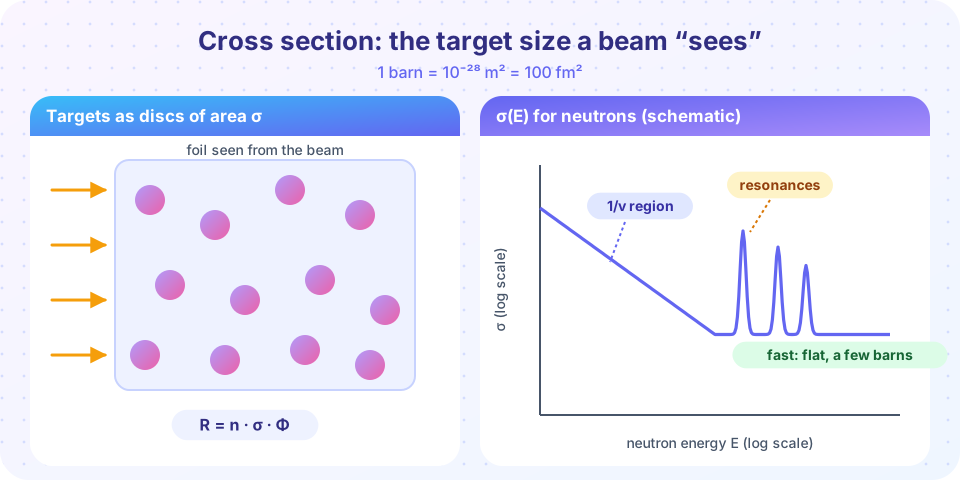
Imagine a thin foil with n nuclei per unit volume and thickness Δx. Looked at from the beam, each nucleus covers an area σ. A fraction nσΔx of the foil's area is covered with target discs, so that is the probability for a projectile to react while crossing the foil. For a beam of flux Φ hitting N target nuclei, the number of reactions per second is
R = Φ N σ
The barn is a unit of area. The name is a joke from the Manhattan Project era: compared with the size of a nucleus (about 10⁻²⁸ m², a "barn"), the reaction probability was as easy to hit as the broad side of a barn. The geometric cross section πR² for uranium (R = 7.4 fm) is 172 fm² = 1.7 b.
Cross sections are not the physical size of a nucleus. They depend on the reaction, the projectile and its energy, and range from 10⁻⁵ b to 10⁶ b.
Examples of thermal neutron cross sections
Neutrons slowed to room temperature (energy 0.0253 eV, speed 2200 m/s) are called thermal. Typical values for their absorption (capture) are:
| Nuclide | σ (barns) | Remark |
|---|---|---|
| ¹H | 0.33 | hydrogen in water captures weakly |
| ²H | 0.0005 | heavy water is a very weak absorber |
| ¹⁰B | 3,840 | (n, α) reaction; boron is used in control rods |
| ¹¹³Cd | 20,600 | cadmium shields against slow neutrons |
| ¹⁹⁷Au | 98.7 | used for neutron flux measurements |
| ²³⁵U | about 585 | fission, key for reactors |
| ¹³⁵Xe | about 2.6 × 10⁶ | one of the largest, a poison in reactors |
Beam attenuation
For a beam in a thick target, the intensity falls exponentially:
I = I₀ e^(−nσx)
with the mean free path λ = 1/(nσ). Worked example: natural cadmium has n = 4.6 × 10²² atoms/cm³ and an absorption cross section of about 2,500 b for thermal neutrons, so nσ = 4.6 × 10²² × 2.5 × 10⁻²¹ ≈ 115 cm⁻¹. The mean free path is 0.09 mm. A 1 mm sheet transmits e^(−11.5) ≈ 10⁻⁵ of the thermal neutrons.
How cross sections depend on energy
For neutrons the typical pattern has three regions:
- 1/v region (low energy). A slow neutron spends more time near a nucleus, so the probability of absorption is proportional to 1/v, or to E^(−1/2). This is why moderated neutrons are so effective at causing fission in uranium-235.
- Resonance region. At certain energies the neutron plus nucleus matches an energy level of the compound nucleus, and the cross section jumps by orders of magnitude. The shape follows the Breit-Wigner formula
σ(E) = σ₀ × (Γ/2)² / [(E − E_r)² + (Γ/2)²]
where E_r is the resonance energy and Γ its width. By the uncertainty principle Γ is related to the lifetime of the compound state, τ = ħ/Γ. A width of 0.026 eV corresponds to τ = 6.58 × 10⁻¹⁶ eV·s / 0.026 eV ≈ 2.5 × 10⁻¹⁴ s. ²³⁸U has a famous resonance at 6.67 eV.
- Fast region (MeV). Cross sections are smooth and of the order of the geometric area, one to a few barns.
For charged projectiles the cross section is suppressed at low energies by the Coulomb barrier (lesson 2) and rises rapidly with energy.
Differential cross sections: Rutherford scattering
Experiments also record where the particles go. The differential cross section dσ/dΩ is the effective area per unit solid angle for scattering into a given direction. For Coulomb scattering of a charge Z₁ off a nucleus Z₂ at energy E,
dσ/dΩ = (1.44 Z₁Z₂ / 4E)² / sin⁴(θ/2) (in fm²/sr, with E in MeV)
Worked example: a 5.5 MeV alpha particle on gold, scattered through θ = 90°. (1.44 × 2 × 79/(4 × 5.5))² = 10.34² = 107 fm²; sin⁴(45°) = 0.25; so dσ/dΩ = 428 fm²/sr = 4.3 b/sr. This is the 1/sin⁴ pattern Geiger and Marsden observed.
Worked example: activating a gold foil
A gold foil of mass 0.10 g sits in a beam of thermal neutrons with Φ = 10¹² cm⁻² s⁻¹. The number of atoms is N = 0.10/197 × 6.022 × 10²³ = 3.06 × 10²⁰. The capture cross section is σ = 98.7 b = 9.87 × 10⁻²³ cm². The reaction rate is R = ΦNσ = 10¹² × 3.06 × 10²⁰ × 9.87 × 10⁻²³ = 3.0 × 10¹⁰ per second. The product ¹⁹⁸Au has a half-life of 2.695 days (λ = 2.98 × 10⁻⁶ s⁻¹), and its activity grows as A(t) = R(1 − e^(−λt)). After one day, A = 3.0 × 10¹⁰ × (1 − e^(−0.257)) = 6.9 × 10⁹ Bq. Waiting many half-lives gives the saturation activity A = R.
Common misconceptions
"The cross section is the size of the nucleus." It is an effective area that depends on the reaction and the energy, and can be a million times larger than the geometric size.
"A big cross section means the reaction is fast." A big cross section means a high probability per projectile. The rate also depends on the flux and the number of nuclei.
"Cross sections are constant." They change by many orders of magnitude with energy; slow neutrons are absorbed far more strongly than fast ones.
Try it
First, the activation of a foil and the attenuation of a beam, with the numbers above.
Press Run (or Ctrl + Enter) to see the result here.
Program input · what you'd type while the program runs
Type the answers before you press Run, one per line. Each time the program reads a line (with input()), it gets the next line from this box.
Second, the shape of a neutron cross section: a 1/v background and a Breit-Wigner resonance. The parameters are illustrative, chosen to look like the first large resonance of uranium-238 near 6.67 eV.
Press Run (or Ctrl + Enter) to see the result here.
Program input · what you'd type while the program runs
Type the answers before you press Run, one per line. Each time the program reads a line (with input()), it gets the next line from this box.
Finally, an interactive shield. Pick a material and a thickness and see how many thermal neutrons survive.
Check your understanding
Quick check · 5 questions
of 5 answered You scored / 5 · perfect!
-
1. How many square metres is one barn?
1 barn = 10⁻²⁸ m² = 10⁻²⁴ cm². -
2. A target has N = 10²⁰ nuclei exposed to a flux of 10¹⁰ cm⁻² s⁻¹. If σ = 1 b = 10⁻²⁴ cm², what is the reaction rate?
R = ΦNσ = 10¹⁰ × 10²⁰ × 10⁻²⁴ = 10⁶ per second. -
3. In the 1/v region, how does the neutron absorption cross section change if the neutron's speed is doubled?
σ ∝ 1/v, so doubling v halves σ. -
4. A resonance has width Γ = 0.1 eV. What is the lifetime of the compound state (ħ = 6.58 × 10⁻¹⁶ eV·s)?
τ = ħ/Γ = 6.58 × 10⁻¹⁶ / 0.1 = 6.6 × 10⁻¹⁵ s. -
5. The mean free path of a neutron in a material is 2 mm. What fraction survives a thickness of 6 mm?
x/λ = 3, so the fraction is e⁻³ ≈ 0.05.
Summary
- The cross section σ is an effective area; 1 b = 10⁻²⁸ m².
- Reaction rate R = ΦNσ; attenuation I = I₀e^(−nσx) with a mean free path 1/(nσ).
- Neutron cross sections follow a 1/v law at low energy, resonances at intermediate energies and are smooth and small for fast neutrons.
- The foil activity grows as R(1 − e^(−λt)) and saturates at R.
Track your progress
Create a free account to tick off lessons and pick up where you left off on any device.
of Nuclear and Particle Physics lessons completed