


















Lesson 14 of 51 · Radioactivity and Decay
Alpha Decay and Quantum Tunnelling
Why do heavy nuclei emit alpha particles? Learn the Q-value, the Coulomb barrier, Gamow's tunnelling theory and the Geiger-Nuttall law with worked numbers.
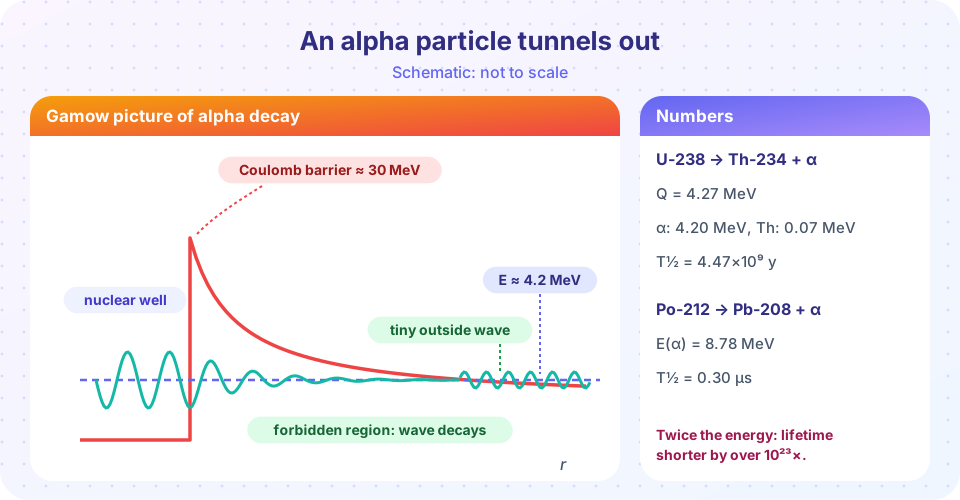
Uranium-238 releases an alpha particle with 4.2 MeV of kinetic energy, but to escape the nucleus an alpha particle has to climb over an electric barrier about 28 MeV high. By classical physics it can never get out, yet uranium decays, slowly, with a half-life of 4.5 billion years. In 1928 George Gamow, and independently Ronald Gurney and Edward Condon, explained this with a brand-new idea from quantum mechanics: the alpha particle tunnels through the barrier. It was the first time quantum theory was applied successfully to the nucleus, and it explains a spread of half-lives covering more than twenty orders of magnitude.
What you will learn
- Calculate the Q-value and the alpha particle's kinetic energy.
- Explain the Coulomb barrier puzzle and how tunnelling resolves it.
- Estimate a half-life with Gamow's theory and recognize the Geiger-Nuttall law.
- Describe uses of alpha emitters, and why they are hazardous only when inside the body.
Key terms
Alpha particle: a helium-4 nucleus, two protons and two neutrons, charge +2e.
Coulomb barrier: the electric potential energy hill that a positively charged particle must cross to leave or enter a nucleus.
Quantum tunnelling: passage of a particle through a barrier higher than its energy, which is impossible classically.
Gamow factor: the factor e^(−2G) that gives the probability of tunnelling through the barrier.
Assault frequency: how often the alpha particle hits the barrier, about 10²¹ times per second.
Energetics
The decay ᴬ_Z X → ᴬ⁻⁴_{Z−2} Y + ⁴He is allowed if
Q = [M(X) − M(Y) − M(⁴He)] c² > 0
For ²³⁸U → ²³⁴Th + α the masses are 238.050788 u, 234.043601 u and 4.002603 u, so Q = 0.004583 u × 931.494 MeV/u = 4.27 MeV. Momentum conservation splits that energy between the two products in inverse proportion to their masses. The heavy thorium recoils slowly and the alpha particle takes almost everything:
T_α = Q × (A − 4) / A = 4.27 × 234/238 = 4.20 MeV
while the thorium nucleus gets only 0.07 MeV. Alpha decays of one nuclide give sharp, discrete energies, which identify the source like a fingerprint. Typical alpha energies run from 4 to 9 MeV.
Why an alpha particle and not, say, a proton or a lithium nucleus? Helium-4 is extremely tightly bound (7.07 MeV per nucleon), so emitting it uses the binding energy of its four nucleons efficiently: the Q-value is positive for most heavy nuclides. Emitting heavier clusters can have an even larger Q, but with an enormously lower probability: ¹⁴C emission from radium-223 occurs about once in a billion decays.
The barrier puzzle and Gamow's solution
Outside the nucleus the alpha particle and the daughter nucleus repel each other with the Coulomb force. When they touch, at a separation of about R = 1.2 (A_d^(1/3) + 4^(1/3)) fm ≈ 9.3 fm for thorium, the electric potential energy is
V_B = 1.44 MeV·fm × 2 × 90 / 9.3 fm ≈ 28 MeV
while the alpha energy is only 4.2 MeV. Classically, the alpha particle could only emerge at a separation where V(r) = 4.2 MeV, which is 61 fm: it would have to start 52 fm outside the nucleus and cross a region where its kinetic energy would be negative.
In quantum mechanics a particle is described by a wave, which does not stop dead at a barrier: inside the forbidden region it decays exponentially. If the barrier is thin enough, a small part of the wave emerges on the other side. For the Coulomb barrier the probability of transmission is
P ≈ e^(−2G), with 2G = (2/ħ) ∫ √(2μ [V(r) − E]) dr
integrated from the nuclear surface R to the outer turning point r₂. The exponent 2G is about 89 for ²³⁸U, so P ≈ 10⁻³⁹. The alpha particle bounces around the nucleus at a rate f ≈ v/2R ≈ 10²¹ per second, and each time it has that tiny chance to escape. The decay constant is λ = f e^(−2G), which for uranium-238 gives a half-life of order 10¹⁷ seconds, close to the measured 1.4 × 10¹⁷ s. The calculation below reproduces this.
The Geiger-Nuttall law
In 1911, before quantum mechanics, Hans Geiger and John Nuttall noticed that alpha emitters with higher energies have shorter half-lives, following a straight line when log T½ is plotted against 1/√Q (for a fixed Z):
log₁₀ T½ ≈ a + b / √Q
The reason is clear in Gamow's theory: the exponent 2G falls rapidly as E rises, because the barrier thins and shortens. Compare ²¹²Po (Q = 8.95 MeV, T½ = 0.30 µs) with ²³⁸U (Q = 4.27 MeV, T½ = 4.5 billion years): doubling the energy shortens the half-life by more than 10²³.
Uses and hazards
- Smoke detectors contain a tiny amount of americium-241 (T½ = 432 years). Its alpha particles ionize the air in a small chamber so that a small current flows; smoke particles absorb the ions and cut the current, which triggers the alarm.
- Radioisotope thermoelectric generators convert the heat from decaying plutonium-238 (T½ = 87.7 years) into electricity, and power space probes that are too far from the Sun for solar panels.
- Hazards. An alpha particle travels only a few centimetres in air, and its 5 MeV of energy is absorbed in the dead outer layer of skin. It cannot hurt from the outside, but if an alpha emitter is inhaled or swallowed, all of its energy is deposited in a tiny volume of living tissue. This is why polonium-210 and radon decay products are so much more dangerous inside the body than outside.
Common misconceptions
"Alpha radiation is harmless because paper stops it." It is stopped easily, but inside the body, where there is no protective layer, it can do the most local damage of any common radiation.
"The alpha particle exists as a ready-made particle in the nucleus." Alpha clustering is part of the story, but the alpha particle has a certain probability to form on the surface. The Gamow calculation assumes a preformation probability of about one, and refinements change the result by factors of a few.
"Tunnelling means the particle goes through with less energy." Its energy is unchanged. It reaches the other side because of the wave nature of quantum particles.
Try it
Gamow's estimate, in code. For each decay it calculates the barrier integral and the half-life, and compares with measurement. The model is crude, but it spans 24 orders of magnitude.
Press Run (or Ctrl + Enter) to see the result here.
Program input · what you'd type while the program runs
Type the answers before you press Run, one per line. Each time the program reads a line (with input()), it gets the next line from this box.
Now the Geiger-Nuttall law, using five polonium isotopes (all Z = 84). A straight line in log T½ against 1/√Q means every point is predictable from the others.
Press Run (or Ctrl + Enter) to see the result here.
Program input · what you'd type while the program runs
Type the answers before you press Run, one per line. Each time the program reads a line (with input()), it gets the next line from this box.
Finally, try your own alpha emitter. Enter the daughter's Z and A and the Q-value, and the page estimates the barrier and the half-life using the same method.
Check your understanding
Quick check · 5 questions
of 5 answered You scored / 5 · perfect!
-
1. An alpha decay has Q = 5.60 MeV and the daughter has A = 218 (parent A = 222). What is the alpha kinetic energy?
T_α = Q × 218/222 ≈ 5.50 MeV; the recoiling daughter takes about 0.10 MeV. -
2. Why was alpha decay a puzzle before 1928?
The barrier is about 28 MeV for uranium, while the alpha has only about 4 MeV. -
3. What does the Geiger-Nuttall law say?
log T½ is linear in 1/√Q, so a larger Q greatly shortens the half-life. -
4. Why is alpha radiation most dangerous when the source is inside the body?
Alpha particles ionize heavily over a very short path, so nothing shields the tissue when the emitter is inside. -
5. The tunnelling probability is e^(−2G) with 2G = 69. About what power of ten is that?
e⁻⁶⁹ = 10^(−69/2.303) = 10^(−30).
Summary
- Alpha decay: Z − 2, A − 4; Q = [M(X) − M(Y) − M(⁴He)]c² and T_α = Q(A − 4)/A.
- A Coulomb barrier of about 28 MeV blocks 4–9 MeV alpha particles; they escape by quantum tunnelling.
- The decay constant is λ = f e^(−2G), and the result is extremely sensitive to the energy.
- Geiger-Nuttall: log T½ is linear in 1/√Q.
- Alpha emitters are useful (smoke detectors, power sources) and dangerous only inside the body.
Track your progress
Create a free account to tick off lessons and pick up where you left off on any device.
of Nuclear and Particle Physics lessons completed