


















Lesson 15 of 51 · Radioactivity and Decay
Beta Decay and the Neutrino
Understand beta-minus, beta-plus and electron capture, the continuous energy spectrum that led to the neutrino, and the weak force at the quark level.
In the 1920s beta decay seemed to break the most sacred law of physics. A nucleus with a definite energy turned into a daughter nucleus with a definite energy and an electron, so the electron should have carried away a definite amount of energy. Instead, it came out with any energy from zero up to a maximum. Energy appeared to vanish. Niels Bohr was ready to give up energy conservation. In 1930 Wolfgang Pauli proposed a different escape: a tiny, neutral, nearly massless particle was stealing the missing energy. It took twenty-six years to detect it, and the idea became a cornerstone of the Standard Model.
What you will learn
- Write the equations for β⁻, β⁺ and electron capture, and decide which is possible from atomic masses.
- Explain the continuous spectrum and the evidence for the neutrino.
- Describe beta decay at the level of quarks and the weak force.
- Know the key conservation laws, including lepton number.
Key terms
Beta-minus decay (β⁻): a neutron turns into a proton, emitting an electron and an electron antineutrino.
Beta-plus decay (β⁺): a proton turns into a neutron, emitting a positron and an electron neutrino.
Electron capture (EC): the nucleus absorbs an inner atomic electron; a proton turns into a neutron and a neutrino is emitted.
Neutrino (ν): a neutral, nearly massless lepton that interacts only through the weak force and gravity.
Weak interaction: the force responsible for changing quark flavors, carried by W and Z bosons.
The three processes
β⁻ decay: n → p + e⁻ + ν̄ₑ. In a nucleus: ᴬ_Z X → ᴬ_{Z+1} Y + e⁻ + ν̄ₑ. It happens in neutron-rich nuclei. The mass number is unchanged, and the nuclear charge goes up by one. Example: ¹⁴C → ¹⁴N + e⁻ + ν̄ₑ.
β⁺ decay: p → n + e⁺ + νₑ. In a nucleus: ᴬ_Z X → ᴬ_{Z−1} Y + e⁺ + νₑ. It happens in proton-rich nuclei. A free proton can never do this (the neutron is heavier), but a proton inside a nucleus can borrow the energy from the binding.
Electron capture: p + e⁻ → n + νₑ. The nucleus absorbs one of its own atomic electrons, usually from the innermost K shell. Electron capture competes with β⁺ decay, and it is the only option when there is not enough energy for a positron.
Free neutrons decay as well: the neutron lives on average 878 seconds (a half-life of 10.2 minutes), and the decay releases 0.782 MeV, the difference m_n − m_p − m_e. The two experimental methods of measuring the neutron lifetime currently disagree by a few seconds, which remains an open puzzle.
Energy conditions with atomic masses
Atomic masses include the electrons, so you must be careful with electron masses:
- β⁻:
Q = [M(P) − M(D)] c². The electron masses cancel. - β⁺:
Q = [M(P) − M(D) − 2mₑ] c², where 2mₑc² = 1.022 MeV. The parent atom has one more electron than the daughter atom, and a positron is created. - EC:
Q = [M(P) − M(D)] c²minus the binding energy of the captured electron (a few keV at most for light nuclei).
If M(P) − M(D) lies between 0 and 1.022 MeV only electron capture is possible. ⁷Be → ⁷Li, with M(P) − M(D) = 0.862 MeV, is an example: it decays by EC alone, with a half-life of 53 days.
The continuous spectrum and the neutrino
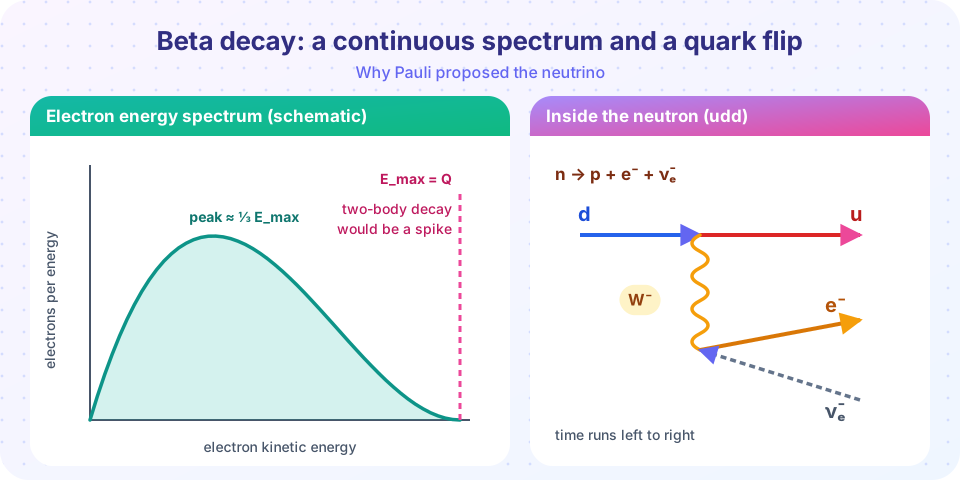
A two-body decay (daughter plus electron) would give the electron exactly one energy, fixed by conservation of energy and momentum. Charles Ellis and William Wooster showed in 1927 that the electrons have a continuous distribution from 0 up to a maximum energy E_max equal to Q, with an average only about a third of E_max. The missing energy was not in the daughter, which carries off almost no energy because it is heavy.
There was another problem: angular momentum. Neutron, proton and electron all have spin ½. Two spin-½ particles can only combine to a total of 0 or 1 (plus any whole-number orbital angular momentum), never ½, so a neutron cannot decay into just a proton and an electron without breaking the conservation of angular momentum. A third spin-½ particle fixes both problems.
Pauli's 1930 letter proposed this particle; Enrico Fermi named it the neutrino ("little neutral one") and in 1934 built the first theory of beta decay around it. Clyde Cowan and Frederick Reines finally detected antineutrinos from a nuclear reactor in 1956, by observing the reaction ν̄ₑ + p → n + e⁺ in a tank of water and cadmium chloride (Reines received the 1995 Nobel Prize). The neutrino has no electric charge and feels only the weak force, so most pass through the Earth without a trace.
Beta decay at the quark level
A neutron is udd and a proton is uud. Beta-minus decay turns one down quark into an up quark, d → u + W⁻, and the virtual W⁻ immediately becomes e⁻ + ν̄ₑ. The W boson is so heavy (80.4 GeV/c²) that the process is very slow compared with strong or electromagnetic ones, which explains why beta half-lives are typically seconds to billions of years. The force is also unusual in another way: in 1957 Chien-Shiung Wu and her collaborators studied β⁻ decay of ⁶⁰Co nuclei in a magnetic field and found that electrons come out preferentially in the direction opposite to the nuclear spin. Nature distinguishes left from right in weak interactions, so parity is violated. Tsung-Dao Lee and Chen-Ning Yang, who predicted it, received the 1957 Nobel Prize.
Conservation laws at work
| Quantity | Before: n | After: p + e⁻ + ν̄ₑ |
|---|---|---|
| Electric charge | 0 | +1 − 1 + 0 = 0 |
| Baryon number | 1 | 1 + 0 + 0 = 1 |
| Electron lepton number | 0 | 0 + 1 − 1 = 0 |
| Energy, momentum, angular momentum | all conserved |
The antineutrino has lepton number −1, which balances the electron's +1. In β⁺ decay a neutrino appears, with lepton number +1 balancing the positron's −1.
Uses of beta emitters
- Positron emission tomography (PET) uses β⁺ emitters such as fluorine-18 (half-life 110 minutes). Each positron stops within a millimetre and annihilates with an electron, producing two 511 keV gamma rays in opposite directions that the scanner detects.
- Carbon-14 and tritium serve as tracers and, in the case of carbon-14, as clocks.
- Cobalt-60 and caesium-137 are used as gamma sources, because their β⁻ decays leave excited daughters that emit gamma rays (next lesson).
Common misconceptions
"The electron was inside the nucleus all along." The nucleus contains protons and neutrons. The electron and antineutrino are created in the decay, like a photon is created when an atom emits light.
"Antimatter is science fiction." β⁺ emitters produce antimatter (positrons) every second in every hospital that has a PET scanner.
"Neutrinos were invented to save energy conservation, so they are just a trick." They were later detected directly in many experiments, and the energy balance in beta decay now matches to high precision.
Try it
Compute the Q-values for several decays from atomic masses and let the code decide which modes are open.
Press Run (or Ctrl + Enter) to see the result here.
Program input · what you'd type while the program runs
Type the answers before you press Run, one per line. Each time the program reads a line (with input()), it gets the next line from this box.
Now plot the beta spectra of two nuclides. This quick model uses phase space only (electron momentum and energy and the squared neutrino energy), so it has the right general hump.
Press Run (or Ctrl + Enter) to see the result here.
Program input · what you'd type while the program runs
Type the answers before you press Run, one per line. Each time the program reads a line (with input()), it gets the next line from this box.
Finally, a rule of thumb. Enter any nuclide and see on which side of the valley of stability it lies.
Check your understanding
Quick check · 5 questions
of 5 answered You scored / 5 · perfect!
-
1. What are the products of β⁻ decay of a neutron?
n → p + e⁻ + ν̄ₑ. -
2. Why does the beta spectrum extend from zero to a maximum energy?
A three-body final state allows a continuous range of electron energies, and the neutrino carries the rest. -
3. A parent atom is 0.80 MeV heavier than the daughter atom (Z − 1). Which decay can occur?
β⁺ needs M(P) − M(D) > 1.022 MeV; electron capture needs only M(P) − M(D) > 0. -
4. Which particle's weak interaction caused beta decay at the quark level?
A down quark emits a W⁻ boson and becomes an up quark; the W⁻ then becomes e⁻ and ν̄ₑ. -
5. What did the Wu experiment of 1957 demonstrate?
Electrons from ⁶⁰Co decay were emitted preferentially opposite to the nuclear spin, so the weak force distinguishes left from right.
Summary
- β⁻: n → p + e⁻ + ν̄ₑ (Z + 1); β⁺: p → n + e⁺ + νₑ (Z − 1); EC: p + e⁻ → n + νₑ.
- With atomic masses: Q(β⁻) = ΔM c²; Q(β⁺) = ΔM c² − 1.022 MeV; EC needs only ΔM > 0.
- The continuous spectrum and angular momentum require the neutrino (Pauli 1930, Fermi 1934, detected 1956).
- At the quark level d → u + W⁻; the weak force violates parity (Wu 1957).
- Lepton number is conserved: e⁻ and ν̄ₑ together have lepton number zero.
Track your progress
Create a free account to tick off lessons and pick up where you left off on any device.
of Nuclear and Particle Physics lessons completed