


















Lesson 43 of 51 · Cosmic Frontiers
Dark Matter and Dark Energy
The evidence for dark matter (rotation curves, lensing, the Bullet Cluster, the CMB), candidate particles and searches, and the discovery of cosmic acceleration.
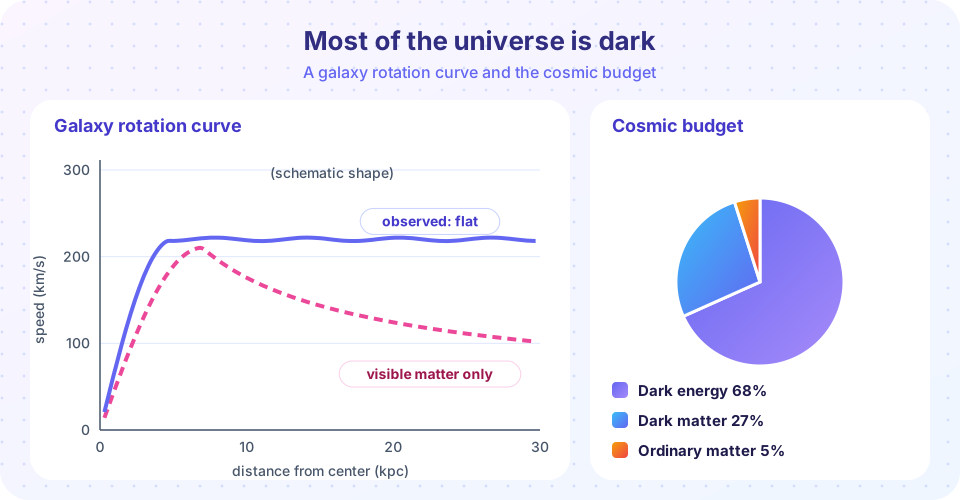
We know the composition of stars, planets and ourselves very well, but all of it adds up to only about 5% of the energy content of the universe. About 27% is dark matter, which pulls on everything gravitationally but does not emit or absorb light, and about 68% is dark energy, a mysterious component that makes the expansion of the universe speed up. We do not yet know what either one is. This lesson lays out how we know they exist, and what the leading ideas are.
What you will learn
- The four main lines of evidence for dark matter.
- What particle candidates exist and how they are searched for.
- How supernovae revealed cosmic acceleration.
- What the cosmological constant is and how the universe's contents evolve.
- Which alternatives (modified gravity) exist and why most physicists favor dark matter.
Key terms
Dark matter: matter that interacts gravitationally but not (noticeably) electromagnetically.
Rotation curve: a graph of orbital speed against distance from a galaxy's center.
Gravitational lensing: the bending of light by mass, which lets us weigh matter whether or not it shines.
Dark energy: the component driving accelerated expansion. The simplest form is a cosmological constant Λ.
WIMP: a hypothetical weakly interacting massive particle; the classic dark-matter candidate.
Evidence for dark matter
- Galaxy clusters (1933). Fritz Zwicky found that galaxies in the Coma cluster move much too fast to be held by the visible mass.
- Rotation curves (1970s). Vera Rubin and Kent Ford measured orbital speeds in spiral galaxies. If most mass were in the visible stars, speeds beyond the disc should fall as
v ∝ 1/√r(Kepler). Instead they stay flat at about 200 km/s out to the edge, which needs mass density in a halo falling as1/r². - Gravitational lensing and the Bullet Cluster (2006). In a collision of two galaxy clusters, hot gas (most of the visible mass) was slowed down and stayed in the middle, while the lensing map showed the mass had passed through. The mass is not where the gas is, so it is not ordinary matter.
- The CMB and structure (1990s to now). The pattern of hot and cold spots, and the way galaxies cluster, need a form of matter that does not interact with light and clumped early on. Both give a dark matter density about five times the ordinary matter density.
Nucleosynthesis (the previous lesson) adds that the ordinary-matter share is only 4 to 5%, so the missing mass cannot be hidden ordinary matter such as faint stars or gas.
What could it be?
Dark matter must be stable, cold (slow-moving), and interact weakly if at all with light. No Standard Model particle fits: neutrinos are too light and would wash out small structures.
- WIMPs have a mass of order 10 GeV to TeV and weak-scale interactions. A particle with this property would be produced in the right quantity in the early universe, a coincidence called the "WIMP miracle." Searches look for the rare recoil of a nucleus struck by a passing WIMP in large underground tanks of liquid xenon (XENONnT, LZ, PandaX). So far they have found nothing, excluding much of the favored range.
- Axions are very light particles proposed to solve a different problem, and could also be dark matter. Experiments such as ADMX use strong magnetic fields and resonant cavities to convert them to microwave photons.
- Others: sterile neutrinos, primordial black holes, and many "dark sector" models with hidden forces.
Three search strategies are used together: direct detection (a nucleus recoils), indirect detection (gamma rays or antiparticles from annihilation) and collider production (missing transverse momentum at the LHC).
An alternative idea, MOND (Mordehai Milgrom, 1983), modifies gravity at tiny accelerations and fits many rotation curves well, but it has difficulty with galaxy clusters, lensing in the Bullet Cluster and the CMB. Most physicists consider dark matter the better explanation, though modifying gravity is still tested.
Dark energy and acceleration
For decades the debate was whether gravity would slow the expansion enough to stop it. In 1998, two teams (led by Saul Perlmutter, and by Brian Schmidt and Adam Riess) measured distant Type Ia supernovae, which are almost standard candles. They were fainter than expected, meaning the expansion has been accelerating for the last several billion years. The three leaders shared the 2011 Nobel Prize.
The simplest explanation is the cosmological constant Λ, an energy density of empty space that does not dilute as space expands. In Einstein's equations it acts as a repulsive gravity. Its measured value corresponds to about 5×10⁻¹⁰ J/m³, which is 120 orders of magnitude smaller than what a naive quantum-field estimate of vacuum energy gives. This is perhaps the worst prediction in physics and is called the cosmological constant problem. Recent surveys, such as DESI, have hinted that dark energy may change slowly with time, but this is not established.
How the contents evolve
As space expands by a factor a (scale factor, a = 1 today):
- matter dilutes as
a⁻³, - radiation dilutes as
a⁻⁴(and also loses energy to redshift), - a cosmological constant stays constant.
So the universe passed through a radiation era, then a matter era (from about z = 3400), and since about z = 0.3 it has been dominated by dark energy, which is why acceleration began only recently.
Common misconceptions
"Dark matter is the same as dark energy." They are unrelated: dark matter clumps and attracts; dark energy is smooth and drives expansion.
"Dark matter is just matter we haven't looked at yet." Nucleosynthesis and the CMB limit ordinary matter strictly to about 5%. The rest has to be something else.
"No detection means dark matter doesn't exist." The evidence is gravitational, from many independent observations. Non-detection only constrains particle models.
Try it
Press Run (or Ctrl + Enter) to see the result here.
Program input · what you'd type while the program runs
Type the answers before you press Run, one per line. Each time the program reads a line (with input()), it gets the next line from this box.
Press Run (or Ctrl + Enter) to see the result here.
Program input · what you'd type while the program runs
Type the answers before you press Run, one per line. Each time the program reads a line (with input()), it gets the next line from this box.
Press Run (or Ctrl + Enter) to see the console output here.
No output.
Check your understanding
Quick check · 5 questions
of 5 answered You scored / 5 · perfect!
-
1. What does a flat rotation curve imply?
Kepler's law with visible mass alone predicts falling speeds. Flat speeds mean extra mass in a halo. -
2. What did the Bullet Cluster show?
Lensing showed the mass peaks passed through the collision while the gas lagged behind. -
3. Which observation revealed the accelerating expansion?
Distant supernovae were dimmer than a decelerating or coasting universe predicts (1998). -
4. How does the density of a cosmological constant change as space expands?
By definition a cosmological constant is an energy density of empty space that does not dilute. -
5. Which is NOT a way to search for WIMPs?
Weighing by light cannot see dark matter. The other two are standard WIMP searches.
Summary
- Dark matter (27%) is revealed by cluster motions, rotation curves, lensing, the Bullet Cluster and the CMB.
- Ordinary matter makes up only about 5%; dark energy about 68%.
- WIMPs, axions and other candidates are being searched for by direct, indirect and collider methods, so far without a detection.
- Supernovae in 1998 showed that expansion is accelerating; the simplest explanation is a cosmological constant.
- Matter dilutes as
a⁻³, radiation asa⁻⁴, dark energy not at all: radiation, matter and dark-energy eras follow each other.
Track your progress
Create a free account to tick off lessons and pick up where you left off on any device.
of Nuclear and Particle Physics lessons completed