


















Lesson 28 of 51 · Fission and Fusion
Fusion in Stars
How the Sun fuses hydrogen despite a huge Coulomb barrier: quantum tunneling, the Gamow peak, the proton-proton chain, the CNO cycle and the path to iron.
Every star is a fusion reactor held together by its own gravity. The Sun converts about 600 million tonnes of hydrogen into helium every second and has done so for 4.6 billion years. Yet the numbers look odd at first glance: the centre of the Sun is "only" 15 million kelvin, which is far too cold for protons to climb over their mutual electric repulsion by simple brute force. Fusion in the Sun is a quantum-mechanical bargain between the Coulomb barrier, tunneling and the thermal tail of the particle speeds.
What you will learn
- Why classical thermal energy is not enough and how tunneling helps.
- What the Gamow peak is and where in energy most fusion happens.
- How the proton-proton chain and the CNO cycle turn hydrogen into helium.
- What happens in stars after hydrogen runs out.
- How to estimate the Sun's fusion rate and lifetime.
Key terms
Coulomb barrier: the electric repulsion energy of two nuclei at the distance where the strong force takes over.
Tunneling: quantum passage through a barrier that a particle classically cannot climb.
Gamow peak: the energy window where the product of the thermal distribution and the tunneling probability is largest.
Hydrostatic equilibrium: the balance of gravity against the pressure gradient inside a star.
Reaction chain: a series of reactions with a net result, such as 4 protons → helium-4.
The Coulomb barrier problem
Two protons have to approach within a couple of femtometres (1 fm = 10⁻¹⁵ m) before the strong force pulls them together. At that distance their electric potential energy is roughly
U = e² / (4π ε₀ r) = 1.44 MeV·fm / r (about 0.7 MeV at r = 2 fm)
At the Sun's core temperature T ≈ 1.5×10⁷ K the typical thermal energy is
kT = 8.617×10⁻⁵ eV/K × 1.5×10⁷ K ≈ 1.3 keV
That is several hundred times too small. Even the fastest particles in the Maxwell–Boltzmann tail would almost never get close enough classically.
Tunneling and the Gamow peak
Quantum mechanics rescues fusion. A proton has a wave nature; there is a small probability that it tunnels through the barrier. George Gamow worked this out in 1928 for alpha decay, and in the 1930s it was applied to stars. The tunneling probability at relative energy E is approximately
P(E) ∝ exp( − √(E_G / E) ) with E_G = 2 m_r c² (π α Z₁ Z₂)²
where α ≈ 1/137 is the fine-structure constant and m_r is the reduced mass. For two protons E_G ≈ 493 keV.
Now two opposite trends compete:
- The thermal distribution drops with energy,
∝ exp(−E / kT). - The tunneling probability rises with energy.
Their product has a narrow maximum, the Gamow peak, at
E₀ = ( E_G (kT)² / 4 )^(1/3)
For the solar core this gives about 6 keV, nearly five times kT. Fusion happens in a rare, narrow slice of the distribution, which is why stellar reaction rates are extremely sensitive to temperature (the pp rate scales like T⁴ near the Sun's centre; CNO rates like T¹⁶ or more).
The proton-proton chain
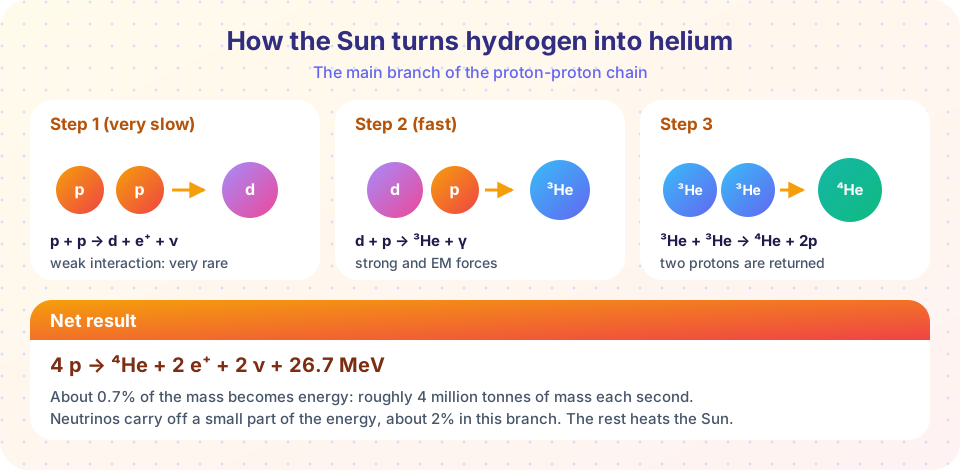
In stars like the Sun, hydrogen burns mainly by the pp chain:
p + p → d + e⁺ + ν_einvolves the weak interaction because one proton must turn into a neutron. This is the bottleneck: a given proton waits on the order of 10¹⁰ years for it to happen in the Sun. That slowness is why the Sun lives so long.d + p → ³He + γtakes about a second.³He + ³He → ⁴He + 2pcompletes the main branch.
The net result is 4p → ⁴He + 2e⁺ + 2ν_e + 26.7 MeV. The positrons annihilate with electrons, and the neutrinos escape the Sun with about 0.5 MeV of energy per chain on average, so roughly 26 MeV heats the star. Two other branches go through ⁷Be and ⁸B; they are less common but produce the high-energy neutrinos that experiments first detected in the 1960s (Chapter 8 returns to these).
The CNO cycle
Heavier stars, about 1.3 solar masses and up, are hotter and burn hydrogen mainly through the CNO cycle, where carbon, nitrogen and oxygen act as catalysts: a proton is captured by ¹²C, then a series of captures and beta decays ends with the release of ⁴He and the return of ¹²C. The net result is again 4 protons to one helium-4. The Sun makes only about 1% of its energy this way, but CNO neutrinos were directly detected in the Sun in 2020 by the Borexino experiment.
After hydrogen: heavier fuels
When the hydrogen in the core is used up, gravity compresses the core until it reaches about 10⁸ K and helium burning begins via the triple-alpha process: three ⁴He nuclei make ¹²C through a short-lived ⁸Be and a resonant excited state of ¹²C (the Hoyle state at 7.65 MeV, predicted in 1953 by Fred Hoyle). Massive stars go on to burn carbon, neon, oxygen and silicon, each stage hotter and shorter, until the core is iron-group nuclei. Iron cannot release energy by fusion, the core collapses, and a core-collapse supernova follows. Elements heavier than iron come from neutron capture in supernovae and neutron star mergers.
Common misconceptions
"The Sun is a giant hydrogen bomb." A bomb releases energy in microseconds. The Sun's core makes only about 276 W per cubic metre (less than a compost heap) but there are an enormous number of cubic metres. The rate is set by the very slow weak-interaction step.
"The Sun burns fuel like a fire." It does not use oxygen. Fusion converts mass to energy in the core, and the energy leaks outward slowly: light needs tens of thousands of years to random-walk out of the Sun.
"Stars are hot enough for classical fusion." The core is far too cold for that. Fusion works only because of tunneling.
Try it
Press Run (or Ctrl + Enter) to see the result here.
Program input · what you'd type while the program runs
Type the answers before you press Run, one per line. Each time the program reads a line (with input()), it gets the next line from this box.
Press Run (or Ctrl + Enter) to see the console output here.
No output.
Check your understanding
Quick check · 5 questions
of 5 answered You scored / 5 · perfect!
-
1. Why is tunneling essential for fusion in the Sun?
kT is several hundred times smaller than the barrier. Quantum tunneling through the barrier makes fusion possible, though slow. -
2. What is the Gamow peak?
The thermal factor falls with energy, tunneling rises. Their product peaks at an intermediate energy, about 6 keV for the solar core. -
3. Why does the first step of the pp chain take so long?
The strong and electromagnetic forces cannot change a proton into a neutron. The weak interaction can, and it is extremely slow. -
4. In the CNO cycle, what do the carbon, nitrogen and oxygen nuclei do?
The cycle begins and ends with ¹²C. The net result is still four protons becoming one helium-4 nucleus. -
5. Why does fusion in a massive star stop at iron?
Iron-group nuclei are the most tightly bound, so neither fusion nor fission of them releases energy.
Summary
- Thermal energy in the Sun (about 1.3 keV) is far below the Coulomb barrier; fusion proceeds by quantum tunneling.
- The Gamow peak, about 6 keV for solar pp fusion, is where most reactions happen.
- The pp chain (4p → ⁴He + 2e⁺ + 2ν + 26.7 MeV) powers the Sun; the weak-interaction first step makes it slow.
- Hotter stars use the CNO cycle; later stages burn helium (triple-alpha), then heavier elements up to iron.
- Fusion stops at iron because it is the most tightly bound nucleus group; core collapse then makes a supernova.
Track your progress
Create a free account to tick off lessons and pick up where you left off on any device.
of Nuclear and Particle Physics lessons completed