


















Lesson 22 of 51 · Nuclear Reactions
Landmark Reactions and Reaction Mechanisms
From Rutherford's 1919 transmutation to the discovery of the neutron and induced radioactivity: the landmark reactions, plus direct and compound-nucleus mechanisms.
The history of nuclear reactions reads like a detective story. In fifteen years, from 1919 to 1934, physicists went from the first accidental sign that one element can be turned into another to the deliberate manufacture of artificial radioactive elements. Each step used a reaction that you can now analyze with the tools of this chapter. At the same time, theorists worked out how a reaction actually unfolds: sometimes a projectile makes a quick glancing collision, and sometimes it merges with the target and shares its energy with every nucleon.
What you will learn
- Describe the landmark reactions of 1919–1934 and what each proved.
- Identify unknown products using Z and A conservation.
- Distinguish direct reactions from compound-nucleus reactions in time scale, energy sharing and angular distribution.
- Calculate the excitation energy of a compound nucleus.
Key terms
Transmutation: the change of one element into another by a nuclear reaction.
Artificial radioactivity: radioactivity of nuclides produced in a laboratory reaction.
Direct reaction: a fast, surface-level interaction in which one or a few nucleons are involved.
Compound nucleus: an intermediate state in which the projectile's energy is shared among all nucleons of the combined system.
Excitation energy E*: the energy above the ground state of the compound nucleus.
Four landmark reactions
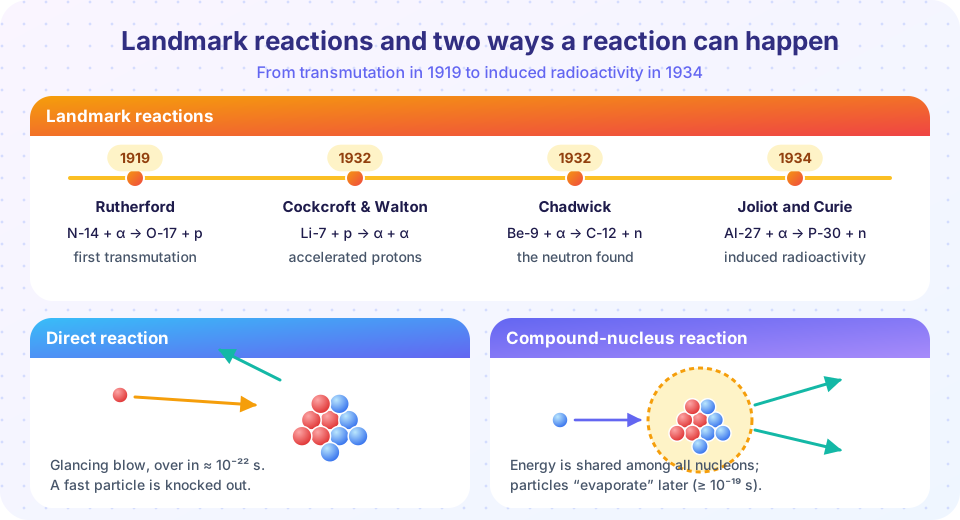
1919, Rutherford: ¹⁴N(α, p)¹⁷O. Ernest Rutherford studied alpha particles from a radium source passing through different gases. In nitrogen he saw scintillations from particles with a longer range than any alpha: they were protons, knocked out of nitrogen nuclei. This was the first deliberate transmutation of an element. Patrick Blackett photographed the reaction in a cloud chamber in 1925, and the picture showed the oxygen-17 nucleus recoiling (the alpha particle vanishes, since it is absorbed).
1932, Chadwick: ⁹Be(α, n)¹²C. Walther Bothe and Herbert Becker found in 1930 that beryllium bombarded by alpha particles emits a very penetrating radiation. The Joliot-Curies showed it knocks protons out of paraffin. James Chadwick measured the recoil energies of protons and nitrogen nuclei and concluded in February 1932 that the radiation was a neutral particle with about the mass of the proton, the neutron. The reaction has Q = +5.70 MeV. Chadwick received the Nobel Prize in 1935.
1932, Cockcroft and Walton: ⁷Li(p, α)⁴He. John Cockcroft and Ernest Walton built a voltage multiplier that accelerated protons to a few hundred keV and fired them at lithium. They were the first to cause a nuclear reaction with artificially accelerated particles. The alpha particles carried about 8.6 MeV each, as expected from Q = 17.35 MeV, a direct test of E = mc². They shared the 1951 Nobel Prize.
1934, Irène and Frédéric Joliot-Curie: ²⁷Al(α, n)³⁰P. The phosphorus-30 produced is not stable: it decays by positron emission with a half-life of 2.5 minutes to ³⁰Si. This was the first artificial radioactive isotope. It opened the way to the thousands of radioactive isotopes made since, and earned the pair the 1935 Nobel Prize in Chemistry. In the same year Enrico Fermi irradiated almost every element with neutrons and found that slowing the neutrons first, with paraffin or water, made the reactions far more probable (the 1/v law of the previous lesson).
Mechanism 1: direct reactions
In a direct reaction the projectile interacts with the nuclear surface and one or a few nucleons. The reaction takes about 10⁻²² s, the time a fast particle needs to cross the nucleus. Examples: elastic scattering, inelastic scattering to a low-lying excited state, and nucleon transfer such as ¹²C(d, p)¹³C, where the deuteron's neutron is stripped off and joins the target while the proton continues.
Direct reactions are forward-peaked, because the outgoing particle did not lose all memory of the beam direction. Their angular distribution is a diffraction-like pattern with a shape that depends on the orbital angular momentum l of the transferred nucleon. By matching the pattern, physicists can read off l (and so the spin and parity) of the final nuclear state, which makes transfer reactions an important tool of nuclear structure.
Mechanism 2: the compound nucleus
Niels Bohr proposed in 1936 that at low and moderate energies the projectile does not stay a separate entity: it is absorbed and its energy is shared among all nucleons, like a billiard ball dropped into a tray of balls. The nucleus is left in an excited state, a compound nucleus that lives for a long time (10⁻¹⁹ s or even longer, orders of magnitude longer than the crossing time). Later it decays by emitting a particle that, by chance, collects enough energy at the surface to escape, rather like evaporation from a hot liquid drop, or it emits a gamma ray.
Bohr's key idea, the independence hypothesis, is that the decay does not depend on how the compound nucleus was formed, only on its energy, spin and parity. Experiments confirmed it: for example, ⁶⁴Zn* formed from p + ⁶³Cu and from α + ⁶⁰Ni, at the same excitation energy, decays into the same channels with the same branching ratios. Compound reactions produce nearly symmetric angular distributions (the same forward and backward) and narrow resonances at energies where the compound state is a true quantum level. The Breit-Wigner formula of the last lesson describes them.
Between the two extremes the optical model treats the nucleus as a "cloudy crystal ball": partly transparent (the projectile passes or scatters) and partly absorbing (the projectile is captured).
The excitation energy of the compound nucleus
If a projectile a is captured by target A, the compound nucleus C has the excitation energy
E* = S + E_cm, with S = (m_a + m_A − m_C)c² and E_cm = E_lab × m_A/(m_a + m_A).
S is the separation energy of the projectile from C (its binding), and E_cm is the kinetic energy available in the centre-of-mass frame. Worked example: an alpha particle of 7.7 MeV hitting ¹⁴N makes ¹⁸F*. S = (14.003074 + 4.002603 − 18.000937) u × 931.494 = 4.42 MeV and E_cm = 7.7 × 14.003/18.006 = 5.99 MeV, so E* ≈ 10.4 MeV, much more than needed to emit a proton (the separation energy of a proton from ¹⁸F is about 5.6 MeV).
Common misconceptions
"Rutherford split the atom." In 1919 he transformed a nitrogen nucleus into oxygen by knocking a proton out of it. Atoms had not been 'split' in a physical sense, and the energy involved was small. The first fission came in 1938.
"A compound nucleus remembers how it was formed." Apart from energy, spin and parity, it does not. Its decay probabilities are independent of the entrance channel.
"All reactions are either direct or compound." Real reactions are mixed, with direct reactions dominating at high energy and for the surface, and compound ones at low energy.
Try it
Find the compound nucleus and its excitation energy for the landmark reactions, using atomic masses.
Press Run (or Ctrl + Enter) to see the result here.
Program input · what you'd type while the program runs
Type the answers before you press Run, one per line. Each time the program reads a line (with input()), it gets the next line from this box.
Now the angular distributions. A compound reaction is nearly symmetric about 90°, while a direct stripping reaction is peaked at forward angles with a pattern set by the transferred angular momentum l. These are schematic shapes, for illustration only.
Press Run (or Ctrl + Enter) to see the result here.
Program input · what you'd type while the program runs
Type the answers before you press Run, one per line. Each time the program reads a line (with input()), it gets the next line from this box.
Last, test yourself. Each reaction has one missing product. Enter its Z and A, then check.
Check your understanding
Quick check · 5 questions
of 5 answered You scored / 5 · perfect!
-
1. Which reaction led Chadwick to the discovery of the neutron?
Alpha particles on beryllium produced a penetrating neutral radiation, which Chadwick identified as neutrons in 1932. -
2. What was new about the Joliot-Curies' 1934 experiment?
²⁷Al(α, n)³⁰P gave ³⁰P, which decays by positron emission with a 2.5 minute half-life. -
3. How long does a compound-nucleus reaction typically last compared with a direct reaction?
A direct reaction takes about 10⁻²² s, a compound reaction 10⁻¹⁹ s or more. -
4. What does Bohr's independence hypothesis say?
The formation and decay are independent steps; different entrance channels leading to the same compound state give the same branching ratios. -
5. An alpha particle of S = 4.4 MeV separation energy hits a target and the centre-of-mass energy is 6.0 MeV. What is the excitation energy of the compound nucleus?
E* = S + E_cm = 4.4 + 6.0 = 10.4 MeV.
Summary
- 1919 Rutherford ¹⁴N(α, p)¹⁷O; 1932 Chadwick ⁹Be(α, n)¹²C and Cockcroft-Walton ⁷Li(p, α)⁴He; 1934 Joliot-Curie ²⁷Al(α, n)³⁰P.
- Direct reactions are fast (10⁻²² s), forward-peaked and involve a few nucleons; compound reactions are slow (≥ 10⁻¹⁹ s), share energy and show resonances.
- Bohr's independence hypothesis: the compound nucleus forgets how it was made.
- E* = S + E_cm for the compound nucleus.
Next: Making Isotopes: Activation, Cyclotrons and the Technetium Generator
Track your progress
Create a free account to tick off lessons and pick up where you left off on any device.
of Nuclear and Particle Physics lessons completed