


















Lesson 36 of 51 · Accelerators and Detectors
Accelerators and Detectors: The Big Picture
Why physicists build giant accelerators and detectors: wavelength and resolution, creating massive particles, a short history from Cockcroft-Walton to the LHC.
To study something as small as a quark you have to hit it hard and then watch what flies out. An accelerator gives particles enormous energy and makes them collide. A detector records what the collision produced. Almost everything we know about the Standard Model comes from this simple recipe, executed with machines that are among the largest and most complex ever built.
What you will learn
- Why high energy is needed to see small things and to create heavy particles.
- The difference between a collider and a fixed-target machine.
- A short history of accelerators.
- The three jobs of a detector: track, measure energy and identify.
- How this chapter is organised.
Key terms
Electronvolt (eV): the energy a particle with one elementary charge gains across one volt. 1 GeV = 10⁹ eV, 1 TeV = 10¹² eV.
Collider: a machine where two beams collide head-on.
Fixed-target experiment: a beam hits a stationary target.
Center-of-mass energy √s: the total energy available for making new particles in a collision.
Luminosity L: how many particles cross per unit area per second; the collision rate is rate = σ L.
Why high energy?
To see small things. A particle of momentum p has a de Broglie wavelength λ = h/p. Using hc = 1239.84 MeV·fm, a particle with pc = 1 GeV has λ ≈ 1.24 fm, about the size of a proton. To resolve structure inside the proton you need wavelengths well below that, so momenta of tens or hundreds of GeV. That is how the SLAC experiments of 1968 saw quarks.
To make heavy things. Einstein's E = mc² runs both ways: energy can become mass. To produce a Higgs boson (125 GeV/c²) in a collision you need at least 125 GeV of center-of-mass energy, and in practice a lot more, because only a part of the proton's energy goes into each collision (the quarks and gluons carry fractions of the proton's momentum). Top quark pairs need over 345 GeV, W and Z need about 80 to 91 GeV.
To reach the early universe. Collisions at 13.6 TeV recreate, for a tiny region, conditions last present in the universe about 10⁻¹² s after the Big Bang.
Collider or fixed target?
Suppose a proton of energy E hits a proton at rest. Most of the energy goes into motion of the products and only a fraction is available for new particles:
fixed target:  √s ≈ √(2 m c² E)        (E ≫ m c²)
collider:      √s = 2 E                (two equal beams head-on)
With E = 7 TeV, fixed target gives only √s ≈ 115 GeV, whereas a collider gives 14 TeV: over a hundred times more. That is why modern frontier machines are colliders. Fixed-target experiments are still valuable for intense beams, neutrinos and rare processes.
A short history
- 1932: John Cockcroft and Ernest Walton use a high-voltage accelerator to split lithium nuclei with protons of a few hundred keV.
- 1930s: Ernest Lawrence builds the cyclotron; the first fits in a hand.
- 1950s to 1970s: Synchrotrons at Brookhaven, CERN and Fermilab reach GeV and then hundreds of GeV; the discovery of strange particles, the J/ψ (1974) and more.
- 1971: The Intersecting Storage Rings at CERN make the first proton-proton collider.
- 1983: CERN's Super Proton Synchrotron collides protons and antiprotons; the W and Z are found.
- 1989 to 2000: LEP, a 27 km electron-positron collider, measures the Z boson with great precision.
- 1995: The Tevatron at Fermilab discovers the top quark.
- 2008 to now: The Large Hadron Collider; Higgs boson in 2012; upgrades planned.
What a detector must do
A detector surrounds the collision point in layers. Every particle species leaves a different pattern, so combining layers identifies them:
- Tracker: records the path of charged particles; in a magnetic field the curvature gives the momentum and the direction gives the charge sign.
- Calorimeters: absorb particles and measure their energy; the electromagnetic one stops electrons and photons, the hadronic one stops protons, pions and other hadrons.
- Muon system: the outermost layer, because muons pass through everything else.
- Missing energy: neutrinos leave no signal at all, but momentum conservation shows them: if the visible momentum does not balance, something invisible escaped.
Then the problem becomes one of data. The LHC has bunches crossing 40 million times per second with dozens of collisions each time, far too much to record. A trigger system quickly decides in microseconds which few thousand events per second to keep.
Why big machines?
Collide, don't hit
Detector layers
In this chapter
In this chapter
| Lesson | Topic |
|---|---|
| How accelerators work | Electric fields, magnets, RF cavities, synchrotron radiation, luminosity |
| How detectors work | Tracking, calorimetry, particle identification, invariant mass, significance |
| Chapter review | Recap and mixed quiz |
Common misconceptions
"The LHC creates black holes that will swallow Earth." Cosmic rays have collided with higher energies for billions of years. The safety assessments were published and confirmed that nothing dangerous happens.
"Accelerators only matter for fundamental science." The same technology powers cancer treatment (proton and ion therapy), medical isotope production and synchrotron X-ray sources used in biology and materials science.
"A detector takes a picture of a particle." Particles are not seen directly. Detectors record signals such as ionization and energy deposits, and the physics is reconstructed afterwards from them.
Try it
Press Run (or Ctrl + Enter) to see the result here.
Program input · what you'd type while the program runs
Type the answers before you press Run, one per line. Each time the program reads a line (with input()), it gets the next line from this box.
Press Run (or Ctrl + Enter) to see the console output here.
No output.
Check your understanding
Quick check · 5 questions
of 5 answered You scored / 5 · perfect!
-
1. A beam particle has pc = 10 GeV. About what is its de Broglie wavelength?
λ = hc/pc = 1.24 GeV fm / 10 GeV ≈ 0.12 fm, much smaller than a proton. -
2. Why do modern frontier machines use colliders instead of fixed targets?
In a fixed-target collision √s grows only like the square root of E. -
3. Which detector layer is outermost in a typical collider experiment?
Muons pass through all other layers, so the muon chambers sit on the outside. -
4. How are neutrinos detected in a collider experiment?
They leave no signal. The momentum imbalance of the visible particles shows that something escaped. -
5. What does the trigger do?
Of 40 million bunch crossings per second, only a few thousand are recorded.
Summary
- High-momentum beams have short wavelengths and see fine detail; energy can be turned into heavy particles.
- In a collider
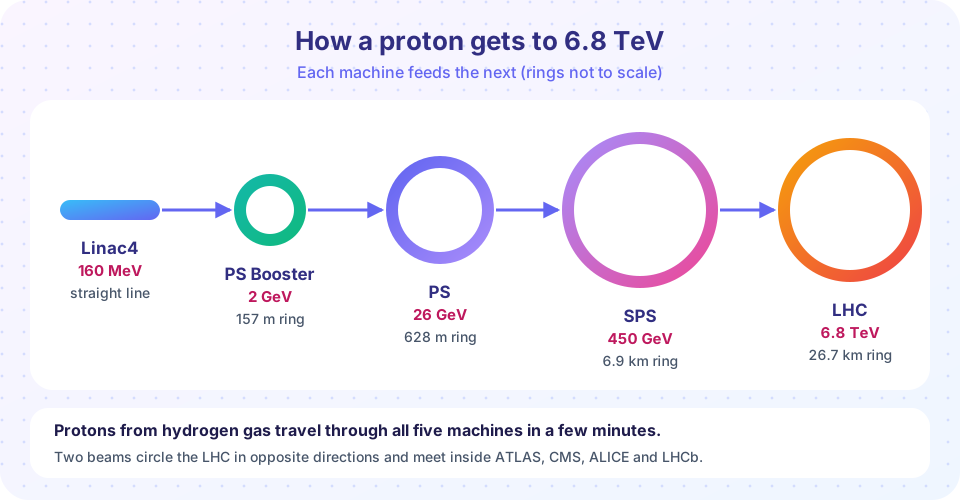
√s = 2E; in a fixed-target experiment√s ≈ √(2mc²E). - Accelerators grew from table-top devices to the 26.7 km LHC; the CERN chain boosts protons stage by stage.
- Detectors combine tracker, calorimeters, muon system and missing-energy inference to identify particles.
- A trigger picks out the rare interesting events from 40 million crossings per second.
Next: How Accelerators Work
Track your progress
Create a free account to tick off lessons and pick up where you left off on any device.
of Nuclear and Particle Physics lessons completed