


















Lesson 38 of 51 · Accelerators and Detectors
How Detectors Work
How a collider detector measures momentum, energy and identity: trackers, calorimeters, muon systems, Cherenkov light, invariant mass and the 5-sigma rule.
A particle detector is a camera that does not take pictures of particles, because particles cannot be seen. Instead it records tiny signals when particles pass through matter: a few electrons knocked out of atoms, a flash of light, a pulse of heat. From millions of such signals, software reconstructs what happened in the collision a billionth of a second earlier.
What you will learn
- How trackers and magnetic fields give momentum and charge.
- How calorimeters measure energy and why showers happen.
- How muons, photons and neutrinos are recognised.
- How Cherenkov light and energy loss identify particle types.
- How invariant mass and statistics turn events into discoveries.
Key terms
Ionization: the knocking of electrons out of atoms by a passing charged particle; the basis of tracking.
Transverse momentum p_T: the momentum component perpendicular to the beam.
Shower: a cascade of secondary particles created as a high-energy particle hits dense matter.
Invariant mass: the mass calculated from the energies and momenta of decay products; it peaks at the mass of the parent particle.
Significance (in sigma): how many standard deviations a signal stands above the background expectation.
Tracking: momentum from curvature
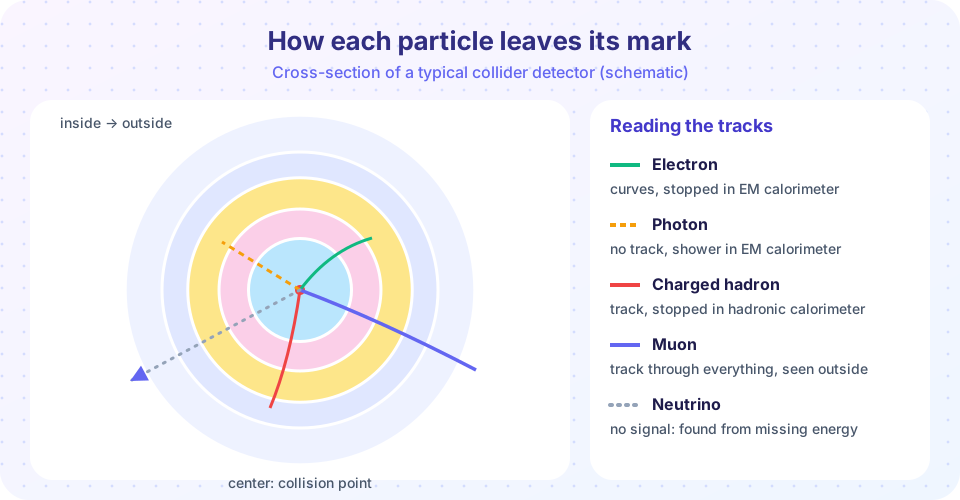
A charged particle passing through thin layers of silicon sensors ionizes a few atoms in each. Each ionization is read out as a "hit," and many hits along the path form a track with almost no disturbance. A solenoid magnet surrounds the tracker. In a field B the track curves with radius r, so
p_T [GeV/c] = 0.2998 × B [T] × r [m]
The direction of the curve gives the sign of the charge. In the CMS detector B = 3.8 T, so a track of p_T = 1 GeV/c has r ≈ 0.88 m; a 100 GeV track has r ≈ 88 m and is nearly straight. Over a tracker of length L, the track sags by a sagitta s ≈ 0.3 B L² / (8 p_T). High-momentum tracks bend very little, so measuring their momentum precisely needs strong fields, large radius and precise sensors (micrometres).
Calorimeters: energy by absorption
A calorimeter is made of dense material that stops particles and measures the energy they deposit.
- Electromagnetic calorimeter (ECAL): an electron or photon entering a dense material (lead, or lead tungstate crystals) creates a shower: electrons radiate photons, photons make electron-positron pairs, and so on. The number of particles multiplies and the total light is proportional to the incoming energy. A typical resolution is
σ/E ≈ 3% / √Eplus small constant terms, so a 100 GeV electron is measured to roughly 0.5%. - Hadronic calorimeter (HCAL): hadrons interact with nuclei (iron or steel with scintillator layers). Hadronic showers are broader and less precisely measured, with resolution around
100% / √E.
Photons give no track but they do deposit energy in the ECAL, so a missing track plus an ECAL cluster means a photon.
Muons and neutrinos
A muon is about 200 times heavier than an electron, so it radiates little and passes through all the calorimeters with just a small energy loss. Muon chambers on the outside see it, and the track is reconstructed through the whole detector.
A neutrino only interacts weakly and passes through the entire detector. The sum of the transverse momenta of all visible particles should be zero, since the beams carry none. If it is not, the imbalance, called missing transverse momentum, points to invisible particles. Dark matter candidates would also show up this way.
Particle identification
Tracks and energy alone cannot tell a pion from a kaon or a proton. Extra information helps:
- Energy loss
dE/dx: the ionization per unit length depends on velocity, so at a known momentum it depends on mass. - Time of flight: at the same momentum, a heavy particle is slower.
- Cherenkov radiation: a particle moving faster than light in a medium (
β > 1/n) emits a cone of light at an anglecos θ = 1/(nβ). Rings of this light identify particles. Neutrino experiments such as Super-Kamiokande use huge tanks of water lined with light sensors this way.
Invariant mass and discovery
Most particles of interest decay before reaching the detector, so we look for their decay products. For a particle that decays into two particles with energies E₁, E₂ and momenta p₁, p₂:
m² c⁴ = (E₁ + E₂)² − |p₁c + p₂c|²
For two photons with opening angle θ: m c² = √(2 E₁ E₂ (1 − cos θ)). If we compute m for every pair in a million events, the pairs that really came from one parent all give the same value and make a peak on top of a smooth background of random pairings. That is how the π⁰ (135 MeV), the Z (91 GeV) and the Higgs boson (125 GeV) were found.
How sure is a peak? Suppose B background events are expected in the peak region and S extra events are seen. A rough measure is the significance S/√B standard deviations. Particle physics calls a result a discovery when it exceeds 5σ, a one-sided probability of about 3×10⁻⁷ that the background alone fluctuated up that far. The strict standard exists because there are many places to look.
Data volumes
The LHC detectors see 40 million bunch crossings per second. A hardware Level-1 trigger takes about 4 microseconds to decide, reducing the rate to about 100,000 per second; a software trigger then reduces it to around a thousand events per second, which are stored. Even so, each experiment records many petabytes per year, analyzed worldwide on a computing grid.
Common misconceptions
"Detectors can see a single quark." They see jets of hadrons. Quarks are never seen on their own.
"If there is no track, nothing was there." Photons and neutral hadrons leave no track; the calorimeter sees them.
"5σ means we are 99.99997% sure the particle exists." It is the probability that background alone fakes a signal this large; it does not give the probability that a theory is true.
Try it
Press Run (or Ctrl + Enter) to see the result here.
Program input · what you'd type while the program runs
Type the answers before you press Run, one per line. Each time the program reads a line (with input()), it gets the next line from this box.
Press Run (or Ctrl + Enter) to see the console output here.
No output.
Check your understanding
Quick check · 5 questions
of 5 answered You scored / 5 · perfect!
-
1. A track curves with radius 0.88 m in a 3.8 T field. About what is its transverse momentum?
p_T = 0.2998 × 3.8 × 0.88 ≈ 1.0 GeV/c. -
2. Which particle passes through the calorimeters and is seen in the outer muon chambers?
Muons radiate little and interact weakly with the dense material, so they traverse the whole detector. -
3. How do collider experiments infer that a neutrino was produced?
Visible momenta that do not balance indicate invisible particles. -
4. What does an invariant mass peak indicate?
Combinations that really came from one parent all give its mass; random combinations spread out smoothly. -
5. What significance is conventionally needed to claim a discovery in particle physics?
5σ corresponds to a background fluctuation probability of about 3×10⁻⁷.
Summary
- Trackers measure momentum from curvature in a magnetic field:
p_T = 0.2998 B r; the bending direction gives the charge sign. - Calorimeters stop particles and measure energy from showers; ECAL for electrons and photons, HCAL for hadrons.
- Muons pass through everything; neutrinos are inferred from missing transverse momentum.
- Cherenkov light, time of flight and
dE/dxidentify particle types. - Invariant-mass peaks reveal parent particles; discoveries require 5σ.
Track your progress
Create a free account to tick off lessons and pick up where you left off on any device.
of Nuclear and Particle Physics lessons completed