


















Lesson 8 of 51 · Nuclear Structure
Binding Energy and the Mass Defect
Calculate nuclear binding energy from the mass defect, read the binding energy per nucleon curve and see why fusion and fission both release energy.
Weigh a helium-4 nucleus and then weigh its two protons and two neutrons separately. The separate pieces are heavier. The missing mass is not lost: it was carried away as energy when the pieces came together, and you would have to put exactly that energy back to pull them apart. This is binding energy, the single most important number about a nucleus, and one graph of it explains why stars shine, why reactors work and why iron is the end of the line for stellar fusion.
What you will learn
- Compute the mass defect and binding energy of a nucleus from atomic masses.
- Interpret the binding energy per nucleon curve and locate its maximum.
- Explain why fusion of light nuclei and fission of heavy nuclei both release energy.
- Explain why helium-4 is unusually tightly bound for its size.
Key terms
Mass defect Δm: the difference between the mass of the separated nucleons and the mass of the nucleus.
Binding energy B: B = Δm c², the energy needed to separate a nucleus completely into free nucleons.
Binding energy per nucleon B/A: a measure of how tightly each nucleon is held on average.
Separation energy: the energy to remove one particular nucleon (or an alpha particle) from a nucleus.
The mass defect
Nuclear masses are not additive. The deuteron, the nucleus of heavy hydrogen, has a mass of 1875.613 MeV/c², but a free proton (938.272) plus a free neutron (939.565) adds to 1877.837. The difference is 2.224 MeV/c². Einstein's E = mc² says that mass difference is the binding energy: 2.224 MeV is the energy released when a proton captures a neutron, and the energy of the gamma ray you would need to split a deuteron.
In practice you use atomic masses (nucleus plus electrons), which tables list to high precision in atomic mass units. If you subtract atomic masses using hydrogen-1 atoms for the protons, the electron masses cancel, to a very good approximation:
B = [ Z M(¹H) + N m_n − M(ᴬX) ] × 931.494 MeV/u
Worked example 1: helium-4
M(¹H) = 1.007825 u, m_n = 1.008665 u, M(⁴He) = 4.002603 u.
- Separate parts: 2 × 1.007825 + 2 × 1.008665 = 4.032980 u.
- Mass defect: 4.032980 − 4.002603 = 0.030377 u.
- Binding energy: 0.030377 × 931.494 = 28.30 MeV.
- Per nucleon: 28.30 / 4 = 7.07 MeV.
Helium-4 is a doubly magic nucleus, and it is much more tightly bound than its neighbours. Removing a single neutron from it costs 20.6 MeV, almost three times the average, which is why alpha particles are such stable bundles and why they are ejected as units in radioactivity.
Worked example 2: iron-56
M(⁵⁶Fe) = 55.934936 u. Parts: 26 × 1.007825 + 30 × 1.008665 = 56.463400 u. Δm = 0.528462 u, so B = 492.3 MeV and B/A = 8.790 MeV. That is more than you get from nearly any other nucleus.
The binding energy curve
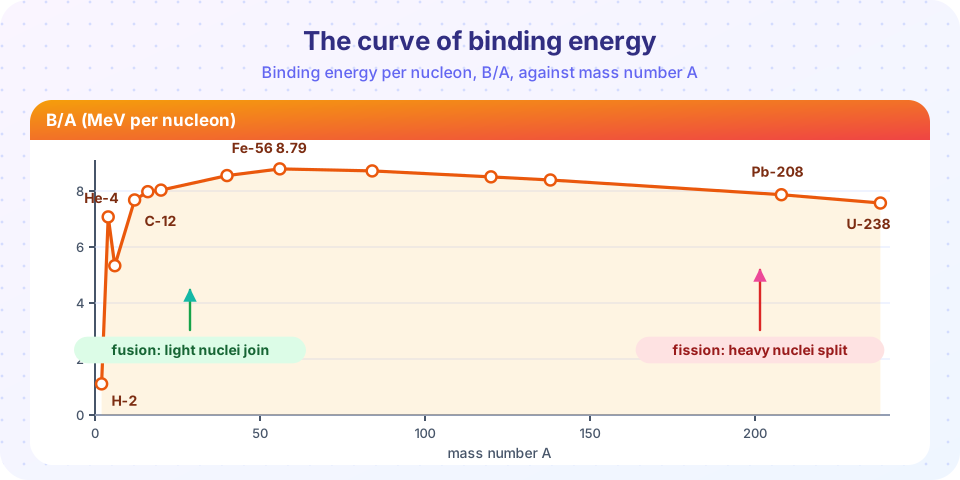
Plot B/A against A for all stable nuclei and you get the curve in the figure. Its features:
- It rises very fast for the lightest nuclei (deuteron 1.11 MeV, helium-4 7.07 MeV). Very light nuclei have few neighbours, so each nucleon is poorly bound.
- Helium-4, carbon-12 (7.68) and oxygen-16 (7.98) show bumps above the trend: they are "alpha-like" and compact.
- A broad maximum between A ≈ 50 and 70. The highest value is nickel-62 at 8.795 MeV, iron-58 at 8.792 and iron-56 at 8.790.
- A gentle decline beyond: tin-120 has 8.51, lead-208 has 7.87 and uranium-238 has 7.57. Heavy nuclei have more Coulomb repulsion that does not cancel.
Energy is released whenever nucleons move to a higher point on the curve. Fusion of light nuclei climbs the steep left slope: fusing four protons into helium-4 gains about 7 MeV per nucleon at the end. Fission of a heavy nucleus into two medium ones climbs the gentle right slope: splitting uranium-236* into two fragments near A = 118 gains about 8.5 − 7.6 ≈ 0.9 MeV per nucleon, or about 200 MeV in total. Fusion releases more energy per nucleon but is harder to start.
Compare with chemistry: burning carbon releases about 4 eV per carbon atom, whereas a nuclear reaction typically releases millions of eV per nucleus. That factor of about a million is why one kilogram of uranium fuel does the work of thousands of tonnes of coal.
Iron, nickel and the end of stellar fusion
Iron-56 is often called the most stable nucleus. That is slightly misleading. Nickel-62 has the highest binding energy per nucleon, and iron-56 has the lowest mass per nucleon because of the way the proton-neutron mass difference enters. In stellar interiors the details of nuclear reactions favour iron-group nuclei as the end products, and fusion stops releasing net energy there. Elements beyond iron are made mostly in other ways, such as neutron capture during supernovae and neutron-star collisions (chapter 8).
Common misconceptions
"Binding energy is the energy stored inside the nucleus, ready to be released." It is the energy you must supply to take the nucleus apart. A reaction releases the difference between the binding energies before and after.
"Fusion releases energy because mass becomes energy, and fission is different." Both follow the same curve: the product nuclei are more tightly bound per nucleon, so mass is lower and energy is released.
"Higher binding energy per nucleon means a heavier nucleus." Binding energy per nucleon is a measure of stability, not of mass.
Try it
First, compute the binding energy of nuclides from atomic masses. The code matches the values quoted in this lesson.
Press Run (or Ctrl + Enter) to see the result here.
Program input · what you'd type while the program runs
Type the answers before you press Run, one per line. Each time the program reads a line (with input()), it gets the next line from this box.
Second, plot the whole curve from those masses and mark where fusion and fission climb.
Press Run (or Ctrl + Enter) to see the result here.
Program input · what you'd type while the program runs
Type the answers before you press Run, one per line. Each time the program reads a line (with input()), it gets the next line from this box.
Check your understanding
Quick check · 5 questions
of 5 answered You scored / 5 · perfect!
-
1. The deuteron's mass is 2.224 MeV/c² less than a free proton plus neutron. What does 2.224 MeV represent?
The mass defect times c² is the binding energy, the energy needed to separate the nucleus into free nucleons. -
2. Which nucleus has the highest binding energy per nucleon?
Nickel-62 has the highest B/A at about 8.795 MeV, narrowly ahead of iron-58 and iron-56. -
3. Why does fission of a heavy nucleus release energy?
Medium-mass fragments have a higher B/A than uranium, so total mass decreases and the difference is released. -
4. A reaction has a total mass defect (initial minus final mass) of 0.0188 u. How much energy is released?
0.0188 × 931.494 ≈ 17.5 MeV (this is close to the D-T fusion reaction). -
5. Why does helium-4 stand out above the trend of light nuclei?
Both its proton and neutron shells are full (Z = N = 2), which makes it unusually tightly bound.
Summary
- Binding energy B = Δm c² with Δm computed from atomic masses; 1 u corresponds to 931.494 MeV.
- B/A rises from 1.1 MeV (deuterium) to 8.8 MeV (Fe/Ni region) and slowly falls to 7.6 MeV (uranium).
- Moving toward the peak from either side releases energy: fusion from the left, fission from the right.
- Nickel-62 has the highest B/A; iron-56 has the lowest mass per nucleon.
Track your progress
Create a free account to tick off lessons and pick up where you left off on any device.
of Nuclear and Particle Physics lessons completed