


















Lesson 44 of 51 · Cosmic Frontiers
Cosmic Rays and Antimatter
Where cosmic rays come from, how air showers work, what the knee, ankle and GZK cutoff mean, and how positrons, antiprotons and antihydrogen are studied.
Every second, a handful of particles from outer space strike each square meter of the top of the atmosphere, a few with more energy than any accelerator could ever deliver. They were found over a century ago by a man in a balloon and gave us the positron, the muon and the pion before accelerators could make them. Cosmic rays are still the highest-energy particles known, and their sources are still debated.
What you will learn
- What cosmic rays are made of and how they were discovered.
- How cosmic rays are accelerated and why the spectrum has a knee and an ankle.
- What an air shower is, and why muons reach the ground.
- Why very high-energy protons are slowed by the CMB (the GZK effect).
- How antimatter is found, made and studied, and why there is so little of it.
Key terms
Primary cosmic ray: a particle from space (mostly protons and nuclei) before it hits the atmosphere.
Air shower: the cascade of secondary particles created when a primary collides with air nuclei.
Larmor radius: the radius of a charged particle's circular path in a magnetic field, r = E / (Z e c B) at high energy.
Fermi acceleration: gain of energy by repeated crossing of a shock wave.
GZK cutoff: the suppression above about 5×10¹⁹ eV from collisions of protons with CMB photons.
A short history
In 1912 Victor Hess made balloon flights up to 5 km and found that an electroscope discharged faster at height, so the ionizing radiation came from above, not from the Earth. He shared the 1936 Nobel Prize with Carl Anderson, who in 1932 saw a track curving the wrong way in a cloud chamber: the positron, the first antiparticle detected. Cosmic rays also revealed the muon (1936) and the pion (1947).
What they are and how fast they go
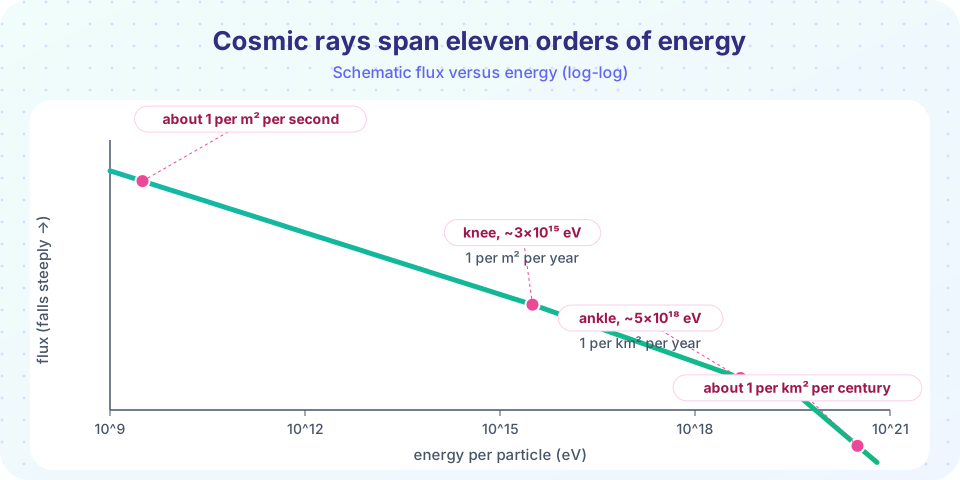
About 89% of primary cosmic rays are protons, about 10% helium nuclei, about 1% heavier nuclei, and a small share electrons. Their energies span over eleven decades, from about 10⁹ eV to above 10²⁰ eV. The highest-energy event ever recorded, the "Oh-My-God particle" seen by the Fly's Eye detector in Utah in 1991, had 3.2×10²⁰ eV, about 51 joules: the kinetic energy of a baseball thrown at around 27 m/s, packed into one subatomic particle. The LHC's protons reach 7×10¹² eV, about thirty million times less.
The flux falls rapidly, roughly as E^(−2.7):
- about one particle per square metre per second near 1 GeV,
- about one per square metre per year near the knee (
3×10¹⁵ eV), where the spectrum steepens, - about one per square kilometre per year near the ankle (
5×10¹⁸ eV), where it flattens, - about one per square kilometre per century above
10²⁰ eV.
Rare events need huge detectors: the Pierre Auger Observatory in Argentina covers 3,000 km² with water tanks and telescopes.
Where do they come from?
Charged cosmic rays are bent by magnetic fields, so their directions do not point back at their sources. The Larmor radius gives a clue. In the galactic field of about 3 µG, a proton of 10¹⁵ eV has r ≈ 0.4 pc, tiny compared with the Galaxy, so it is trapped. A proton of 10¹⁹ eV has r ≈ 3.6 kpc, comparable to the Galaxy's thickness, so it cannot be held in.
- Up to about the knee, cosmic rays are believed to come from supernova remnants, where diffusive shock acceleration (a form of Fermi acceleration) gives particles energy as they bounce back and forth across the expanding blast wave. Gamma rays from such remnants support this.
- Above the ankle, the particles are likely extragalactic, from active galactic nuclei, starburst galaxies or gamma-ray bursts, though the sources are not settled. The Auger observatory reported in 2017 that the arrival directions of particles above
8×10¹⁸ eVhave a dipole anisotropy that points outside the Galaxy.
The GZK cutoff
Space is filled with CMB photons. A proton of very high energy sees them head-on as gamma rays, and above a threshold it can produce a pion: p + γ_CMB → p + π⁰. The threshold energy for a photon of energy ε is
E_th = m_π (m_π + 2 m_p) c⁴ / (4 ε)
With a typical CMB photon (ε ≈ 6×10⁻⁴ eV) this is around 10²⁰ eV; the energetic tail of the photon distribution lowers the effective cutoff to about 5×10¹⁹ eV. Protons above it lose energy quickly and cannot come from farther than about 50 Mpc. Greisen, Zatsepin and Kuzmin predicted this in 1966. Auger and others do see a suppression near that energy, though part may be the sources running out of power.
Air showers
When a primary cosmic ray hits an air nucleus, about 15 km up, the collision makes a spray of pions and other hadrons. Neutral pions decay into photons that make electromagnetic cascades; charged pions decay into muons and neutrinos. At sea level most of the particles that reach you are muons, about one per square centimetre per minute, which is why a muon passes through your hand about every second. Their long lifetime reaches the ground only through relativistic time dilation (see the lesson on decays).
Antimatter
Antiparticles are a small part of the cosmic rays: positrons are roughly 5 to 15% of the electron-plus-positron flux at tens of GeV, and antiprotons only about one in ten thousand of the protons.
- Positrons: the PAMELA satellite (2008) and the Alpha Magnetic Spectrometer (AMS-02) on the International Space Station measured a rise in the positron fraction above 10 GeV. It could come from nearby pulsars or from dark matter annihilation; pulsars are the leading explanation.
- Antiprotons: measured at a level consistent with production by cosmic rays hitting interstellar gas.
- Antihelium: none confirmed. A single antihelium nucleus would be strong evidence for antimatter made in the early universe or in exotic sources.
In the laboratory, antihydrogen atoms have been produced and held in magnetic traps at CERN since 2010 by the ALPHA collaboration, and in 2023 ALPHA-g observed that antihydrogen atoms fall downward in Earth's gravity, as normal matter does. Positron emission tomography (PET) scanners use positron-emitting isotopes every day in hospitals.
Why so little antimatter in the universe? That is the puzzle from the first lesson of this chapter: the Standard Model has too little CP violation to explain it.
Common misconceptions
"Cosmic rays are rays like light or X-rays." Most are particles, mostly protons and nuclei. The name is historical.
"A very energetic cosmic ray would hurt like a bullet." It deposits energy in a single atmospheric shower; at the ground you see only a fraction of the secondary particles, and the dose from cosmic rays is a small part of natural background radiation (though aircraft crews get a few mSv per year).
"Antimatter is rare because it is hard to make." It is rare in the universe because matter won the early annihilation. Making a few atoms in the lab is feasible, but the total amount produced at CERN is only nanograms.
Try it
Press Run (or Ctrl + Enter) to see the result here.
Program input · what you'd type while the program runs
Type the answers before you press Run, one per line. Each time the program reads a line (with input()), it gets the next line from this box.
Press Run (or Ctrl + Enter) to see the console output here.
No output.
Check your understanding
Quick check · 5 questions
of 5 answered You scored / 5 · perfect!
-
1. Who discovered cosmic rays and how?
Hess showed ionization increases with altitude, so the radiation comes from space. -
2. What is the most common type of primary cosmic ray?
About 89% are protons. -
3. What is the GZK cutoff?
Above about 5×10¹⁹ eV, protons lose energy to p + γ → p + π⁰, limiting the distance they can travel. -
4. Why are cosmic rays above about 10¹⁸ to 10¹⁹ eV thought to be extragalactic?
r_L = E/(Z e c B) is several kiloparsecs at 10¹⁹ eV in a 3 µG field. -
5. What did the 2023 ALPHA-g experiment show?
The antihydrogen atoms released from a trap fell downward, consistent with gravity acting like on normal matter.
Summary
- Cosmic rays (89% protons) were discovered by Hess in 1912 and led to the positron, muon and pion.
- The spectrum follows a power law
E^(−2.7)with a knee (3×10¹⁵ eV) and ankle (5×10¹⁸ eV); the highest energy seen is about 3×10²⁰ eV. - Supernova remnants likely accelerate Galactic cosmic rays; the highest-energy ones are extragalactic; the GZK effect cuts off protons above about 5×10¹⁹ eV.
- Air showers deliver muons to the ground, about one per cm² per minute.
- Antimatter (positrons, antiprotons) is seen in cosmic rays; antihydrogen is made and trapped at CERN; why matter dominates the universe is open.
Track your progress
Create a free account to tick off lessons and pick up where you left off on any device.
of Nuclear and Particle Physics lessons completed