


















Lesson 46 of 51 · Projects and Practice
Project: A Reactor Kinetics Simulator
Build a reactor point-kinetics model with temperature feedback and decay heat in Python, step by step, and explore why reactors with negative feedback are self-limiting.
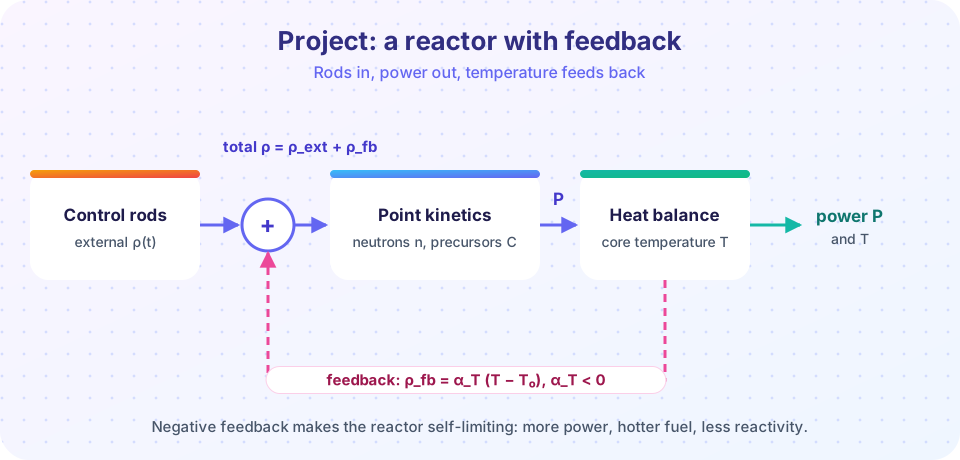
In this project you will build a small but realistic model of how reactor power responds to a change in reactivity. You will start from the point-kinetics equations from the lesson on reactors, add a heat balance and a temperature feedback, and then simulate a control-rod step, a shutdown with decay heat, and a comparison of feedback strengths. It is a teaching model, not a plant safety code, but it shows the same behavior that real reactors are designed around.
What you will learn
- How to turn the point-kinetics equations into a runnable simulation with a stiff ODE solver.
- How to add a lumped heat balance and temperature feedback.
- How decay heat is modeled after a shutdown.
- How the strength of the feedback coefficient shapes the response.
- How to check a model against simple analytic limits.
Key terms
Point kinetics: reactor physics model that treats the whole core as one point with a single neutron population n(t).
Precursors C(t): fission products whose later decay emits delayed neutrons.
Temperature coefficient α_T: change of reactivity per kelvin; negative in well-designed reactors.
Scram: rapid shutdown by inserting all control rods.
Way-Wigner formula: a standard approximation for decay-heat power after shutdown.
The model
We track three variables: the relative power n (1 means full power), the precursor concentration C, and the core temperature T.
dn/dt = ((ρ − β)/Λ) n + λ C
dC/dt = (β/Λ) n − λ C
C_th dT/dt = P₀ n − h (T − T_cool)
ρ = ρ_ext + α_T (T − T₀)
with β = 0.0065, generation time Λ = 10⁻⁴ s, one effective precursor group with λ = 0.08 s⁻¹. The heat balance has full power P₀, a heat-removal coefficient h and a heat capacity C_th. We choose h so that full power raises the core 500 K above the coolant, and a thermal time constant C_th/h = 10 s. The feedback coefficient is α_T = −2.5×10⁻⁵ K⁻¹, that is, −2.5 pcm per kelvin.
Analytic check. After a small step ρ_ext, the feedback must eventually cancel it: α_T ΔT = −ρ_ext, so ΔT = ρ_ext/|α_T| and the new relative power is n = 1 + ΔT/500. For ρ_ext = 0.003 that gives ΔT = 120 K and n = 1.24. Your simulation should converge to these.
Step 1: a reactivity step with feedback
Press Run (or Ctrl + Enter) to see the result here.
Program input · what you'd type while the program runs
Type the answers before you press Run, one per line. Each time the program reads a line (with input()), it gets the next line from this box.
Step 2: scram and decay heat
After all control rods are inserted (a large negative reactivity, say −5%), the fission power drops to about a tenth almost at once (the prompt drop, by a factor near β/(β − ρ)) and then falls over tens of seconds as the delayed neutrons die away. But decay heat from fission products remains. The Way-Wigner formula gives it as a fraction of the pre-shutdown power, for an operating time T_op:
P_decay / P₀ = 0.066 [ t⁻⁰·² − (t + T_op)⁻⁰·² ] (t in seconds)
Press Run (or Ctrl + Enter) to see the result here.
Program input · what you'd type while the program runs
Type the answers before you press Run, one per line. Each time the program reads a line (with input()), it gets the next line from this box.
Step 3: how strong must the feedback be?
Repeat the step test for several feedback coefficients, and also for a reactivity above β (prompt critical) to see how much the feedback strength limits the peak. For the prompt-critical case we cut the run short, since the model is a simplification (it ignores fuel melting, the delay of the Doppler effect and many other things).
Press Run (or Ctrl + Enter) to see the result here.
Program input · what you'd type while the program runs
Type the answers before you press Run, one per line. Each time the program reads a line (with input()), it gets the next line from this box.
Questions to explore
- How does the response change if the thermal time constant is 2 s instead of 10 s (a fast-responding fuel)?
- What happens to the final power if the heat-removal capacity
hdrops by 10% during the step? - Try a positive feedback coefficient (
α_T > 0): can you see the thermal runaway? Why would a real design avoid it? - Add a second delayed-neutron group (for example
β₂ = 0.0013, λ₂ = 3 s⁻¹) and compare.
Common misconceptions
"If the model has feedback, a reactor cannot go wrong." Feedback limits power only if the coolant, heat removal and design stay within their assumed conditions. A model with one temperature is a simplification.
"A step reactivity above β is always catastrophic." Above β the reactor is prompt critical and the response is very fast, but how large the excursion becomes depends on feedback, geometry and shutdown systems. That is exactly why designs never allow it.
"A simulation proves a design is safe." Safety analysis uses validated, detailed codes and experiments. This project is for understanding.
Check your understanding
Quick check · 5 questions
of 5 answered You scored / 5 · perfect!
-
1. In the model, why does the power settle at a new steady level after a reactivity step?
α_T ΔT = −ρ_ext at the new equilibrium, so the net reactivity returns to zero. -
2. Which value of α_T gives the smallest final temperature change for the same reactivity step?
ΔT = ρ_ext/|α_T|, so the strongest feedback needs the smallest temperature rise. -
3. One hour after shutdown from long operation, the decay heat is about...
The Way-Wigner formula gives roughly 1% at one hour. -
4. Why does the model use a stiff solver (Radau)?
Time scales of 10⁻⁴ s and 10 s together make the equations stiff. -
5. A reactivity above β means the reactor is...
The chain reaction no longer needs delayed neutrons.
Summary
- Point kinetics plus a heat balance and a temperature coefficient gives a compact reactor model.
- With negative feedback the power settles where
α_T ΔT = −ρ_ext. - After a scram, fission power falls quickly but decay heat (about 6% at once, about 1% after an hour) needs cooling.
- Stronger negative feedback means a smaller power and temperature change for the same disturbance.
- Models are for understanding; real safety work uses validated codes and experiments.
Track your progress
Create a free account to tick off lessons and pick up where you left off on any device.
of Nuclear and Particle Physics lessons completed