


















Lesson 29 of 51 · Fission and Fusion
Fusion Power and the Lawson Criterion
What it takes to make net energy from fusion on Earth: D-T fuel, the triple product, magnetic and inertial confinement, and where ITER, JET and NIF stand.
A star holds its fuel with gravity. On Earth we have to do it by other means. A fusion power plant must heat a gas to over a hundred million degrees, keep it from touching the walls, and hold it long enough that the fusion energy exceeds what was used to heat and confine it. That requirement was written down by John Lawson in 1955 and is still the central yardstick of the field.
What you will learn
- Why deuterium-tritium is the first-generation fuel.
- What a plasma is and why temperatures are quoted in keV.
- How to derive the Lawson triple-product condition for ignition.
- How magnetic and inertial confinement differ.
- What the major experiments have achieved so far.
Key terms
Plasma: a gas hot enough that its atoms are ionised into free electrons and nuclei.
Reactivity ⟨σv⟩: the fusion rate per pair of nuclei per unit density, averaged over the thermal speed distribution.
Energy confinement time τ_E: how long the plasma energy would last if the heating were turned off.
Ignition: when the heating by fusion products alone sustains the plasma temperature.
Gain Q: fusion power divided by the external heating power.
Choosing a fuel
Among the possible reactions, deuterium plus tritium has by far the largest reactivity at the lowest temperature:
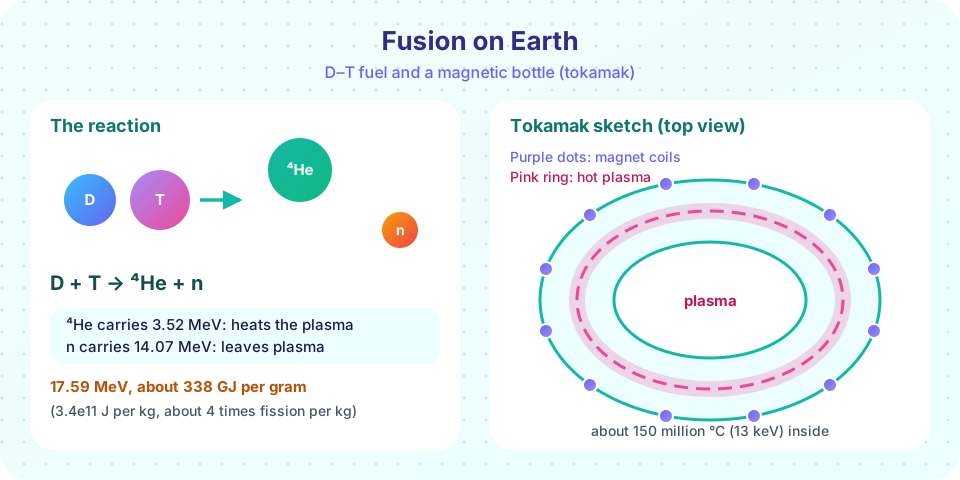
D + T → ⁴He (3.52 MeV) + n (14.07 MeV) Q = 17.59 MeV
Deuterium is abundant: about 1 in 6,400 hydrogen atoms in seawater is deuterium. Tritium is radioactive (half-life 12.3 years) and does not occur in nature in useful amounts, so a power plant would breed it in a lithium blanket around the plasma using the fusion neutrons:
n + ⁶Li → ⁴He + T + 4.8 MeV
The 14 MeV neutrons carry about 80% of the energy. They escape the magnetic field, heat the blanket (the useful part) and also damage and activate the structure over time. Other fuels, such as D–D and p–¹¹B, need much higher temperatures.
Temperatures in keV
Plasma physicists quote temperature as kT in keV. The conversion is 1 keV ↔ 11.6 million kelvin. The D–T reactivity is best near T ≈ 14 keV and a power plant would run at 10 to 20 keV (115 to 230 million kelvin), many times the temperature of the Sun's core. Because the density is far lower than in the Sun (a thousandth to a millionth of the density of air), fast particles are needed to get a useful rate.
The Lawson criterion
Consider a plasma with ion and electron densities n and temperature T (in keV). The fusion power density is
P_fus = (n/2)² ⟨σv⟩ E_fus (n/2 deuterium and n/2 tritium, E_fus = 17.59 MeV)
Of this, only the helium nucleus (E_α = 3.52 MeV) stays in the plasma. The loss rate is the plasma's thermal energy density, 3nT for ions plus electrons, divided by the confinement time:
P_loss = 3 n T / τ_E
Ignition means the alpha heating equals the loss:
(n²/4) ⟨σv⟩ E_α = 3 n T / τ_E ⟹ n τ_E ≥ 12 T / (⟨σv⟩ E_α)
Near 10 to 20 keV the D–T reactivity is approximately ⟨σv⟩ ≈ 1.1×10⁻²⁴ T² m³/s (T in keV). Substitute that and the temperature cancels:
n T τ_E ≥ 12 / (1.1×10⁻²⁴ × 3500 keV) ≈ 3×10²¹ keV · s / m³
This is the triple product condition for ignition in D–T. It collects three things that matter: density, temperature and confinement time.
Two routes to the triple product
Different designs reach the same product with very different parameters:
- Magnetic confinement (tokamaks and stellarators): a low-density plasma (
n ≈ 10²⁰ m⁻³) is held for seconds (τ_Eseveral seconds) by strong magnetic fields. Charged particles spiral around field lines and do not touch the walls. - Inertial confinement: a pellet is compressed to enormous density (a hundred times the density of lead) for a very short time,
≈ 10⁻¹⁰ s, relying on the fuel's own inertia to hold it. Lasers or X-rays drive the implosion.
A tokamak uses a toroidal field from external coils plus a poloidal field from a current driven through the plasma itself; the field lines twist helically round the doughnut. A stellarator shapes the coils so the twist needs no plasma current, which helps steady operation.
Where things stand
- JET (UK, tokamak) produced 59 megajoules of fusion energy in a roughly five-second pulse in 2023, a record, but with less energy out than the input heating.
- NIF (USA, laser) announced in December 2022 the first inertial fusion shot with target gain above 1: about 3.15 MJ of fusion energy from 2.05 MJ of laser energy hitting the target. The lasers themselves needed far more energy from the grid, so this is not yet net power.
- ITER (France, under construction by an international partnership) aims for
Q = 10: about 500 MW of fusion power from 50 MW of heating, in pulses of several minutes.
No experiment yet produces net electricity. The remaining challenges are materials that withstand neutrons, tritium breeding, and engineering that is reliable and affordable.
Common misconceptions
"Fusion produces no waste." It makes no long-lived fission products, but neutrons activate the reactor structure and tritium must be handled. Most activated material decays over decades rather than millennia.
"A fusion reactor could melt down." The plasma holds a few grams of fuel. If conditions fail it cools and stops within a second or less.
"We reached breakeven, so fusion power is here." NIF's gain refers to the target alone; the lasers use far more energy. A power plant needs engineering gain above 1 for the whole facility.
Try it
Press Run (or Ctrl + Enter) to see the result here.
Program input · what you'd type while the program runs
Type the answers before you press Run, one per line. Each time the program reads a line (with input()), it gets the next line from this box.
Press Run (or Ctrl + Enter) to see the console output here.
No output.
Check your understanding
Quick check · 5 questions
of 5 answered You scored / 5 · perfect!
-
1. Why is D–T the first fuel for fusion power?
D–T reaches useful rates near 10 to 20 keV. Tritium must be bred from lithium because it is not abundant. -
2. In the Lawson derivation, what is the energy loss rate per unit volume?
The thermal energy density of ions and electrons is 3nT, and it leaks away on the confinement time τ_E. -
3. Roughly what triple product n T τ_E does D–T ignition need?
Around 3×10²¹ keV·s/m³ near T of 14 keV. -
4. Which describes inertial confinement?
Inertial confinement compresses a small fuel capsule very quickly with lasers or X-rays, and the fuel burns before it can fly apart. -
5. What did NIF achieve in December 2022?
About 3.15 MJ of fusion energy came from 2.05 MJ of laser energy on target. The lasers needed far more electrical energy.
Summary
- D–T fusion releases 17.59 MeV (3.52 MeV in the alpha, 14.07 MeV in the neutron); tritium is bred from lithium.
- Fusion plasmas need roughly 10 to 20 keV (over 100 million kelvin).
- Ignition requires
n T τ_E ≳ 3×10²¹ keV·s/m³, the Lawson triple product. - Magnetic confinement holds a thin plasma for seconds; inertial confinement compresses fuel for about a tenth of a nanosecond.
- JET, NIF and ITER are milestones, but net electricity from fusion is still to come.
Track your progress
Create a free account to tick off lessons and pick up where you left off on any device.
of Nuclear and Particle Physics lessons completed