


















Lesson 16 of 51 · Radioactivity and Decay
Gamma Decay and Decay Chains
Learn how excited nuclei emit gamma rays, what isomers and internal conversion are, and how uranium decays in a chain with secular equilibrium and radon.
Alpha and beta decays rarely leave the daughter nucleus resting calmly in its ground state. Much more often it is born excited, like a bell that has just been struck, and it rings down by emitting one or more photons of very high energy: gamma rays. A single radioactive atom may therefore go through a whole cascade, and a heavy nucleus like uranium-238 passes through fourteen successive decays before it finally becomes stable lead. This lesson follows both stories.
What you will learn
- Explain gamma emission, nuclear energy levels, isomers and internal conversion.
- Read a decay scheme such as that of cobalt-60.
- Describe the four natural decay series and count their alpha and beta steps.
- Use the ideas of secular and transient equilibrium, and understand why radon matters.
Key terms
Gamma ray: a photon emitted by a nucleus, with energy from a few keV to several MeV.
Isomer: a long-lived excited state of a nucleus, written with an "m" (for example ⁹⁹ᵐTc).
Internal conversion: a process where the excited nucleus passes its energy to an atomic electron, which is ejected, instead of emitting a photon.
Decay series (chain): a sequence of successive decays from a long-lived parent to a stable end product.
Secular equilibrium: a state where a short-lived daughter decays as fast as it is made, so its activity equals the parent's.
Nuclei have energy levels
Just as atoms have electron energy levels, nuclei have discrete levels, with spacings of keV to MeV (a million times larger than in atoms). When a nucleus drops from level i to level f it emits a photon with energy
E_γ ≈ E_i − E_f
(minus a tiny recoil correction, below). Gamma rays have the same nature as visible light and X-rays; they are only distinguished by their origin in the nucleus and their high energy. A 1.332 MeV gamma ray has a wavelength of 2πħc/E ≈ 930 fm = 9.3 × 10⁻¹³ m.
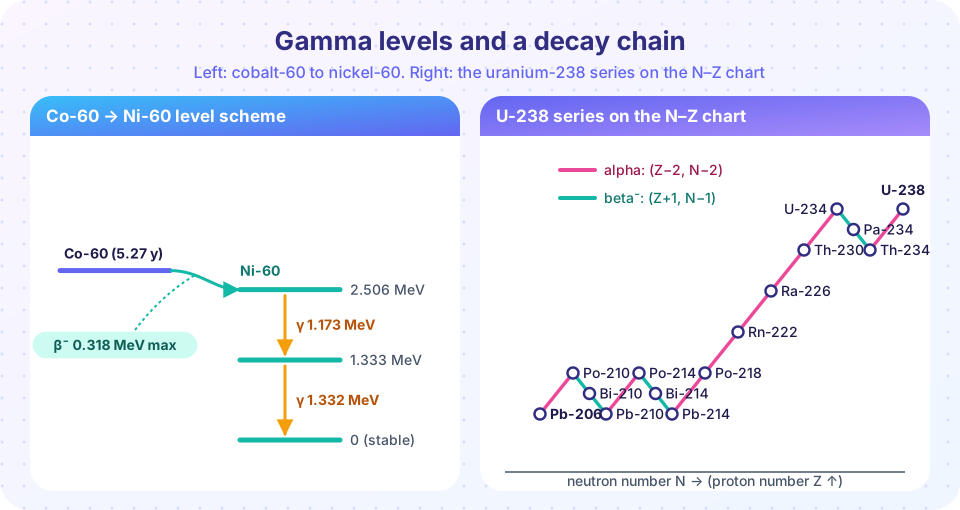
The decay scheme of cobalt-60 is a good example. Cobalt-60 (half-life 5.27 years) decays by β⁻ almost entirely to the 2.506 MeV level of nickel-60, which emits two gamma rays in quick succession: 1.173 MeV down to the 1.333 MeV level, and 1.332 MeV to the ground state. These two lines are why cobalt-60 is widely used for radiotherapy and sterilization.
Selection rules and isomers
A photon carries angular momentum, so the nucleus can only emit a gamma ray if the spins of the two levels allow it: the photon has multipolarity L (dipole L = 1, quadrupole L = 2, ...) with |J_i − J_f| ≤ L ≤ J_i + J_f, and parity changes according to the type (electric or magnetic). Transitions with large L are very slow. A nucleus trapped in a state where every allowed way down has a large change of spin is stuck: that is an isomer.
- Technetium-99m has a half-life of 6.01 hours and emits gamma rays of about 140 keV, ideal for imaging because they pass out of the body and a gamma camera can see them without delivering a high dose.
- Tantalum-180m is the extreme case. No one has ever seen it decay, and its half-life is at least a million billion years.
Internal conversion
Instead of emitting a photon, an excited nucleus can transfer its energy directly to an atomic electron (usually from the K shell), which is ejected with kinetic energy T = E_transition − B_electron. The vacancy is then filled by an outer electron, which gives off an X-ray or an Auger electron. The ratio of conversion electrons to gamma rays is the conversion coefficient; it is largest for low energy, high multipolarity and heavy nuclei.
Recoil
Momentum is conserved. When a nucleus of mass M emits a photon of energy E_γ, it recoils with a kinetic energy of E_γ²/(2Mc²). For the 1.332 MeV line of nickel-60 this is about 16 eV, tiny compared with the gamma energy but much larger than the natural width of a nuclear level (about 10⁻⁹ eV for iron-57's 14.4 keV state). The photon therefore carries slightly less than the level spacing, and a free nucleus cannot absorb its own gamma ray. Rudolf Mössbauer found in 1958 that when the nuclei are locked in a crystal, the whole crystal takes up the recoil and absorption becomes possible, an effect used to measure incredibly small energy shifts.
Decay chains
A heavy nucleus such as ²³⁸U is far from the valley of stability, and one decay does not get it there. Each alpha decay lowers A by 4 and each beta decay leaves A unchanged, so the mass number modulo 4 never changes. This gives four families, called the radioactive series:
| Series | A = | Parent | Half-life | Stable end |
|---|---|---|---|---|
| Thorium | 4n | ²³²Th | 14.0 × 10⁹ y | ²⁰⁸Pb |
| Neptunium | 4n + 1 | ²³⁷Np | 2.14 × 10⁶ y | ²⁰⁹Bi |
| Uranium | 4n + 2 | ²³⁸U | 4.47 × 10⁹ y | ²⁰⁶Pb |
| Actinium | 4n + 3 | ²³⁵U | 7.04 × 10⁸ y | ²⁰⁷Pb |
The neptunium series is extinct in nature, since ²³⁷Np's half-life is much shorter than the age of the Earth; it can only be made in reactors. The uranium series from ²³⁸U to ²⁰⁶Pb takes 8 alpha steps and 6 beta steps: the mass drops by 32 (238 − 206), and the charge falls by 16 from alpha emission, so six beta decays are needed to bring Z from 76 back up to 82. Along the way come radium-226, radon-222 and polonium-210.
Equilibrium
Consider a parent 1 with decay constant λ₁ producing a daughter 2 with λ₂. The number of daughter nuclei obeys dN₂/dt = λ₁N₁ − λ₂N₂, with the solution (Bateman)
N₂(t) = N₁(0) λ₁/(λ₂ − λ₁) × (e^(−λ₁t) − e^(−λ₂t))
Two important limits:
- Secular equilibrium (λ₁ ≪ λ₂, parent much longer-lived): after about seven daughter half-lives the daughter activity equals the parent's, A₂ = A₁, and both fall together very slowly. Radium-226 (1,600 years) and its daughter radon-222 (3.82 days) are an example; every radium sample sits next to a growing stock of radon.
- Transient equilibrium (λ₁ < λ₂ with comparable values): the daughter activity peaks and then follows the parent's with a constant ratio A₂/A₁ = λ₂/(λ₂ − λ₁), as in the technetium generator of chapter 4.
Why radon matters
Radon-222 is a noble gas, so it escapes from soil and building materials and can accumulate in basements. It is its short-lived alpha-emitting daughters (polonium-218 and -214) that cause harm: they stick to lung tissue and deliver a local dose. Health agencies treat radon as one of the leading causes of lung cancer after smoking, and measure it in becquerel per cubic metre of air. This is educational information, not advice for a particular building.
Common misconceptions
"The daughter nucleus has the same half-life as the parent." Each nuclide has its own half-life. In a chain the half-lives range from microseconds to billions of years.
"Gamma radiation comes from the electrons of the atom." It comes from the nucleus; atomic transitions give X-rays and light with much lower energy.
"A decay chain always ends in a single stable nuclide of the same element." The uranium chain ends in lead, a different element.
Try it
Secular equilibrium in action: start with pure radium-226 and watch radon-222 and polonium-218 build up.
Press Run (or Ctrl + Enter) to see the result here.
Program input · what you'd type while the program runs
Type the answers before you press Run, one per line. Each time the program reads a line (with input()), it gets the next line from this box.
Next, gamma rays and recoil. The code computes how much kinetic energy the daughter nucleus takes away and compares it with the natural linewidth of the level.
Press Run (or Ctrl + Enter) to see the result here.
Program input · what you'd type while the program runs
Type the answers before you press Run, one per line. Each time the program reads a line (with input()), it gets the next line from this box.
Finally, walk down the uranium chain yourself. Choose α or β⁻ for each step and see the nuclide change.
Check your understanding
Quick check · 5 questions
of 5 answered You scored / 5 · perfect!
-
1. A nucleus drops from a level at 2.506 MeV to one at 1.333 MeV. What is the gamma-ray energy (ignoring recoil)?
E_γ = 2.506 − 1.333 = 1.173 MeV, one of the two cobalt-60 lines. -
2. How many alpha and beta-minus decays take ²³⁸U to ²⁰⁶Pb?
A falls by 32, which is 8 alpha decays; Z falls by 16 from the alphas, so 6 beta decays are needed to end at Z = 82. -
3. What is internal conversion?
The nucleus transfers its energy directly to an orbital electron instead of emitting a photon. -
4. In secular equilibrium, how does the activity of the daughter compare with that of the parent?
When the parent lives much longer than the daughter, the daughter is produced as fast as it decays, so the activities match. -
5. A decay series member has A = 226. To which family does it belong (A = 4n, 4n+1, 4n+2 or 4n+3)?
226 = 4 × 56 + 2, so A = 4n + 2, the uranium series.
Summary
- Gamma rays are photons from nuclear transitions: E_γ ≈ E_i − E_f. Isomers are long-lived excited states.
- Internal conversion ejects an atomic electron instead of a photon.
- Heavy nuclei decay in chains. A mod 4 is conserved, giving the 4n, 4n+1, 4n+2 and 4n+3 series.
- ²³⁸U → ²⁰⁶Pb takes 8 alpha and 6 beta-minus decays.
- Secular equilibrium makes a short-lived daughter's activity equal to its long-lived parent's; radon is the biggest natural radiation source for most people.
Track your progress
Create a free account to tick off lessons and pick up where you left off on any device.
of Nuclear and Particle Physics lessons completed