


















Lesson 19 of 51 · Nuclear Reactions
Nuclear Reactions: Chapter 4 Overview
Meet nuclear reactions: the a + A → B + b notation, A(a,b)B shorthand, the main reaction types, conservation laws and the stages of a collision.
Radioactive decay waits for nature to act. A nuclear reaction is you taking the initiative: you fire a projectile at a target nucleus and see what comes out. This is how physicists first changed one element into another, discovered the neutron, made the isotopes that light up medical scans and, eventually, learned to release the energy of the nucleus. This chapter gives you the language and the tools: how to write a reaction, how to calculate the energy it releases or costs, how to describe its probability, and how reactions are used to make isotopes.
What you will learn
- Write nuclear reactions in the forms a + A → B + b and A(a, b)B.
- Name the main types of reactions and the particles used.
- List the quantities that are conserved and use them to find an unknown product.
- Describe a reaction as a sequence of approach, interaction and exit.
Key terms
Projectile (a) and target (A): the incoming particle and the nucleus it hits, usually at rest in the laboratory.
Ejectile (b) and residual nucleus (B): the light outgoing particle that is detected and the heavier nucleus that is left.
Compound nucleus: a short-lived excited nucleus formed when the projectile is absorbed, which then decays.
Q-value: the energy released (Q > 0) or required (Q < 0) in a reaction.
Cross section σ: the effective area for a reaction, measured in barns (10⁻²⁸ m²).
Writing a reaction
A nuclear reaction is written like a chemical one:
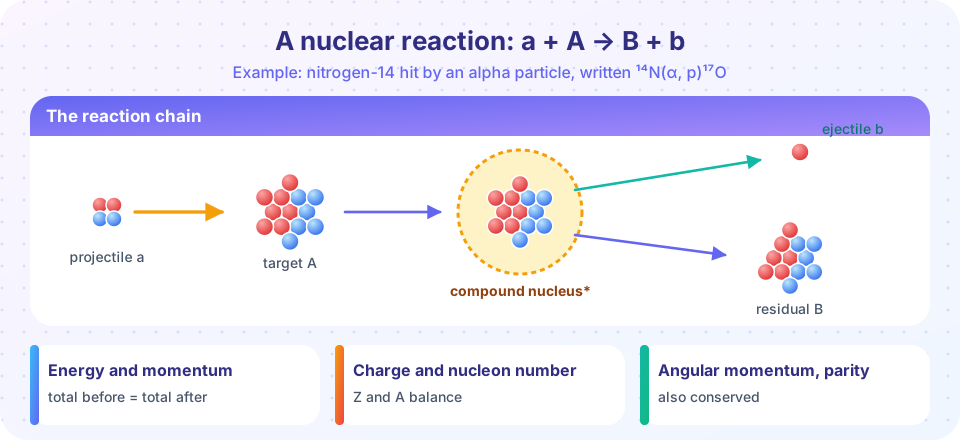
a + A → B + b
For example, ⁴He + ¹⁴N → ¹⁷O + ¹H. Nuclear physicists use a compact form A(a, b)B: target, then in parentheses the projectile and the light outgoing particle, then the residual nucleus. The same reaction becomes ¹⁴N(α, p)¹⁷O. The particles that appear most often have their own symbols:
| Symbol | Particle |
|---|---|
| n | neutron |
| p | proton (¹H nucleus) |
| d | deuteron (²H nucleus) |
| t | triton (³H nucleus) |
| α | alpha particle (⁴He nucleus) |
| γ | photon |
Types of reaction
| Type | Example | Description |
|---|---|---|
| Elastic scattering | ¹²C(n, n)¹²C | the same particles come out; only kinetic energy is exchanged |
| Inelastic scattering | ¹²C(n, n′)¹²C* | the target is left in an excited state |
| Radiative capture | ⁵⁹Co(n, γ)⁶⁰Co | the projectile is absorbed and a gamma ray is emitted |
| Transfer (stripping, pickup) | ¹²C(d, p)¹³C | one nucleon is passed from projectile to target (or the reverse) |
| Knockout | ¹²C(p, 2p)¹¹B | a fast projectile knocks out a nucleon |
| Charge exchange | ⁷Li(p, n)⁷Be | a proton becomes a neutron and vice versa |
| Photonuclear | ²H(γ, n)¹H | a gamma ray breaks up a nucleus |
| Fission | ²³⁵U(n, f) | a heavy nucleus splits (chapter 5) |
| Fusion | ²H(t, n)⁴He | two light nuclei merge (chapter 5) |
| Spallation | p + Pb | a very energetic proton shatters a heavy nucleus into many pieces and neutrons |
What is conserved
| Quantity | Rule |
|---|---|
| Energy (including rest mass) and momentum | always |
| Electric charge | always (sum of Z) |
| Nucleon (baryon) number | always (sum of A) |
| Lepton number | always (relevant for weak processes) |
| Angular momentum | always |
| Parity | in strong and electromagnetic reactions, not in weak ones |
The conservation of Z and A is enough to find an unknown product. Worked example: ²⁷Al + α → ? + n. A: 27 + 4 = 31, minus the neutron's 1 gives 30. Z: 13 + 2 = 15, minus 0 gives 15. Z = 15 is phosphorus, so the product is ³⁰P. This is the reaction in which Irène and Frédéric Joliot-Curie made the first artificial radioactive isotope in 1934.
The three stages of a collision
- Approach. A charged projectile must overcome the Coulomb repulsion of the target: for a proton on carbon the barrier is about 2 MeV, for an alpha particle on gold about 25 MeV. A neutron has no charge and feels no barrier, which is why slow neutrons can be absorbed by any nucleus.
- Interaction. The projectile may be scattered, may hand over a nucleon in a quick direct reaction (about 10⁻²² s, the time it takes to cross the nucleus), or may be absorbed to form a compound nucleus. The energy is shared among all nucleons, and the nucleus lives for a long time by nuclear standards (10⁻¹⁹ s or more).
- Exit. The excited system decays by emitting particles or gamma rays. Different exit channels may follow the same entrance channel, and the probabilities of each are what experiments measure.
Next, the chapter covers each of these in turn.
Lesson 2: Q-values and thresholds
Lesson 3: Cross sections
Lessons 4 and 5
Common misconceptions
"A nuclear reaction always releases energy." Many reactions need energy; those with Q < 0 are endothermic and only happen above a threshold.
"A projectile hits and sticks, so the target absorbs everything." Many reactions end in scattering, and in capture reactions the energy is carried off again by outgoing particles or gamma rays.
"A nuclear reaction changes the chemical element in the periodic table at random." The rules are strict: Z and A always balance.
Try it
A reaction balance checker. It parses the shorthand A(a, b)B and works out the residual nucleus by conserving Z and A.
Press Run (or Ctrl + Enter) to see the result here.
Program input · what you'd type while the program runs
Type the answers before you press Run, one per line. Each time the program reads a line (with input()), it gets the next line from this box.
Compare the Coulomb barrier for different projectiles on the same target. A charged particle needs roughly V = 1.44 Z₁Z₂/(R₁ + R₂) MeV·fm of energy, while a neutron needs none.
Press Run (or Ctrl + Enter) to see the result here.
Program input · what you'd type while the program runs
Type the answers before you press Run, one per line. Each time the program reads a line (with input()), it gets the next line from this box.
Check your understanding
Quick check · 5 questions
of 5 answered You scored / 5 · perfect!
-
1. In the notation ¹⁴N(α, p)¹⁷O, which is the target?
The target is written first, outside the parentheses: ¹⁴N. -
2. What is the residual nucleus in ⁹Be(α, n)?
A: 9 + 4 − 1 = 12; Z: 4 + 2 − 0 = 6, so ¹²C (the reaction in which Chadwick discovered the neutron). -
3. Why are neutrons especially good projectiles at low energy?
A neutron does not feel the electric repulsion of the nucleus and can approach even at very low energy. -
4. Which conserved quantity is not conserved in weak interactions?
The weak force violates parity; the other quantities are conserved. -
5. How long does a direct reaction typically take?
It is about the time a fast nucleon needs to cross the nucleus (10⁻²² s).
Summary
- A reaction is written a + A → B + b or A(a, b)B.
- Common types: scattering, capture, transfer, knockout, charge exchange, photonuclear, fission, fusion.
- Energy, momentum, Z, A, lepton number and angular momentum are conserved; use Z and A to find unknown products.
- A reaction has approach, interaction (direct or compound) and exit stages.
Next: Q-Values and Thresholds
Track your progress
Create a free account to tick off lessons and pick up where you left off on any device.
of Nuclear and Particle Physics lessons completed