


















Lesson 33 of 51 · The Standard Model
Forces, Bosons and the Higgs
How particles exchange gauge bosons, why the weak force is short-ranged, how electroweak unification works, and what the Higgs field really does.
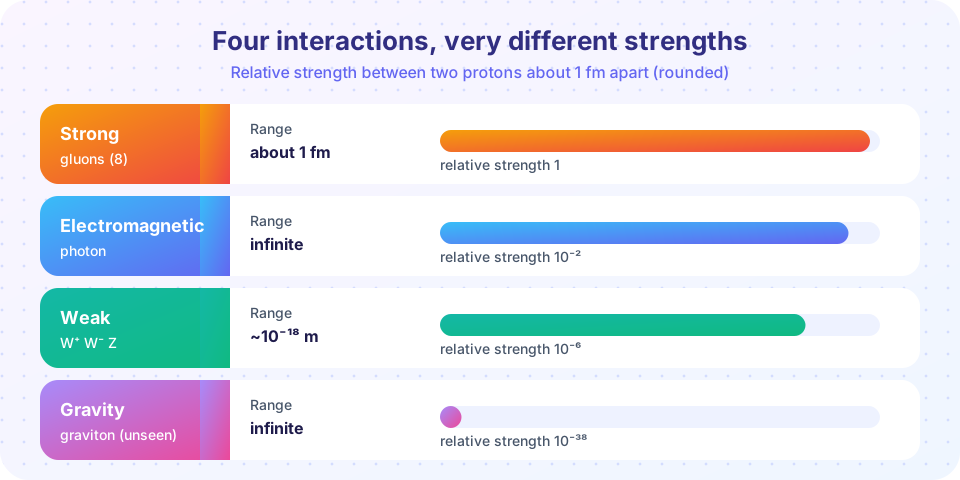
In everyday physics a force is a push or a pull. In particle physics a force is something particles exchange. Two electrons repel because they trade photons; two quarks bind because they trade gluons; a neutron changes into a proton because it emits a W boson. This lesson explains that picture, compares the strengths and ranges of the interactions, and ends with the Higgs mechanism, the most recently confirmed piece of the Standard Model.
What you will learn
- How exchange of a virtual boson produces a force.
- Why range is set by the mass of the carrier.
- How the weak force and electromagnetism are two faces of one electroweak theory.
- What the Higgs field does and what it does not do.
- How the Higgs boson was found and how it decays.
Key terms
Gauge boson: a spin-1 particle that carries an interaction: photon, gluon, W and Z.
Virtual particle: a short-lived exchange particle that need not obey E² = p²c² + m²c⁴; it exists for a time allowed by the uncertainty principle.
Yukawa potential: the potential e^(−r/R) / r from exchanging a massive particle, with range R = ħ / (m c).
Electroweak unification: the theory that merges electromagnetism and the weak interaction above about 100 GeV.
Vacuum expectation value (vev): the non-zero average value of the Higgs field in empty space, about 246 GeV.
Forces from exchange
Quantum field theory describes the electric force between two electrons like this: one emits a photon and recoils, the other absorbs it. The photon is not directly observable; it is "virtual." The uncertainty relation ΔE Δt ≳ ħ/2 allows a particle of mass m to borrow energy mc² for a time about ħ/(mc²). Travelling at nearly the speed of light, it covers a distance of about
R ≈ ħ c / (m c²) = 197.3 MeV·fm / (m c²)
That is the range of the force. Hideki Yukawa used this in 1935 to predict a particle of about 100 MeV/c² to carry the nuclear force. It was the pion, with m c² = 139.6 MeV, so R ≈ 1.4 fm, the size of a nucleus. Photons and gluons are massless, so the formula would give infinite range; photons indeed reach us from distant galaxies, whereas the gluon force is cut short by confinement.
For the W boson with m c² = 80,377 MeV, R ≈ 2.5×10⁻¹⁸ m, a few thousandths of a proton's radius. This explains why the weak force looks so feeble: at everyday distances it simply does not reach.
The three interactions of the Standard Model
| Interaction | Carrier | Acts on | Notes |
|---|---|---|---|
| Strong | 8 gluons | color charge | Binds quarks; residual force binds nuclei |
| Electromagnetic | photon | electric charge | Chemistry, light, all of electronics |
| Weak | W⁺, W⁻, Z⁰ | all fermions | Changes flavor; beta decay; powers the pp chain |
The weak interaction is unique in changing the identity of particles: a W⁻ turns a d quark into a u quark. It is also the only one that distinguishes left from right: in 1957 Chien-Shiung Wu's experiment on cobalt-60 nuclei showed that beta decay violates parity, so nature is not left-right symmetric at the level of the weak force. Z bosons, which transmit "neutral currents," were first seen in neutrino scattering at CERN in 1973, and the W and Z themselves were found in proton-antiproton collisions in 1983.
Electroweak unification
In the 1960s Sheldon Glashow, Abdus Salam and Steven Weinberg showed that electromagnetism and the weak force are two parts of a single electroweak theory with four massless carriers. At low energy the symmetry is hidden: three of the carriers (W⁺, W⁻, Z) acquire large masses and the fourth (photon) stays massless. The theory predicted the W and Z masses with the weak mixing angle θ_W (sin²θ_W ≈ 0.231):
m_W = m_Z cos θ_W ≈ 91.19 × 0.877 ≈ 80 GeV (tree-level; measured 80.38 GeV)
The Higgs mechanism
A theory with massless gauge bosons works nicely, but you cannot just add masses by hand without breaking it. In 1964 Peter Higgs, François Englert and Robert Brout, and Gerald Guralnik, Carl Hagen and Tom Kibble proposed a solution: fill all of space with a field, the Higgs field, whose potential energy looks like a Mexican hat or a double well (see the figure).
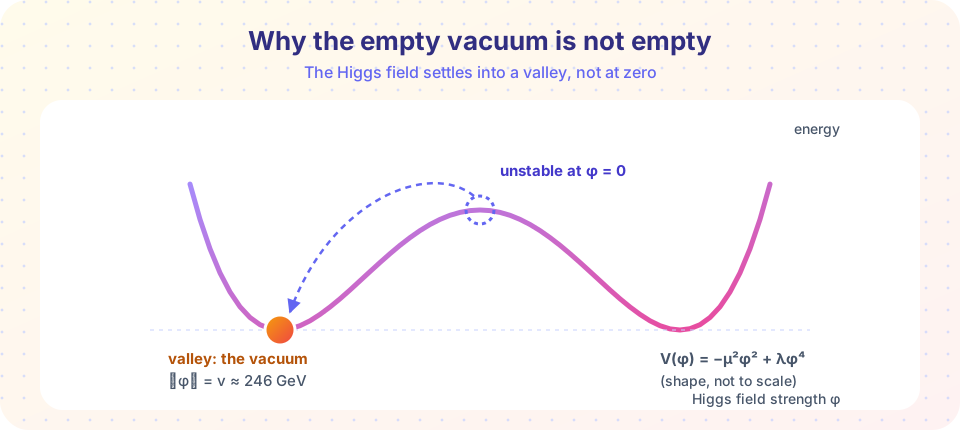
The lowest-energy state is not at zero but in a valley, so the vacuum itself has ⟨φ⟩ = v ≈ 246 GeV. Particles that couple to this background field behave as if they have mass:
- The W and Z bosons get their masses from interacting with the field (
m_W = g v / 2, wheregis the weak coupling). - Each fundamental fermion couples with a strength
y = √2 m / v. The top quark hasy ≈ 1; the electron hasy ≈ 3×10⁻⁶. - The Higgs boson is a ripple of the field, a quantum of the field itself, with
m_H = √(2λ) v ≈ 125 GeV.
The photon and gluons do not couple to the field, so they remain massless.
Discovery
On 4 July 2012 the ATLAS and CMS experiments at the LHC announced a new boson with mass about 125 GeV, produced in proton collisions and seen decaying into two photons, or into four leptons through two Z bosons. Further measurements confirmed spin 0 and couplings in proportion to mass. Englert and Higgs received the 2013 Nobel Prize in Physics. The Higgs lives for about 1.6×10⁻²² s, so detectors see only its decay products. It decays most often to heaviest particles that energy allows: roughly 58% to b quark pairs, 21% to W pairs, 6% to taus and only 0.23% to two photons, the "golden" clean channel.
Common misconceptions
"The Higgs gives all matter its mass." It gives mass to the W, Z and elementary fermions. Most of the mass of everyday matter comes from strong-force energy inside protons and neutrons.
"The Higgs boson is the 'God particle'." That nickname comes from a book title, not from physics. It is an ordinary quantum of a field.
"The Higgs field is like a thick treacle that slows particles." A common metaphor, but a Higgs field does not drag particles; it does not slow anything moving at constant velocity.
Try it
Press Run (or Ctrl + Enter) to see the result here.
Program input · what you'd type while the program runs
Type the answers before you press Run, one per line. Each time the program reads a line (with input()), it gets the next line from this box.
Press Run (or Ctrl + Enter) to see the result here.
Program input · what you'd type while the program runs
Type the answers before you press Run, one per line. Each time the program reads a line (with input()), it gets the next line from this box.
Press Run (or Ctrl + Enter) to see the console output here.
No output.
Check your understanding
Quick check · 5 questions
of 5 answered You scored / 5 · perfect!
-
1. A force carrier with mass m has a range of about...
The uncertainty principle lets a virtual particle live for about ħ/(mc²), so it travels about ħc/(mc²). -
2. Why does the weak force seem so weak at everyday distances?
The W and Z masses of about 80 and 91 GeV limit the range to a few thousandths of a proton's radius. -
3. What is the Higgs vacuum expectation value?
The Higgs field has a non-zero value of about 246 GeV everywhere, in all of space. The 125 GeV is the mass of the Higgs boson. -
4. Which particles remain massless after electroweak symmetry breaking?
The photon and gluons do not couple to the Higgs field. -
5. How does the Higgs boson couple to fermions?
The Yukawa coupling is y = √2 m/v, so heavier particles couple more strongly. That is why the Higgs decays mostly to b quarks.
Summary
- Forces arise from the exchange of gauge bosons: photon, gluons, W and Z.
- A carrier's mass sets the range,
R = ħc / (mc²): about 1.4 fm for the pion, about 2.5×10⁻¹⁸ m for the W. - Electromagnetism and the weak force unify in the electroweak theory; the W and Z masses come from the Higgs mechanism.
- The Higgs field has a vacuum value of 246 GeV; the Higgs boson (125 GeV, discovered 2012) couples in proportion to mass.
- The Higgs gives mass to W, Z and fermions, not most of the mass of everyday matter.
Track your progress
Create a free account to tick off lessons and pick up where you left off on any device.
of Nuclear and Particle Physics lessons completed