


















Lesson 35 of 51 · The Standard Model
Chapter Review: The Standard Model
A one-page recap of quarks, leptons, force carriers, the Higgs mechanism and conservation laws, with a mixed ten-question quiz.
The Standard Model packs the whole of known particle physics into one chart and a few rules. This review pulls the chapter together before we move to the machines that test it.
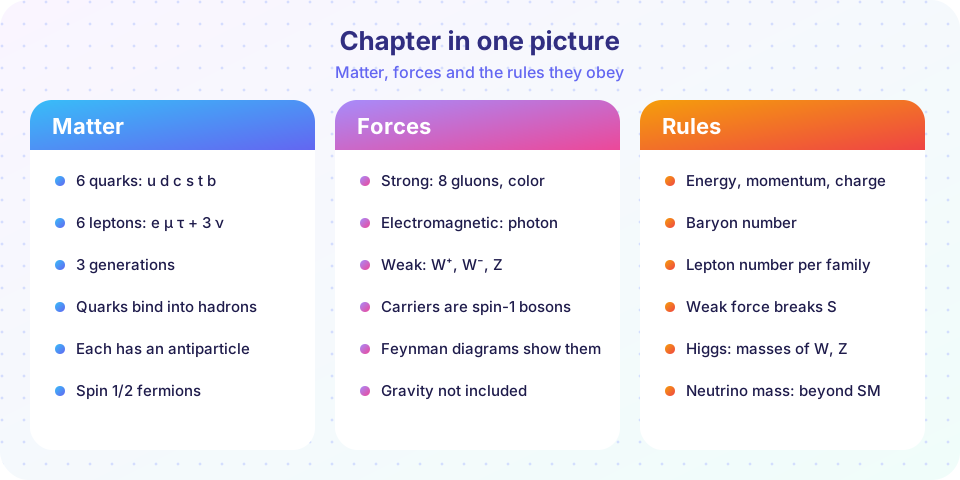
Recap
| Lesson | Main ideas | Numbers to remember |
|---|---|---|
| The big picture | Quarks, leptons, bosons, three generations | 6 quarks, 6 leptons, 4 gauge-boson types, 1 Higgs |
| Quarks, leptons and hadrons | Baryons, mesons, color, confinement | Charges ±2/3, ∓1/3; proton = uud |
| Forces, bosons and the Higgs | Exchange, range, electroweak, Higgs field | R = ħc/(mc²); v = 246 GeV; m_H = 125 GeV |
| Conservation laws and decays | Rules, Feynman diagrams, lifetimes | τ: 10⁻²³ s strong, 10⁻¹⁶ s EM, 10⁻¹⁰ s and longer weak |
A problem-solving routine
When you face a reaction or decay:
- Write the quantum numbers for every particle: Q, B, lepton numbers, strangeness.
- Check the conservation table for the interaction that could do it.
- Check energy: the initial rest energy must be at least the final rest energy.
- Estimate the lifetime from the interaction: strong, electromagnetic or weak.
- Draw the diagram with the fewest vertices that gets you there.
Matter
Forces
Rules
Higgs
Try it
Press Run (or Ctrl + Enter) to see the result here.
Program input · what you'd type while the program runs
Type the answers before you press Run, one per line. Each time the program reads a line (with input()), it gets the next line from this box.
Press Run (or Ctrl + Enter) to see the console output here.
No output.
Check your understanding
Quick check · 10 questions
of 10 answered You scored / 10 · perfect!
-
1. What is the electric charge of an anti-up quark?
An antiparticle has the opposite charge, so ū has −2/3. -
2. Which is a meson?
A meson is a quark plus an antiquark. -
3. Which interaction can change a quark's flavor?
Only W exchange changes flavors, as in d → u + W⁻. -
4. What limits the range of the weak force?
R = ħc/(mc²) is about 2.5×10⁻¹⁸ m for the W. -
5. The reaction μ⁻ → e⁻ + γ is not seen because...
Muon number goes from 1 to 0 and electron number from 0 to 1. -
6. The Higgs field's vacuum value is about...
v ≈ 246 GeV. The Higgs boson mass is 125 GeV. -
7. How many gluons carry the strong force in QCD?
Eight color-anticolor combinations. -
8. A particle with lifetime 10⁻²³ s most likely decays through...
Strong decays are by far the fastest. -
9. Where does most of the proton's mass come from?
The three valence quark masses add up to only about 9 MeV of 938 MeV. -
10. Why can cosmic-ray muons reach the ground?
The lab lifetime is γ times 2.2 µs.
Summary
- Matter is quarks and leptons in three generations; forces are carried by γ, g, W and Z; the Higgs field gives W, Z and fermions mass.
- Hadrons are color-neutral: baryons qqq, mesons q q̄.
- Reactions obey conservation of energy, momentum, charge, baryon number and lepton family number; only the weak force changes flavor.
- Carrier mass sets range; interaction strength sets lifetime.
Track your progress
Create a free account to tick off lessons and pick up where you left off on any device.
of Nuclear and Particle Physics lessons completed