


















Lesson 39 of 51 · Accelerators and Detectors
Chapter Review: Accelerators and Detectors
A one-page recap of how particle accelerators and detectors work, with the key formulas, a self-check calculator and a mixed ten-question quiz.
This chapter followed a proton from a bottle of hydrogen through the CERN accelerator chain to a collision, and then followed the debris through the layers of a detector to a peak in a histogram. Here are the main formulas and ideas in one place.
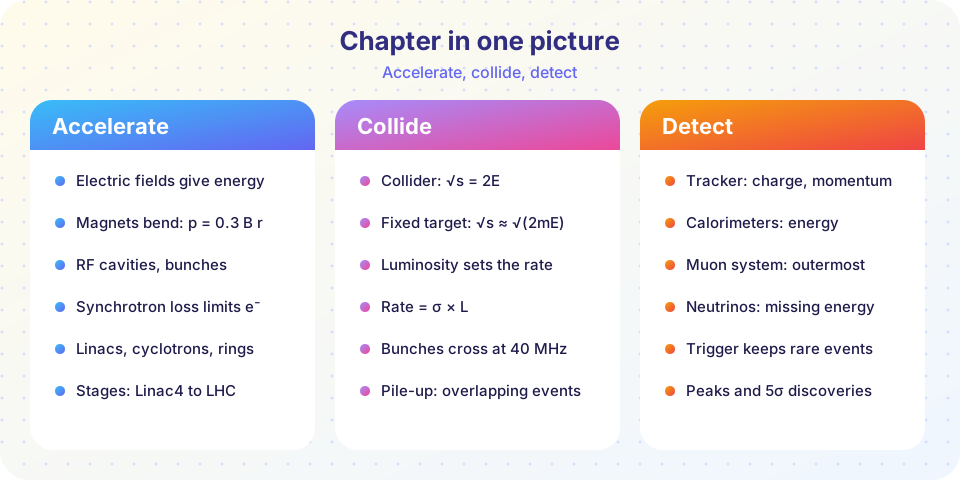
Recap
| Lesson | Main ideas | Formulas |
|---|---|---|
| The big picture | Wavelength, mass creation, colliders vs fixed target, detector layers | λ = hc / pc; √s = 2E vs √(2mc²E) |
| How accelerators work | RF cavities, dipoles, quadrupoles, synchrotron radiation, luminosity | p = 0.2998 B r; ΔE ∝ γ⁴/ρ; rate = σ L |
| How detectors work | Tracking, calorimetry, muons, Cherenkov, invariant mass, 5σ | p_T = 0.2998 B r; cos θ_C = 1/(nβ); m² = (ΣE)² − (Σp)² |
Habits to build
- Convert units early. GeV for energy, GeV/c for momentum, GeV/c² for mass; tesla and meters for the bending rule.
- Ask what is limiting. An accelerator is limited by magnet strength and radius (protons) or by radiation (electrons); a detector by resolution; an analysis by background.
- Check the scale. The LHC dipoles are about 8 T and the ring radius is a few kilometres; if your result gives a mountain-sized ring or a micro-tesla field, something is off.
Accelerate
Collide
Detect
Try it
Press Run (or Ctrl + Enter) to see the result here.
Program input · what you'd type while the program runs
Type the answers before you press Run, one per line. Each time the program reads a line (with input()), it gets the next line from this box.
Press Run (or Ctrl + Enter) to see the console output here.
No output.
Check your understanding
Quick check · 10 questions
of 10 answered You scored / 10 · perfect!
-
1. A particle beam has pc = 0.1 GeV. Its de Broglie wavelength is about...
λ = 1.24 GeV fm / 0.1 GeV ≈ 12 fm. -
2. For two equal beams head-on, what is √s?
Equal and opposite momenta cancel, so the total energy of both beams is available. -
3. Which component adds energy to a circulating beam?
Only an electric field changes the energy. RF cavities supply it. -
4. Why do high-energy electron synchrotrons lose so much energy?
γ is large for light particles, so the radiated energy per turn is large. -
5. A collider has L = 10³⁴ cm⁻² s⁻¹. What is the rate for σ = 1 pb?
1 pb = 10⁻³⁶ cm², so the rate is 10⁻² per second, or one per 100 seconds. -
6. Which detector component measures the energy of electrons and photons?
The ECAL absorbs them in a shower and measures the total light. -
7. A neutrino produced in a collision is identified by...
Neutrinos escape unseen; the momentum imbalance shows them. -
8. A particle with β = 0.9 travels in water (n = 1.33). Does it emit Cherenkov light?
The condition is β > 1/n. Here 0.9 > 0.75, so a cone of light is emitted. -
9. Why is 5σ used for discoveries?
A 5σ excess has a one-sided p-value of about 3×10⁻⁷ for background alone. -
10. The LHC dipoles are 8.33 T and the bending radius is 2,804 m. Momentum per beam?
0.2998 × 8.33 × 2804 ≈ 7,000 GeV/c.
Summary
- Short wavelengths need high momentum; heavy particles need high energy; colliders give
√s = 2E. - RF cavities accelerate, dipoles bend, quadrupoles focus;
p = 0.2998 B rlimits rings. - Electrons lose energy as
γ⁴/ρto synchrotron radiation; protons do not. - Trackers measure momentum and charge, calorimeters measure energy, the muon system identifies muons, missing momentum signals neutrinos.
- Invariant-mass peaks and 5σ significance turn events into discoveries.
Track your progress
Create a free account to tick off lessons and pick up where you left off on any device.
of Nuclear and Particle Physics lessons completed