


















Lesson 3 of 51 · Getting Started
Atoms, Nuclides and Isotopes
Read nuclide symbols, count protons and neutrons, tell isotopes from isobars and isotones, and see why stable nuclei sit on a curved band.
Chemistry says an element is defined by its atomic number, the number of protons. Nuclear physics asks the next question: how many neutrons come with those protons? Every different combination is a different nuclide, with its own mass, its own stability and its own behaviour. Over three thousand nuclides have been observed, but only about 250 are stable. In this lesson you learn to name them, count their parts, and read the chart that organizes them all.
What you will learn
- Read and write nuclide symbols such as ²³⁵U and ¹⁴C.
- Compute the neutron number N from A and Z, and the ratio N/Z.
- Distinguish isotopes, isotones, isobars and isomers.
- Describe the valley of stability and why heavy nuclei need extra neutrons.
Key terms
Atomic number Z: the number of protons; it fixes the chemical element.
Neutron number N: the number of neutrons in the nucleus.
Mass number A: the number of nucleons, A = Z + N. It is a whole number, not a mass.
Nuclide: a nucleus with a specific Z and N (a "kind of nucleus").
Isotopes: nuclides of the same element, so the same Z but different N.
Counting and naming
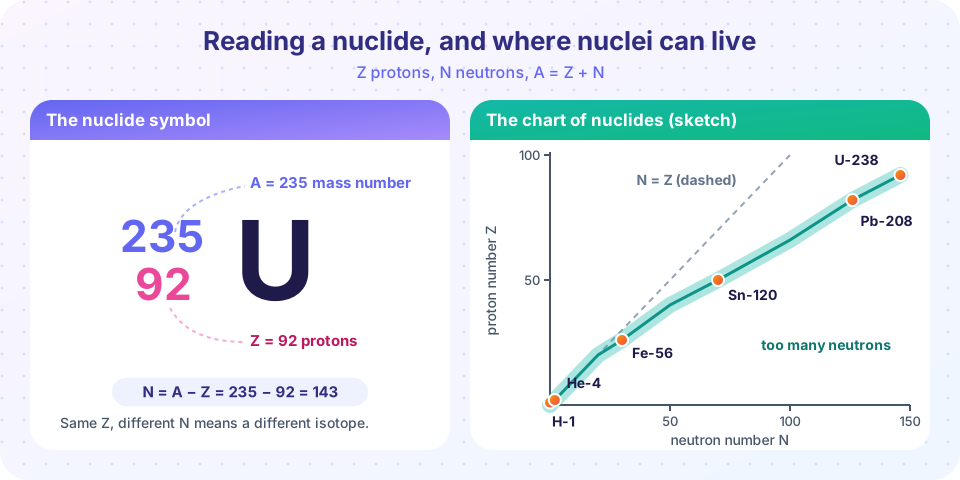
A nuclide is written with the element symbol, the mass number A at the upper left and (optionally) the atomic number Z at the lower left: ²³⁵₉₂U. Because the symbol "U" already tells you Z = 92, the subscript is often dropped. In words you say "uranium-235".
Take uranium-235: A = 235 and Z = 92, so N = A − Z = 235 − 92 = 143. Take carbon-14: A = 14, Z = 6, N = 8. Hydrogen has three isotopes with special names: protium ¹H (no neutron), deuterium ²H (one neutron) and tritium ³H (two neutrons). Chemically they are nearly identical because chemistry depends on the electrons, and the electrons depend on Z. Their nuclear behaviour is very different: deuterium is stable, tritium decays with a half-life of 12.3 years, and each plays a distinct role in reactors and fusion.
The mass number A is not the mass. The atomic mass of ²³⁵U is 235.0439 u, close to 235 but not equal; the difference comes from the binding energy, which chapter 2 explores.
A family of related words
| Same... | Name | Example |
|---|---|---|
| Z (protons) | isotopes | ¹²C, ¹³C, ¹⁴C |
| N (neutrons) | isotones | ¹⁴C (N = 8), ¹⁶O (N = 8), ¹⁵N (N = 8) |
| A (nucleons) | isobars | ¹⁴C, ¹⁴N, ¹⁴O |
| Z and A, different energy | isomers | ⁹⁹Tc and ⁹⁹ᵐTc |
An isomer is a nucleus in a long-lived excited state. The metastable technetium-99m ("m" for metastable) lives for six hours, long enough to be used in medical imaging, and releases its energy as a gamma ray.
The chart of nuclides
Plot every known nuclide as a square on a grid with N on the horizontal axis and Z on the vertical axis and you get the chart of nuclides, the periodic table of nuclear physics. The stable nuclei form a narrow band, the valley of stability. Its shape tells a story:
- For light nuclei the band follows N ≈ Z. Helium-4 (2, 2), carbon-12 (6, 6) and oxygen-16 (8, 8) are all balanced.
- For heavy nuclei the band bends to more neutrons than protons: iron-56 has N/Z = 30/26 ≈ 1.15, tin-120 has 70/50 = 1.4 and lead-208 has 126/82 ≈ 1.54.
- Above Z = 82 (lead) no completely stable nuclide exists. Bismuth-209 is so long-lived (about 2 × 10¹⁹ years) that it counts as practically stable.
Why do heavy nuclei need extra neutrons? Protons repel each other with the electromagnetic force, which has long range and grows with Z². The strong force between nucleons has a short range and is almost the same for a neutron and a proton. Extra neutrons add attraction without adding repulsion, so they dilute the charge. But too many neutrons cost energy, because of the Pauli principle (the next chapter's asymmetry term). The balance sits at a curved line. Nuclei outside the valley are unstable and decay toward it; those with too many neutrons decay by β⁻, and those with too many protons by β⁺ or electron capture (chapter 3).
Technetium (Z = 43) and promethium (Z = 61) are the two elements below lead with no stable isotope at all. Tin (Z = 50) holds the record with ten stable isotopes.
Worked example: a nuclide's quick facts
For ¹³⁷Cs: A = 137 and Z = 55, so N = 82. The ratio N/Z = 82/55 ≈ 1.49. Stable nuclei with Z near 56 have N/Z around 1.45, so cesium-137 is a little too neutron-rich, and indeed cesium-137 is a β⁻ emitter with a half-life of about 30 years. A simple estimate of the stable Z for a given A is
Z₀ ≈ A / (1.98 + 0.0155 A^(2/3))
For A = 137 this gives Z₀ ≈ 137 / (1.98 + 0.0155 × 26.6) ≈ 57. The formula is a guide, not an exact rule: the one stable nuclide with A = 137 is ¹³⁷Ba (Z = 56), and ¹³⁷Cs decays to it.
Common misconceptions
"Isotopes of one element behave the same in every way." Chemically they are almost identical, but nuclear properties (stability, half-life, reaction probability) can be completely different.
"The mass number is the mass in grams or atomic mass units." A counts nucleons. The true mass differs by the binding energy and is not a whole number.
"Heavier means radioactive." Lead-208 is the heaviest stable doubly magic nucleus, while light tritium is radioactive. Stability depends on the N and Z balance.
Try it
First, build a table of nuclide facts for a few familiar nuclei and test the isotope/isotone/isobar rules.
Press Run (or Ctrl + Enter) to see the result here.
Program input · what you'd type while the program runs
Type the answers before you press Run, one per line. Each time the program reads a line (with input()), it gets the next line from this box.
Second, plot the valley of stability from the formula and compare it with real stable nuclei.
Press Run (or Ctrl + Enter) to see the result here.
Program input · what you'd type while the program runs
Type the answers before you press Run, one per line. Each time the program reads a line (with input()), it gets the next line from this box.
Check your understanding
Quick check · 5 questions
of 5 answered You scored / 5 · perfect!
-
1. How many neutrons are in ²³⁸U?
N = A − Z = 238 − 92 = 146. -
2. Which pair are isotopes of the same element?
Isotopes share Z. ¹²C and ¹³C both have Z = 6. -
3. ¹⁴C, ¹⁴N and ¹⁴O are called...
They share A = 14 but have different Z, which makes them isobars. -
4. Why do heavy stable nuclei have more neutrons than protons?
Proton repulsion grows as Z², so adding neutrons dilutes the charge while still adding attraction. -
5. What does the m in ⁹⁹ᵐTc mean?
The m stands for metastable. Technetium-99m is an isomer with a 6-hour half-life.
Summary
- A nuclide has Z protons, N neutrons and A = Z + N nucleons.
- Isotopes share Z, isotones share N, isobars share A, and isomers share both but differ in energy.
- Stable nuclei form a curved band: N ≈ Z for light nuclei, N/Z up to about 1.5 for the heaviest.
- Nuclei off the band are radioactive and decay back toward it.
Track your progress
Create a free account to tick off lessons and pick up where you left off on any device.
of Nuclear and Particle Physics lessons completed