


















Lesson 2 of 51 · Getting Started
Scales and Units: fm, MeV and Mass-Energy
Learn the length, energy and mass units of nuclear physics: femtometres, electronvolts, atomic mass units, E = mc² and the handy constant ħc.
Nuclear physics works at distances where the metre is hopelessly large and at energies where the joule is hopelessly small. A physicist measuring a nucleus does not say "seven quadrillionths of a metre"; she says "seven femtometres". She does not say "a hundred and sixty-thousandths of a billionth of a joule"; she says "a MeV". In this lesson you learn the vocabulary of the field, and the one equation that connects mass, energy and length at this scale.
What you will learn
- Convert between metres, femtometres, joules, electronvolts and atomic mass units.
- Use E = mc² to express masses in MeV/c² and to find energy released by a mass change.
- Use the constant ħc = 197.327 MeV·fm to link a length to an energy.
- Decide when you may use the Newtonian formula for kinetic energy and when you must not.
Key terms
Femtometre (fm): 10⁻¹⁵ m, also called a fermi; the natural unit for nuclear sizes.
Electronvolt (eV): the energy gained by one electron crossing 1 volt; 1 eV = 1.602176634 × 10⁻¹⁹ J.
Atomic mass unit (u): one twelfth of the mass of a carbon-12 atom, 1.66053907 × 10⁻²⁷ kg.
Rest energy: the energy mc² a particle has just by existing at rest.
Natural units: a convention in which ħ = c = 1, so energy, mass, momentum and inverse length share one unit.
Lengths: the femtometre
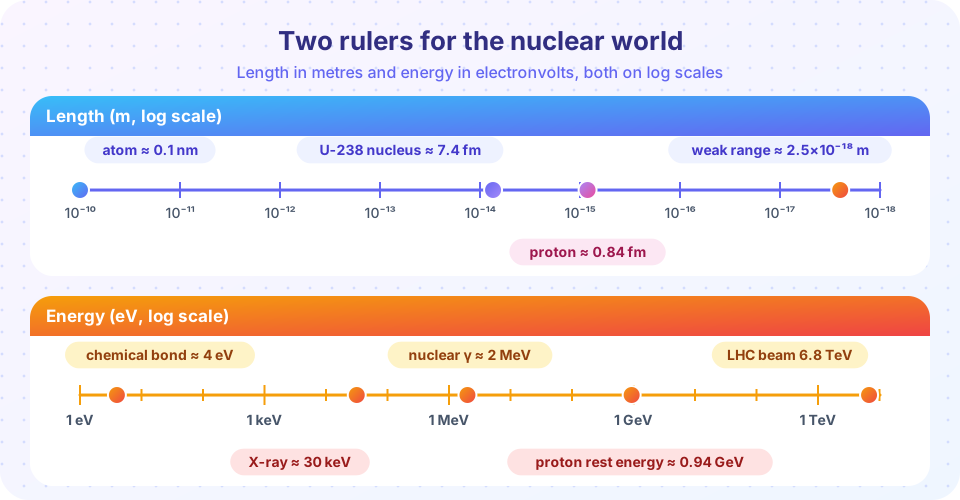
Distances inside atoms are measured in picometres (10⁻¹² m) or ångströms (10⁻¹⁰ m). Inside nuclei we need a thousand times finer units. One femtometre, 1 fm = 10⁻¹⁵ m, is about the diameter of a proton. A lead nucleus is about 14 fm across, a uranium nucleus about 15 fm. Compared with an atom a nucleus is about 10⁵ times smaller, so if an atom were as wide as a 200 m stadium, its nucleus would be a grain 2 mm wide at the centre.
The prefixes you will meet over and over are these: milli (10⁻³), micro (10⁻⁶), nano (10⁻⁹), pico (10⁻¹²), femto (10⁻¹⁵), atto (10⁻¹⁸). For energy and mass the big prefixes matter: kilo (10³), mega (10⁶), giga (10⁹), tera (10¹²).
Energies: the electronvolt
An electron accelerated through a potential difference of 1 V gains 1.602 × 10⁻¹⁹ J. That amount is the electronvolt. It is a convenient unit because accelerators are described by their voltage, and because it matches the energy scales of each branch of physics:
| Process | Typical energy |
|---|---|
| Chemical bond | a few eV |
| Visible photon | 2 to 3 eV |
| Medical X-ray | 30 to 100 keV |
| Nuclear gamma ray | 0.1 to 10 MeV |
| Proton rest energy | 938 MeV |
| LHC proton beam (2022 run) | 6.8 TeV per beam |
The gap between "a few eV" for chemistry and "a few MeV" for nuclear processes is a factor of about a million. That factor is the reason a kilogram of nuclear fuel can release millions of times more energy than a kilogram of chemical fuel.
Mass and energy: E = mc²
Einstein's relation says a particle at rest has energy E = mc². Particle physicists turn this around and quote masses as rest energies divided by c²:
| Particle | Mass (MeV/c²) |
|---|---|
| Electron | 0.511 |
| Proton | 938.272 |
| Neutron | 939.565 |
| Alpha particle (helium-4 nucleus) | 3727.38 |
| 1 atomic mass unit | 931.494 |
The atomic mass unit has a very useful consequence: when a nuclear mass changes by Δm (in u), the energy released is 931.494 × Δm MeV. For example, the neutron is heavier than the proton by 939.565 − 938.272 = 1.293 MeV/c², which is why a free neutron can decay into a proton but not the other way round.
Newtonian kinetic energy ½mv² is only valid when v is much smaller than c. The exact relation is
T = (γ − 1) mc², with γ = 1 / √(1 − β²) and β = v/c.
A 5 MeV alpha particle has T/mc² = 5/3727, so γ − 1 is tiny and the Newtonian formula works: β = √(2T/mc²) ≈ 0.052, about 1.5 × 10⁷ m/s. A 5 MeV electron, however, has T ten times its rest energy; its speed is about 99.6% of c.
The constant ħc
Quantum mechanics links energy and length through Planck's constant. The combination ħc, the reduced Planck constant times the speed of light, equals 197.327 MeV·fm. It converts between an energy and a distance: a quantum of energy E probes structures of size about ħc/E. This is how we know that to look inside a proton (1 fm) you need probes with energies of hundreds of MeV or more, and why the weak force, carried by particles of about 80 GeV, has a range of only ħc/80,000 MeV ≈ 0.0025 fm.
Setting ħ = c = 1 ("natural units") makes this automatic: energy, momentum and mass are all in MeV or GeV, and lengths are in 1/MeV. In this course we keep ħ and c visible, but you will see natural units in particle physics papers.
Worked example: energy released by a mass change
Hydrogen-1 has an atomic mass of 1.007825 u and the neutron 1.008665 u. What is the energy equivalent of their difference?
- Δm = 1.008665 − 1.007825 = 0.000840 u.
- E = 0.000840 u × 931.494 MeV/u ≈ 0.782 MeV.
This 0.782 MeV is the energy released when a free neutron decays (the electron rest mass is already included in the atomic mass of hydrogen). It is shared between the electron, the proton and the antineutrino.
Common misconceptions
"Mass is converted into energy and disappears." Total energy and momentum are always conserved. When a nucleus releases energy, its rest mass decreases, but the energy lives on as kinetic energy and radiation, which carry inertia too.
"MeV/c² is a different kind of mass." It is just a mass in different units, as pounds and kilograms are. 1 MeV/c² ≈ 1.783 × 10⁻³⁰ kg.
"The femtometre is a strange unit." It is the same as a fermi, named after Enrico Fermi, and 1 fm = 10⁻¹⁵ m exactly.
Try it
The first calculator prints the key constants, converts a handful of masses and shows how ħc turns a mass into a range.
Press Run (or Ctrl + Enter) to see the result here.
Program input · what you'd type while the program runs
Type the answers before you press Run, one per line. Each time the program reads a line (with input()), it gets the next line from this box.
The second example plots speed against kinetic energy for an electron and a proton. Watch the electron race to c while the proton barely moves.
Press Run (or Ctrl + Enter) to see the result here.
Program input · what you'd type while the program runs
Type the answers before you press Run, one per line. Each time the program reads a line (with input()), it gets the next line from this box.
Check your understanding
Quick check · 5 questions
of 5 answered You scored / 5 · perfect!
-
1. How large is 1 fm in metres?
Femto means 10⁻¹⁵, so 1 fm = 10⁻¹⁵ m, about the size of a proton. -
2. A nuclear process releases 0.0100 u of mass. How much energy is that?
E = 0.0100 × 931.494 MeV ≈ 9.3 MeV. -
3. Why is a 5 MeV alpha particle treated with Newtonian mechanics but a 5 MeV electron is not?
T = 5 MeV is about 0.13% of the alpha's rest energy, but about ten times the electron's rest energy, so the electron is highly relativistic. -
4. The weak force is carried by particles of about 80 GeV/c². Using ħc = 197 MeV·fm, what is its range?
range ≈ ħc/(mc²) = 197.3 MeV·fm / 80,000 MeV ≈ 0.0025 fm = 2.5 × 10⁻¹⁸ m. -
5. Which is the correct reason a free neutron can decay but a free proton cannot?
The neutron is about 1.293 MeV/c² heavier than the proton, which pays for the electron (0.511) and leaves 0.782 MeV of kinetic energy.
Summary
- Nuclear sizes use femtometres (10⁻¹⁵ m); nuclear energies use MeV.
- 1 eV = 1.602 × 10⁻¹⁹ J; 1 u = 931.494 MeV/c²; the proton rest energy is 938.272 MeV.
- A mass change Δm (in u) releases 931.494 × Δm MeV.
- ħc = 197.327 MeV·fm links an energy to a length.
- Use the relativistic formula
T = (γ − 1) mc²unless T is much smaller than mc².
Track your progress
Create a free account to tick off lessons and pick up where you left off on any device.
of Nuclear and Particle Physics lessons completed