


















Lesson 10 of 51 · Nuclear Structure
The Shell Model and Magic Numbers
Discover why 2, 8, 20, 28, 50, 82 and 126 are magic numbers, how nucleons fill quantum levels and how to predict the spin and parity of a nucleus.
The liquid-drop formula treats nucleons as a crowd. But in 1948 Maria Goeppert Mayer was struck by a pattern: nuclei with 2, 8, 20, 28, 50, 82 or 126 protons or neutrons are far more abundant, more tightly bound and harder to excite than their neighbours, just as the noble gases (2, 10, 18 electrons) stand out in the periodic table. Something like electron shells must exist in the nucleus. Mayer and, independently, Hans Jensen showed that it does, provided you add one crucial ingredient, the spin-orbit force. They shared the 1963 Nobel Prize with Eugene Wigner.
What you will learn
- Explain the evidence for magic numbers.
- Describe how a nucleon fills quantum levels labelled n, l and j, and how many nucleons each level holds.
- Explain why the spin-orbit force creates the magic numbers 28, 50, 82 and 126.
- Predict the ground-state spin and parity of a nucleus with one unpaired nucleon.
Key terms
Shell: a group of nearby energy levels separated from the next group by a large gap.
Magic number: a nucleon number that fills a shell completely (2, 8, 20, 28, 50, 82, 126).
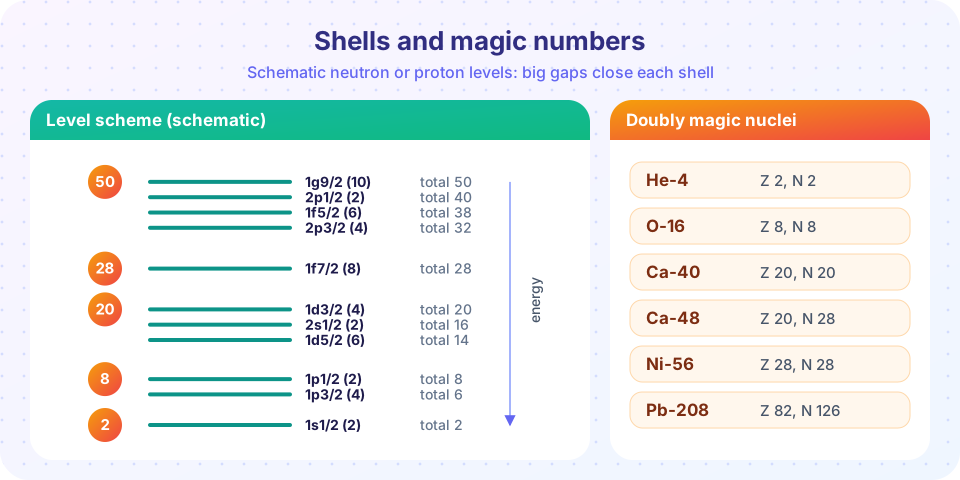
Doubly magic: a nucleus with both Z and N magic, such as ⁴He, ¹⁶O, ⁴⁰Ca, ²⁰⁸Pb.
Spin-orbit coupling: an interaction that lowers the energy of a nucleon whose spin is parallel to its orbital angular momentum.
Spin and parity J^π: the total angular momentum J of the nucleus, and whether its wave function is even (+) or odd (−) under reflection.
Evidence for magic numbers
- Abundance. Tin (Z = 50) has ten stable isotopes, the most of any element. Calcium (Z = 20) has six. Helium-4 and oxygen-16 are among the most abundant nuclei in the universe.
- Separation energy. It takes a lot more energy to remove a nucleon from a closed shell than from the nucleus one step above it, in the same way that ionizing a noble gas costs more than ionizing an alkali metal.
- First excited states. In an even-even nucleus the first excited state is usually at about 1 MeV or less, but in doubly magic nuclei such as ²⁰⁸Pb it lies far higher (2.6 MeV), because breaking a closed shell costs a lot.
- Capture cross sections. Neutron capture is unusually unlikely for nuclei with magic neutron numbers: the extra neutron would start a new shell.
A potential well for nucleons
The shell model replaces the complicated sum of all the forces on one nucleon by an average potential created by all the others: a smooth well, flat in the middle and rounded at the edge, like the density profile of lesson 2. The Schrödinger equation then gives quantized levels, which are labelled with three pieces of information:
- the radial number n (1, 2, 3, ... counts the nodes),
- the orbital angular momentum l, written as a letter (s, p, d, f, g, h, i for l = 0, 1, 2, 3, 4, 5, 6),
- the total angular momentum j = l ± ½ (orbital plus spin).
Each level with total angular momentum j can hold 2j + 1 identical nucleons, because the orientation can take 2j + 1 values and the Pauli principle forbids two nucleons from sharing the same state. Protons and neutrons are different kinds of particles, so each has its own set of levels.
With a plain well, such as a harmonic oscillator or a square well, the levels group into shells closing at 2, 8, 20, 40, 70, 112. The first three match the data, but 28, 50, 82 and 126 are missing. This failure puzzled physicists for fifteen years.
The missing ingredient: spin-orbit coupling
Mayer and Jensen added a term to the potential that depends on the nucleon's spin and orbital motion: a nucleon with its spin parallel to its orbital angular momentum (j = l + ½) is bound more tightly. The effect is large and, unlike in atoms, it has the opposite sign. It is proportional to l, so it is strong for high l. It pushes the j = l + ½ level of each shell, 1f7/2, 1g9/2, 1h11/2 and 1i13/2, down into the shell below, creating new big gaps at 28, 50, 82 and 126.
Filling the levels in order of energy gives the sequence
1s1/2 (2) | 1p3/2 (4) 1p1/2 (2) → 8 | 1d5/2 (6) 2s1/2 (2) 1d3/2 (4) → 20 | 1f7/2 (8) → 28 | 2p3/2 (4) 1f5/2 (6) 2p1/2 (2) 1g9/2 (10) → 50 | ...
The numbers in parentheses are 2j + 1, and the running total at each gap is a magic number. The order of levels beyond 50 differs a little between protons and neutrons because protons also feel the Coulomb repulsion.
Predicting spin and parity
Paired nucleons in the same level have opposite angular momenta that cancel. So:
- Even-even nuclei have J^π = 0⁺ in the ground state, with no unpaired nucleons.
- Odd-A nuclei inherit the spin of the single unpaired nucleon: J equals the j of its level, and the parity is (−1)^l.
Examples:
| Nucleus | Unpaired nucleon | Level | Prediction | Measured |
|---|---|---|---|---|
| ¹⁷O | the 9th neutron | 1d5/2 | 5/2⁺ | 5/2⁺ |
| ⁴¹Ca | the 21st neutron | 1f7/2 | 7/2⁻ | 7/2⁻ |
| ⁷Li | the 3rd proton | 1p3/2 | 3/2⁻ | 3/2⁻ |
| ²⁰⁹Pb | the 127th neutron | 2g9/2 | 9/2⁺ | 9/2⁺ |
Odd-odd nuclei have two unpaired nucleons and need more careful coupling rules; deuteron has J = 1.
Worked example: ¹⁷O
Oxygen-17 has Z = 8 (a full shell for protons, no unpaired proton) and N = 9. The first eight neutrons fill 1s1/2 (2), 1p3/2 (4) and 1p1/2 (2). The ninth goes into 1d5/2. Its angular momentum is j = 5/2 and its parity is (−1)² = + because l = 2. So J^π = 5/2⁺, which is what is measured.
Models side by side
The shell model works with independent nucleons and quantum levels: it explains spins, magic numbers and magnetic moments. The liquid-drop model works with a collective droplet: it explains energies and fission. A modern nucleus needs both: a collective deformable core with shell structure. The island of stability for superheavy elements, predicted near Z ≈ 114–126 and N ≈ 184, is a shell effect that the liquid-drop model alone says should not exist (the exact location depends on the theory).
Common misconceptions
"Nucleons orbit in the nucleus like planets." Levels are quantum states with wave functions spread through the whole nucleus. The word orbit is shorthand.
"Magic numbers never change." Far from stability, in neutron-rich exotic nuclei, shell gaps can shrink, disappear or appear at new places (for example around N = 16). Studying this is an active research area.
"There must be a heavy centre pulling the nucleons, as in an atom." In an atom the nucleus is the centre of force. In a nucleus the average potential is produced by the nucleons themselves.
Try it
Predict the ground-state spin and parity of nuclei with one unpaired nucleon by filling the levels in order. Compare with the measured values.
Press Run (or Ctrl + Enter) to see the result here.
Program input · what you'd type while the program runs
Type the answers before you press Run, one per line. Each time the program reads a line (with input()), it gets the next line from this box.
Now fill the levels yourself. Click "Add nucleon" and watch shells close at the magic numbers.
Check your understanding
Quick check · 5 questions
of 5 answered You scored / 5 · perfect!
-
1. How many nucleons can a level with total angular momentum j = 7/2 hold?
A level with angular momentum j holds 2j + 1 identical nucleons, so 2 × 7/2 + 1 = 8. -
2. Which ingredient turned the simple well model into one that gives all the magic numbers?
Spin-orbit coupling lowers the j = l + 1/2 level of each shell, opening new gaps at 28, 50, 82 and 126. -
3. What is the predicted ground-state spin and parity of ²⁰⁹Pb (one neutron beyond doubly magic ²⁰⁸Pb, in the 2g9/2 level)?
J = j = 9/2, and parity (−1)^l with l = 4 is +, so 9/2⁺. -
4. All even-even nuclei in their ground state have which spin and parity?
All nucleons are paired with opposite angular momenta, so the total is J = 0 with positive parity. -
5. Which of the following is a doubly magic nucleus?
²⁰⁸Pb has Z = 82 and N = 126, both magic numbers.
Summary
- Magic numbers 2, 8, 20, 28, 50, 82 and 126 mark closed shells and extra stability.
- Nucleons occupy levels n l_j in an average potential; each level holds 2j + 1 nucleons.
- Spin-orbit coupling is the ingredient that generates the magic numbers beyond 20.
- Even-even nuclei have J^π = 0⁺; odd-A nuclei take the j and parity of the last nucleon.
- The shell model and the liquid drop are complementary pictures of the same nucleus.
Track your progress
Create a free account to tick off lessons and pick up where you left off on any device.
of Nuclear and Particle Physics lessons completed