


















Lesson 34 of 51 · The Standard Model
Conservation Laws and Particle Decays
Which quantities are conserved in particle reactions, how to draw and read Feynman diagrams, how lifetimes reveal the interaction, and how to compute decay kinematics.
Particles are born, collide and decay by the thousands in every accelerator event. Physicists make sense of the mess with a short list of rules: certain quantities can never change. A reaction that obeys all the rules may happen; one that breaks a rule never does, at least in the Standard Model. This lesson shows how to use the rules, how Feynman diagrams display the allowed processes, and how decay lifetimes tell you which force is at work.
What you will learn
- The conserved quantities and which interactions respect each.
- How to check a reaction for allowed or forbidden status.
- How to read the lines and vertices of a Feynman diagram.
- How lifetime reveals the interaction behind a decay.
- How to compute the energy and momentum of the products of a two-body decay.
Key terms
Conserved quantity: a number that has the same total before and after any allowed reaction.
Lepton number L: +1 for each lepton, −1 for each antilepton; counted separately for the electron, muon and tau families.
Vertex: a point on a Feynman diagram where lines meet, representing one interaction.
Lifetime τ: the mean time before a particle decays; the decay width is Γ = ħ/τ.
Branching ratio: the fraction of decays that go to a particular final state.
The rules
| Quantity | Strong | Electromagnetic | Weak |
|---|---|---|---|
| Energy and momentum | yes | yes | yes |
| Electric charge | yes | yes | yes |
Baryon number B |
yes | yes | yes |
| Lepton number (each family) | yes | yes | yes (in the Standard Model without neutrino mass) |
| Strangeness (and other flavors) | yes | yes | no |
Energy, momentum, charge and baryon number are never observed to be violated. Lepton family numbers hold in all charged-lepton reactions; neutrino oscillations (Chapter 8) are the one place where they are known to change. Only weak interactions change quark flavor, so only they break strangeness conservation.
Worked checks
Neutron decay: n → p + e⁻ + ν̄ₑ
charge:   0  →  +1 −1 + 0 = 0           ✓
baryon:   1  →  1 + 0 + 0 = 1           ✓
Lₑ:       0  →  0 + 1 − 1 = 0           ✓ (the antineutrino carries Lₑ = −1)
energy:   939.565 MeV → 938.272 + 0.511 = 938.783 MeV, 0.782 MeV left as kinetic energy  ✓
Forbidden: μ⁻ → e⁻ + γ. Charge and energy are fine, but lepton family numbers change (L_μ: 1 → 0, Lₑ: 0 → 1), so the reaction is not observed. Experiments have set a limit on its branching ratio below 10⁻¹².
Forbidden: p → e⁺ + π⁰ conserves charge but violates baryon number. No proton decay has ever been seen; the proton lifetime exceeds about 10³⁴ years, far longer than the age of the universe.
Weak only: Λ → p + π⁻ changes strangeness from −1 to 0, so it must be weak. The Λ lives about 2.6×10⁻¹⁰ s, not the 10⁻²³ s expected for a strong decay.
Feynman diagrams
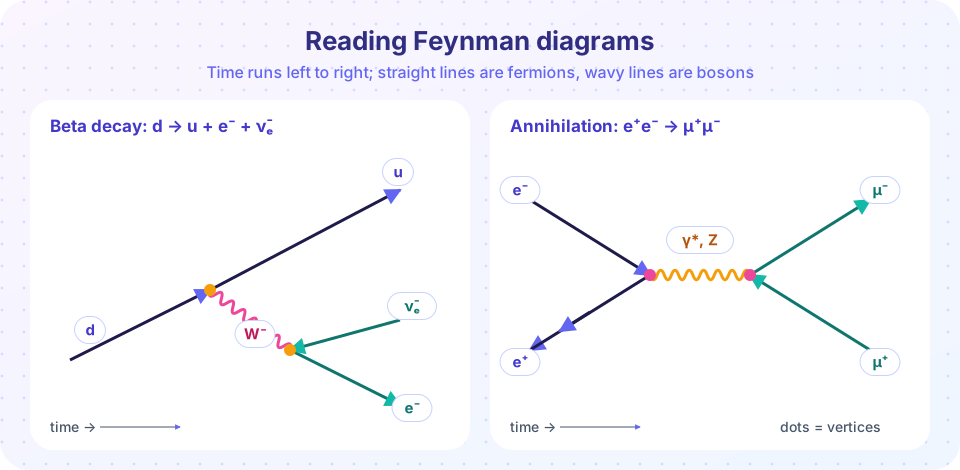
Richard Feynman, Julian Schwinger and Shin'ichiro Tomonaga built quantum electrodynamics in the 1940s, and Feynman invented a graphical shorthand for it. A diagram is a picture of a process, and each part stands for a factor in the calculation of its probability.
- Time runs left to right (some books use bottom to top).
- A straight line with an arrow is a fermion; an arrow pointing against the direction of time stands for an antiparticle.
- A wavy line (or a curly one for gluons) is a gauge boson.
- A vertex is where lines meet. At every vertex the conserved quantities balance, and each vertex gives a factor of the coupling strength: about
√α ≈ 0.085for a photon, larger for the strong force.
In the beta decay diagram of the figure above, a d quark emits a W⁻ and becomes a u quark. The W⁻ then converts to an electron and an antineutrino. Two vertices, two weak couplings. The other two quarks of the neutron just go along for the ride. In annihilation, an electron and positron meet, annihilate into a virtual photon (or Z), which then makes a muon pair. Total probability is a sum over all diagrams, and the ones with fewer vertices matter most.
Lifetimes tell you the force
The mean lifetime of an unstable particle depends strongly on how it decays:
| Interaction | Typical lifetime | Example |
|---|---|---|
| Strong | 10⁻²³ s | Δ⁺⁺ → p + π⁺ |
| Electromagnetic | 10⁻¹⁶ to 10⁻²⁰ s | π⁰ → γγ (8.5×10⁻¹⁷ s) |
| Weak | 10⁻¹³ s to hundreds of seconds | π⁺ → μ⁺ν (26 ns); μ⁻ → e⁻ν̄ν (2.2 µs); n → p e⁻ ν̄ (about 880 s) |
Large differences in lifetime arise from coupling strengths and also from how much energy is available. The neutron lives so long (a quarter of an hour on average) because only 0.78 MeV is available and the rate of the weak decay scales steeply with that energy.
Moving particles live longer in the laboratory: τ_lab = γ τ. Cosmic-ray muons are created about 15 km up, and with a rest lifetime of 2.2 µs and a speed near c they would travel only about 660 m. Time dilation lets a muon of γ ≈ 10 to 20 travel many kilometers, and so many reach the ground. This was among the first confirmations of special relativity in particle physics.
Two-body decay kinematics
When a particle of mass M decays at rest into two particles of masses m₁ and m₂, energy and momentum conservation fix everything. Each product has momentum of equal size p in opposite directions:
p = √[ (M² − (m₁+m₂)²)(M² − (m₁−m₂)²) ] c / (2M) (masses in energy units)
For π⁺ → μ⁺ + ν_μ with a massless neutrino this gives p = (M² − m_μ²)/(2M), about 29.8 MeV/c. The muon takes 4.1 MeV of kinetic energy and the neutrino carries the remaining 29.8 MeV.
Common misconceptions
"The Feynman diagram shows the path the particles take." It is a bookkeeping device for a calculation. The "internal" lines are virtual and do not follow classical paths.
"A decay happens because the particle was made of its products." A neutron does not contain an electron and antineutrino; they are created in the decay.
"Forbidden means impossible in principle." Conservation of baryon number and of lepton flavor are experimental facts, not proven laws. Grand unified theories predict tiny violations, which is why experiments look for proton decay.
Try it
Press Run (or Ctrl + Enter) to see the console output here.
No output.
Press Run (or Ctrl + Enter) to see the result here.
Program input · what you'd type while the program runs
Type the answers before you press Run, one per line. Each time the program reads a line (with input()), it gets the next line from this box.
Press Run (or Ctrl + Enter) to see the result here.
Program input · what you'd type while the program runs
Type the answers before you press Run, one per line. Each time the program reads a line (with input()), it gets the next line from this box.
Check your understanding
Quick check · 5 questions
of 5 answered You scored / 5 · perfect!
-
1. Which reaction is forbidden?
Baryon number changes from 1 to 0, which has never been observed. -
2. Which quantity can change in a weak interaction but not in a strong or electromagnetic one?
Only the weak interaction changes quark flavors, so strangeness is not conserved in weak decays. -
3. In a Feynman diagram, what does a wavy line usually represent?
Photon, W and Z are drawn as wavy lines; gluons as curly ones. -
4. A particle decays in about 10⁻²³ s. Which interaction is probably responsible?
Strong decays are the fastest, with typical lifetimes around 10⁻²³ s. -
5. Why can a muon of rest lifetime 2.2 µs travel 15 km?
The lab lifetime is γτ. With γ of 10 to 20 the decay length is many kilometres.
Summary
- Energy, momentum, charge, baryon number and (almost always) each lepton family number are conserved.
- Strangeness and other flavors are conserved by the strong and electromagnetic interactions but changed by the weak one.
- A Feynman diagram pictures a process: straight lines are fermions, wavy lines are bosons, vertices are interactions.
- Lifetimes range from about 10⁻²³ s (strong) to minutes (weak);
Γ = ħ/τ. - In a two-body decay the products have equal and opposite momentum
p, fixed by the three masses.
Track your progress
Create a free account to tick off lessons and pick up where you left off on any device.
of Nuclear and Particle Physics lessons completed