


















Lesson 17 of 51 · Radioactivity and Decay
Radiation, Shielding and Dose
How radiation interacts with matter, how shielding with half-value layers works, and what gray, sievert and typical doses mean, with calculators.
Radiation is only a problem if energy ends up in the wrong place. How much energy reaches a person depends on three things: how long they are exposed, how far away the source is, and what stands in between. These three levers, time, distance and shielding, are the basis of radiation protection. To use them you need to know how radiation loses energy in matter, how to measure what a body receives, and how big the numbers are compared with those we live with every day.
What you will learn
- Explain how alpha, beta, gamma and neutron radiation interact with matter.
- Use the attenuation law I = I₀e^(−μx) and half-value layers for shielding.
- Define absorbed dose (gray), equivalent dose and effective dose (sievert).
- Compare typical doses and apply the time-distance-shielding rules.
Key terms
Absorbed dose (Gy): the energy deposited per unit mass; 1 gray = 1 joule per kilogram.
Equivalent dose (Sv): the absorbed dose multiplied by a radiation weighting factor w_R that reflects how harmful the radiation type is.
Effective dose (Sv): the sum of the equivalent doses to the organs, weighted by how sensitive each organ is.
Half-value layer (HVL): the thickness of a material that halves a beam of gamma rays.
ALARA: "as low as reasonably achievable", the guiding principle of radiation protection.
How radiation loses energy
- Alpha and other heavy charged particles ionize atoms in a dense, straight track and stop in a well-defined range (about 4 cm of air for a 5 MeV alpha particle). The ionization is strongest at the end of the track, the Bragg peak.
- Beta particles (electrons) ionize less densely and scatter off in zig-zag paths. A 1 MeV electron has a range of a few millimetres in water or aluminium. They also emit bremsstrahlung X-rays when decelerated, which is why high-energy beta sources are shielded with plastic first and lead second.
- Gamma rays do not have a range but are attenuated exponentially. Three processes dominate: the photoelectric effect (low energy, high-Z material), Compton scattering (mid energies, nearly independent of Z) and pair production (above 1.022 MeV, important at high energies and high Z).
- Neutrons are electrically neutral, so they penetrate far. They lose energy mainly by bouncing off hydrogen nuclei (water, polyethylene, concrete) and are then captured; boron or cadmium absorb slow neutrons efficiently.
Attenuation and half-value layers
For a narrow beam of gamma rays, the intensity behind a slab of thickness x falls as
I = I₀ e^(−μx)
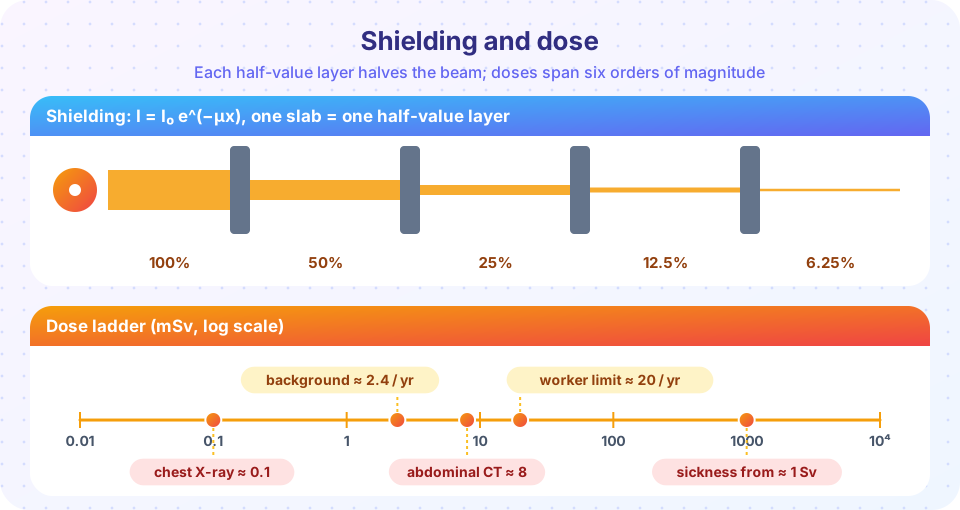
where μ is the linear attenuation coefficient. The thickness that halves the beam is the half-value layer HVL = ln 2 / μ = 0.693/μ, and after n half-value layers the fraction left is (1/2)ⁿ. Approximate HVLs for narrow beams:
| Material | Cs-137 (0.66 MeV) | Co-60 (about 1.25 MeV) |
|---|---|---|
| Lead | 0.6 cm | 1.0 cm |
| Concrete | 4 cm | 5.5 cm |
| Water | 8 cm | 11 cm |
Dense, high-Z materials such as lead are best per centimetre, but concrete is cheaper per square metre and is used for walls. A broad beam includes scattered radiation, so real shielding needs a thicker layer than this table suggests.
Worked example. A dose rate of 80 µSv/h must be cut to 2.5 µSv/h behind a lead wall for Cs-137. Reduction factor = 80/2.5 = 32 = 2⁵, so n = 5 HVLs. Thickness = 5 × 0.6 cm = 3.0 cm of lead.
Inverse-square law
For a small source, the dose rate falls with the square of the distance: D(r) = D(r₀) × (r₀/r)². Doubling the distance cuts the dose rate to a quarter; stepping back from 1 m to 4 m cuts it by 16.
Dose units
Absorbed dose D is energy per mass, measured in gray (Gy = J/kg). An energy of 0.35 J absorbed in a 70 kg person gives 5 mGy. The old unit is the rad (1 rad = 0.01 Gy).
The same absorbed dose is not equally harmful for all radiations, so the equivalent dose in sievert (Sv) is
H = w_R × D
with w_R = 1 for photons, electrons and muons, 2 for protons, 20 for alpha particles and heavy ions, and between about 2.5 and 20 for neutrons depending on energy (ICRP 2007). To account for different organ sensitivities, the effective dose adds the equivalent doses of organs weighted by factors w_T that sum to one. Doses of a few mSv are normal; mSv per year is the usual unit of public exposure.
Typical doses
| Source | Approximate effective dose |
|---|---|
| Chest X-ray | about 0.1 mSv |
| Average natural background (worldwide, per year) | 2.4 mSv |
| CT scan of the abdomen | about 8 mSv |
| Annual limit for radiation workers | 20 mSv per year averaged over five years |
| Public limit from practices | 1 mSv per year |
| Whole-body acute exposure causing sickness | roughly 1 Sv and above |
| Whole-body dose lethal to about half without treatment | roughly 4–5 Sv |
Natural background comes mostly from radon (roughly half), plus cosmic rays, gamma rays from soil and rocks, and potassium-40 and carbon-14 in the body. The exact value varies from about 1 to 10 mSv per year between regions.
Two kinds of effect are distinguished. Deterministic effects (burns, radiation sickness) have a threshold dose and their severity grows with dose. Stochastic effects (cancer, hereditary effects) have a probability that grows with dose and no certain threshold. For protection purposes, regulators assume a linear no-threshold relationship at low doses, though whether this is accurate at the lowest levels is still discussed. This is educational information, not medical advice.
The three protection rules
- Time: the dose is proportional to the exposure time.
- Distance: dose rate falls as 1/r².
- Shielding: each HVL halves the gamma dose.
Together they define ALARA: keep every dose as low as reasonably achievable, balancing the benefit of the activity (a diagnosis, a power station) against the risk.
Common misconceptions
"Sievert and gray are the same unit." Both equal J/kg, but the sievert accounts for the radiation type and organ sensitivity. An absorbed dose of 1 Gy of alpha particles corresponds to 20 Sv of equivalent dose.
"Lead stops all gamma rays." Shielding only reduces them by a factor of 2 per HVL. The beam never reaches exactly zero.
"Any radiation exposure is a catastrophe." Humans always receive radiation from nature. The question is how large the extra dose is compared with background and compared with the benefit.
Try it
A shielding calculator: how many half-value layers, and how thick a wall, to cut a dose rate by a given factor.
Press Run (or Ctrl + Enter) to see the result here.
Program input · what you'd type while the program runs
Type the answers before you press Run, one per line. Each time the program reads a line (with input()), it gets the next line from this box.
Plot how distance and shielding combine to reduce the dose rate from a small source.
Press Run (or Ctrl + Enter) to see the result here.
Program input · what you'd type while the program runs
Type the answers before you press Run, one per line. Each time the program reads a line (with input()), it gets the next line from this box.
Finally, an interactive ALARA planner. Move the sliders to change the three protection levers and see the dose of a job.
Check your understanding
Quick check · 5 questions
of 5 answered You scored / 5 · perfect!
-
1. A shield of 3 half-value layers is placed in front of a gamma source. What fraction of the beam gets through?
Each HVL halves the beam, so 3 HVL give (1/2)³ = 1/8. -
2. You move from 1 m to 3 m from a small gamma source. By what factor does the dose rate change?
The inverse-square law gives (1/3)² = 1/9. -
3. What is the equivalent dose from an absorbed dose of 2 mGy of alpha particles (w_R = 20)?
H = w_R × D = 20 × 2 mGy = 40 mSv. -
4. A radiation worker receives 0.35 J in a body of mass 70 kg from gamma rays. What is the absorbed dose?
D = 0.35 J / 70 kg = 0.005 Gy = 5 mGy. -
5. Which radiation is best slowed by hydrogen-rich materials like water or polyethylene?
Neutrons lose most energy when they collide with hydrogen nuclei, which have nearly the same mass.
Summary
- Alpha and beta particles stop in a defined range; gamma rays and neutrons are attenuated.
- Gamma shielding: I = I₀e^(−μx), HVL = 0.693/μ, and n layers give (1/2)ⁿ.
- Dose: absorbed dose in gray (J/kg); equivalent and effective dose in sievert.
- Natural background averages about 2.4 mSv/year; worker limits are 20 mSv/year averaged over five years.
- Time, distance and shielding give ALARA protection.
Track your progress
Create a free account to tick off lessons and pick up where you left off on any device.
of Nuclear and Particle Physics lessons completed