


















Lesson 40 of 51 · Cosmic Frontiers
Cosmic Frontiers: The Big Picture
How particle physics explains the early universe: expansion, the cosmic microwave background, temperature and time, the matter-antimatter puzzle, and the open questions of this chapter.
The smallest things and the largest thing share one story. A fraction of a second after the Big Bang the whole observable universe was a hot, dense soup of the very particles you have just met, and the processes that cooked it can be studied in accelerators. In the other direction, the universe is the biggest particle-physics experiment there is: it holds clues about neutrinos, dark matter and the matter-antimatter imbalance that no laboratory can supply.
This chapter looks at where the two meet. The first lesson gives the framework: the hot Big Bang, its evidence, and a timeline you will use throughout.
What you will learn
- The three main observational pillars of the hot Big Bang model.
- How temperature and time are related in the early universe.
- What the cosmic microwave background (CMB) is and what it tells us.
- Why the matter-antimatter imbalance is a puzzle for particle physics.
- The map of this chapter.
Key terms
Redshift z: the stretching of light's wavelength by cosmic expansion: 1 + z = λ_observed / λ_emitted.
Hubble constant H₀: the present expansion rate, about 67 to 74 km/s per megaparsec (two methods disagree; this is the "Hubble tension").
CMB: the relic radiation from when the universe became transparent, now at T = 2.7255 K.
Baryon asymmetry: the excess of matter over antimatter, measured by η = n_B / n_γ ≈ 6×10⁻¹⁰.
Recombination: when electrons and nuclei combined into neutral atoms, about 380,000 years after the Big Bang.
Three pillars of the hot Big Bang
- The universe expands. Edwin Hubble found in 1929 that distant galaxies recede with speed proportional to distance,
v = H₀ d. Running the expansion backward, everything was once much denser and hotter. WithH₀ = 70 km/s/Mpcthe naive age1/H₀is about 14 billion years; the fuller calculation with matter and dark energy gives 13.8 billion. - The cosmic microwave background. In 1965 Arno Penzias and Robert Wilson found a faint microwave glow from every direction. It is the most perfect thermal spectrum ever measured, with
T = 2.7255 K, and it is the light released at recombination, when the universe had a temperature of about 3,000 K. Its tiny temperature variations, one part in 100,000, are the seeds of galaxies. - Light element abundances. The universe is about 75% hydrogen and 25% helium by mass, with traces of deuterium, helium-3 and lithium-7. These agree with a calculation of nuclear reactions in the first three minutes (next lesson).
Temperature and time
When the universe was radiation-dominated (until about 50,000 years), its temperature fell as the inverse square root of time: roughly
kT ≈ 1 MeV at t ≈ 1 s kT ∝ t^(-1/2)
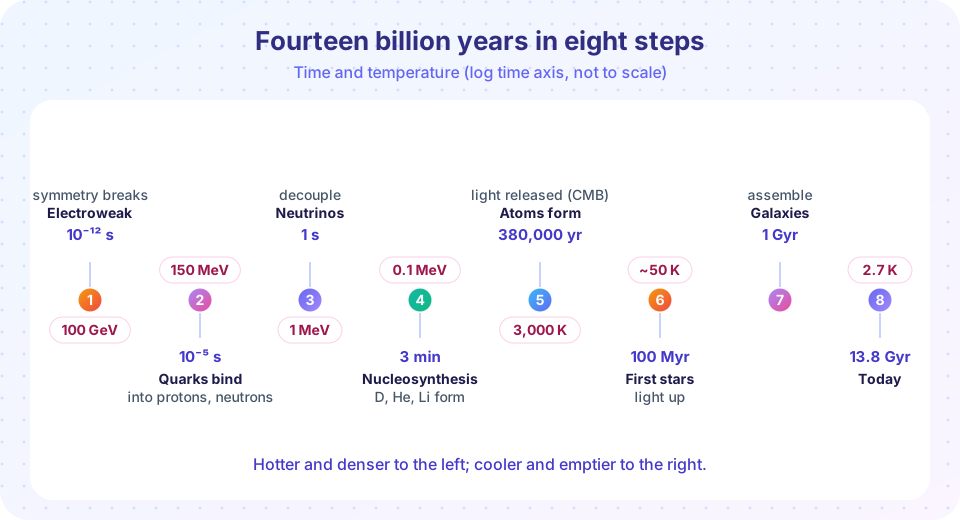
The numerical factor shifts a little as particle species freeze out, but the scaling holds. Extrapolated back, the temperature reaches the electroweak scale (hundreds of GeV) near t = 10⁻¹² s. After that the plasma cooled through the very energies that the LHC explores today, which is why collider physics connects directly to the earliest moments.
| Time | Temperature (kT) | What happens |
|---|---|---|
| 10⁻¹² s | 100 GeV | Electroweak symmetry breaks; W, Z and fermions gain mass |
| 10⁻⁵ s | 150 MeV | Quarks and gluons bind into protons, neutrons and pions |
| 1 s | 1 MeV | Neutrinos decouple; neutron-proton ratio freezes |
| 3 min | 0.1 MeV | Nuclei of D, He and Li form |
| 380,000 yr | 0.26 eV (3,000 K) | Atoms form; the CMB is released |
| 13.8 Gyr | 0.00023 eV (2.7 K) | Today |
While the temperature falls, wavelengths stretch. A CMB photon released at redshift z ≈ 1100 has its temperature lowered by the same factor: T = 2.7255 K × (1 + z).
The matter-antimatter puzzle
Particle physics says matter and antimatter are made in equal amounts. Yet the universe contains almost no antimatter. For every billion photons there is only about 0.6 proton or neutron left over, after almost all matter annihilated with antimatter early on. Where did that tiny excess come from? In 1967 Andrei Sakharov listed three conditions: baryon number violation, violation of C and CP symmetry, and a departure from thermal equilibrium. The Standard Model has some CP violation (seen in K, B and D mesons) but far too little, so new physics is needed. This is one of the main open questions of the field.
Evidence
Timeline
Puzzles
This chapter
In this chapter
| Lesson | Topic |
|---|---|
| Big Bang nucleosynthesis | How the first elements formed and what they tell us |
| Neutrinos and oscillations | Flavor change, masses, solar and atmospheric neutrinos |
| Dark matter and dark energy | Evidence, candidates, expansion history |
| Cosmic rays and antimatter | Particles from space; antimatter searches |
| Chapter review | Recap and mixed quiz |
Common misconceptions
"The Big Bang was an explosion in space." Space itself expanded everywhere at once. There was no center and no outside to explode into.
"The CMB comes from far away." It comes from every direction and every distance: you are seeing the last scattering surface, a shell around you at redshift 1100, a nearly smooth wall of light.
"We know what happened at time zero." The hot Big Bang model works from about 10⁻¹² s onward on tested physics. Earlier times, including inflation, are hypotheses, and time zero is beyond known physics.
Try it
Press Run (or Ctrl + Enter) to see the result here.
Program input · what you'd type while the program runs
Type the answers before you press Run, one per line. Each time the program reads a line (with input()), it gets the next line from this box.
Press Run (or Ctrl + Enter) to see the console output here.
No output.
Check your understanding
Quick check · 5 questions
of 5 answered You scored / 5 · perfect!
-
1. Which observation is NOT one of the three main pillars of the hot Big Bang model?
The three pillars are expansion, the CMB and the abundance of light elements. -
2. What is the present temperature of the CMB?
It was about 3,000 K at recombination and has cooled by a factor of 1,100. -
3. At about what time do neutrinos decouple?
At kT around 1 MeV, about one second after the Big Bang, weak interactions become too slow to keep neutrinos in equilibrium. -
4. What is the baryon-to-photon ratio η?
For every billion photons there is about 0.6 baryon. -
5. Which is NOT one of Sakharov's conditions for making a matter excess?
Sakharov's three conditions concern baryon number, C and CP, and equilibrium.
Summary
- Expansion, the CMB and the light element abundances support the hot Big Bang model.
- Early on,
kT ≈ 1 MeVatt ≈ 1 s; temperature falls liket^(-1/2)in the radiation era. - The CMB, now at 2.7255 K, was released about 380,000 years after the Big Bang at about 3,000 K.
- The matter excess (
η ≈ 6×10⁻¹⁰) needs physics beyond the Standard Model (Sakharov's conditions). - This chapter covers nucleosynthesis, neutrinos, dark matter and dark energy, and cosmic rays.
Next: Big Bang Nucleosynthesis
Track your progress
Create a free account to tick off lessons and pick up where you left off on any device.
of Nuclear and Particle Physics lessons completed