


















Lesson 30 of 51 · Fission and Fusion
Chapter Review: Fission and Fusion
A one-page recap of binding energy, chain reactions, reactors, stellar fusion and fusion power, with a mixed ten-question quiz.
This chapter followed one idea, the binding energy curve, through two very different technologies and a star. Before moving on to the particles themselves, make sure the main threads are tied together.
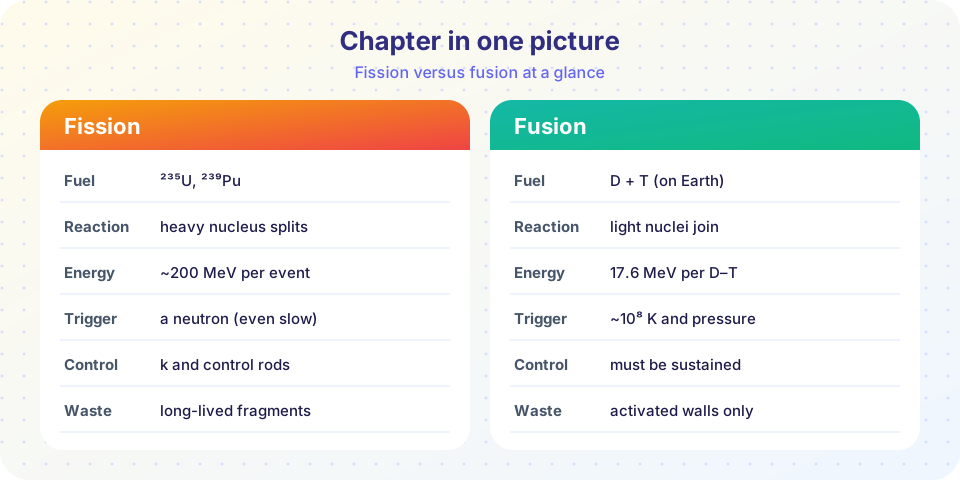
Recap
| Lesson | Main ideas | Numbers to remember |
|---|---|---|
| The big picture | Mass defect, binding energy curve, Q-value | Peak ≈ 8.8 MeV/nucleon at ⁵⁶Fe; 1 u = 931.494 MeV |
| Fission and chain reactions | Liquid drop, fissile vs fertile, k | ≈ 200 MeV per fission, ν̄ ≈ 2.43, β ≈ 0.0065 |
| Reactors and criticality | Moderator, four factors, reactivity, feedback | k∞ = η f p ε; decay heat ≈ 6–7% after shutdown |
| Fusion in stars | Tunneling, Gamow peak, pp chain, CNO | 4p → ⁴He + 26.7 MeV; Gamow peak ≈ 6 keV at 15 MK |
| Fusion power | D–T, Lawson triple product, confinement | 17.59 MeV; n T τ ≳ 3×10²¹ keV s/m³ |
Three things experts do automatically
- Check the energy scale first. Chemical energies are electronvolts, nuclear energies are millions of electronvolts. If a number does not sit in the right band, an error has crept in.
- Count conserved quantities. Every nuclear equation balances nucleon number, charge and lepton number (and energy through the Q-value).
- Ask what competes. Fission is neutron production versus loss; fusion is heating versus loss; stellar fusion is Coulomb repulsion versus tunneling. Almost every result in the chapter is a balance of two opposing rates.
Chapter in 4 slides
Machines
Stars
Next
Try it
Press Run (or Ctrl + Enter) to see the result here.
Program input · what you'd type while the program runs
Type the answers before you press Run, one per line. Each time the program reads a line (with input()), it gets the next line from this box.
Press Run (or Ctrl + Enter) to see the console output here.
No output.
Check your understanding
Quick check · 10 questions
of 10 answered You scored / 10 · perfect!
-
1. Binding energy per nucleon is highest near...
The curve peaks near A ≈ 56 to 62 at roughly 8.8 MeV per nucleon. -
2. A reaction has an atomic mass difference of 0.0035 u (inputs minus outputs). Its Q-value is about...
0.0035 × 931.5 ≈ 3.26 MeV. This is the size of the D + D → ³He + n reaction. -
3. About how much energy does one thermal fission of ²³⁵U release?
About 200 MeV, mostly as kinetic energy of the fragments. -
4. A chain reaction with k = 0.95 will...
With k below 1, each generation is smaller than the last. -
5. What fraction of neutrons from ²³⁵U fission are delayed, roughly?
β ≈ 0.0065. This small fraction slows reactor power changes to the scale of seconds. -
6. Which pair describes the moderator and the control rod correctly?
Slow neutrons fission more readily, so a moderator helps the chain; control rods absorb neutrons to reduce k. -
7. Why can't the Sun's core fuse protons classically?
Only quantum tunneling at the Gamow peak (about 6 keV) allows fusion at a few million kelvin. -
8. The slowest step of the pp chain is slow because...
p + p → d + e⁺ + ν requires a weak decay, which gives a very low rate and a long solar lifetime. -
9. The Lawson triple product for D–T ignition is about...
n T τ_E ≈ 3×10²¹ keV·s/m³ near 14 keV. -
10. Which statement about NIF's 2022 result is accurate?
Target gain was above 1 (about 3.15 MJ out for 2.05 MJ in), but wall-plug energy was much higher.
Summary
- Both fission and fusion move nuclei toward the iron peak of the binding energy curve.
- A fission chain is governed by k and kept steady by delayed neutrons, a moderator and control rods.
- Stars fuse through tunneling at the Gamow peak; the weak-interaction step sets their long lifetimes.
- Fusion power requires the triple product
n T τ_E ≳ 3×10²¹ keV·s/m³.
Track your progress
Create a free account to tick off lessons and pick up where you left off on any device.
of Nuclear and Particle Physics lessons completed