


















Lesson 42 of 51 · Cosmic Frontiers
Neutrinos and Oscillations
From Pauli's desperate remedy to the 2015 Nobel Prize: how neutrinos were found, why solar and atmospheric neutrinos change flavor, and what it says about mass.
Every second, about sixty billion neutrinos from the Sun pass through each square centimetre of your body, and almost none of them interact with it. They are the most abundant particles with mass in the universe after the relic photons, and yet they stayed hidden for a quarter of a century after being predicted. They then turned out to have a property the Standard Model did not expect: they change identity while they travel.
What you will learn
- How neutrinos were predicted and then detected.
- What the solar neutrino problem was and how it was solved.
- Why oscillation requires neutrino masses.
- How to use the two-flavor oscillation formula.
- What we still do not know about neutrinos.
Key terms
Flavor state: a neutrino as produced in a weak interaction: νₑ, ν_μ or ν_τ.
Mass state: a neutrino with a definite mass: ν₁, ν₂ or ν₃.
Mixing angle θ: how the flavor states are combinations of mass states.
Oscillation: the periodic change of flavor with distance traveled.
PMNS matrix: the 3×3 mixing matrix named after Pontecorvo, Maki, Nakagawa and Sakata.
A short history
- 1930: Wolfgang Pauli, trying to save energy conservation in beta decay, proposes a neutral, very light particle. Fermi later names it the neutrino.
- 1956: Clyde Cowan and Frederick Reines detect antineutrinos from a nuclear reactor through the reaction
ν̄ₑ + p → n + e⁺. - 1962: Leon Lederman, Melvin Schwartz and Jack Steinberger show that the muon neutrino is distinct from the electron neutrino.
- 1968 onward: Raymond Davis's Homestake experiment, a tank of 615 tonnes of cleaning fluid, counts solar neutrinos and finds only about a third of the number predicted by solar models. This is the solar neutrino problem.
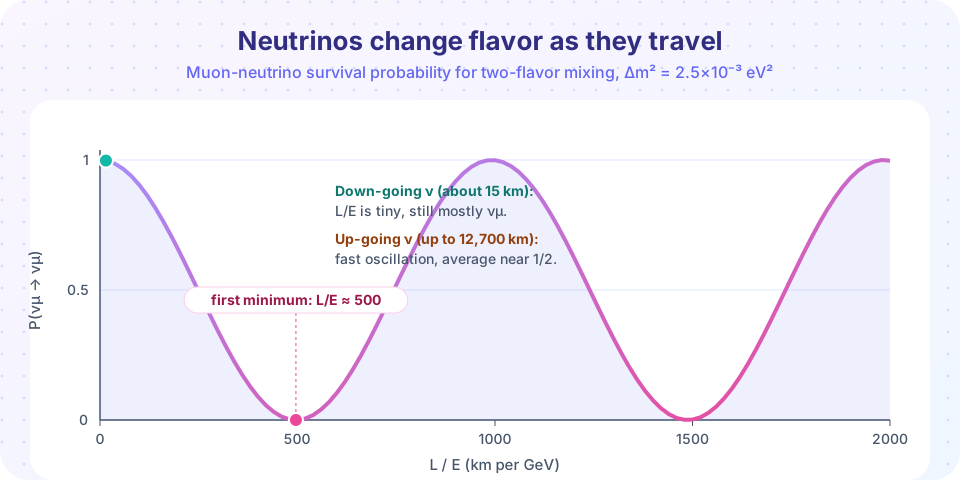
- 1998: Super-Kamiokande in Japan shows that atmospheric muon neutrinos coming from below (after travelling thousands of kilometers) are missing compared with those from above.
- 2001 to 2002: The SNO detector in Canada measures all three flavors of solar neutrinos and shows that the total flux matches the solar model: electron neutrinos from the Sun are turned into other flavors on the way.
- 2015: Takaaki Kajita and Arthur McDonald share the Nobel Prize in Physics for the discovery of neutrino oscillations.
What oscillation means
The neutrino produced in a weak interaction is a flavor state, say ν_μ. But a state with definite mass is a different combination. A ν_μ is a quantum superposition of mass states ν₁, ν₂, ν₃ with slightly different masses. As the neutrino travels, the mass components' quantum phases advance at slightly different rates, so the mixture changes and the particle can later be detected as ν_e or ν_τ.
For two flavors with mixing angle θ and a squared-mass difference Δm²:
P(ν_μ → ν_e) = sin²(2θ) · sin²( 1.267 · Δm² [eV²] · L [km] / E [GeV] )
P(ν_μ → ν_μ) = 1 − P(ν_μ → ν_e)
The first factor is the amplitude: maximal mixing (θ = 45°) gives sin²2θ = 1. The second is the oscillation: it depends on the ratio L/E. Two things follow.
- No oscillation without mass differences. If
Δm² = 0the phase never advances. Observing oscillation therefore proves that at least two neutrinos have non-zero, different masses. The Standard Model as first written had massless neutrinos, so oscillation is the first laboratory evidence of physics beyond it. - Oscillation tells us about mass differences, not the absolute mass.
What we know
Mixing in three flavors is described by three angles and a phase. Approximate values:
| Quantity | Value | Found by |
|---|---|---|
θ₁₂ |
about 33° | solar neutrinos, reactors (KamLAND) |
θ₂₃ |
about 45° to 50° | atmospheric, accelerator (T2K, NOvA) |
θ₁₃ |
about 8.5° | reactor experiments (Daya Bay, RENO, Double Chooz) |
Δm²₂₁ |
about 7.4×10⁻⁵ eV² | solar, KamLAND |
Δm²₃₂ (absolute value) |
about 2.5×10⁻³ eV² | atmospheric, accelerator |
The absolute masses are unknown, but are very small: the tritium beta decay experiment KATRIN limits the electron-antineutrino mass to below about 0.45 eV, and cosmology limits the sum of the three masses to below roughly 0.1 eV, millions of times lighter than the electron.
Unanswered questions: Which neutrino is the lightest (the mass ordering)? Do neutrinos violate CP symmetry, as the matter-antimatter puzzle might hint? Is the neutrino its own antiparticle (a Majorana particle)? Experiments such as DUNE, Hyper-Kamiokande, JUNO and searches for neutrinoless double beta decay aim to answer these.
Why solar neutrinos changed
Neutrinos from the Sun are born as electron neutrinos in fusion reactions (the pp chain). Matter effects inside the Sun (the MSW effect) turn most of the high-energy ones into a different mass state, which then reaches Earth as a mixture of flavors. Homestake detected only νₑ, so it saw about a third. SNO also had sensitivity to neutral-current reactions, which count all flavors, and found the full predicted total. This resolved the puzzle without changing solar physics.
Common misconceptions
"Neutrinos travel faster than light." A 2011 announcement was due to a loose cable in the OPERA experiment. Neutrinos travel just below the speed of light because they have tiny masses.
"A neutrino changes flavor because it is unstable." Oscillation does not involve decay: it is quantum interference between mass states, and the total number of neutrinos is the same.
"Oscillation measures how heavy neutrinos are." It measures differences of squared masses, not the masses themselves.
Try it
Press Run (or Ctrl + Enter) to see the result here.
Program input · what you'd type while the program runs
Type the answers before you press Run, one per line. Each time the program reads a line (with input()), it gets the next line from this box.
Press Run (or Ctrl + Enter) to see the console output here.
No output.
Check your understanding
Quick check · 5 questions
of 5 answered You scored / 5 · perfect!
-
1. What does the observation of neutrino oscillation prove?
The oscillation phase depends on Δm². If all masses were zero the flavors would never change. -
2. Homestake saw about one third of the predicted solar neutrinos because...
SNO later counted all flavors and found the total matched the solar model. -
3. In the formula P = sin²2θ sin²(1.267 Δm² L/E), what does the first factor control?
sin²2θ is the amplitude; the second factor sets the oscillation with L/E. -
4. Which quantity do oscillation experiments measure?
The phase depends on Δm², so only mass-squared differences are accessible. -
5. Who shared the 2015 Nobel Prize in Physics for neutrino oscillations?
Takaaki Kajita (Super-Kamiokande) and Arthur McDonald (SNO).
Summary
- Neutrinos were proposed by Pauli (1930) and first detected by Cowan and Reines (1956); there are three flavors.
- The solar neutrino problem and atmospheric anomalies were solved by oscillation: flavor states are mixtures of mass states.
P = sin²2θ · sin²(1.267 Δm² L/E); oscillation needs non-zero, unequal masses and shows physics beyond the original Standard Model.- Known:
Δm²₂₁ ≈ 7.4×10⁻⁵ eV²,|Δm²₃₂| ≈ 2.5×10⁻³ eV²; the masses are below about 0.1 eV each. - Open: mass ordering, CP violation, Majorana or Dirac nature.
Track your progress
Create a free account to tick off lessons and pick up where you left off on any device.
of Nuclear and Particle Physics lessons completed