


















Lesson 9 of 51 · Nuclear Structure
The Liquid-Drop Model and the Mass Formula
Learn the liquid-drop model of the nucleus and the five-term semi-empirical mass formula: volume, surface, Coulomb, asymmetry and pairing terms.
In 1935 Carl Friedrich von Weizsäcker noticed that the nucleus behaves in many ways like a drop of liquid: it has constant density, a surface tension and a charge that wants to blow it apart. Taking the analogy seriously, he wrote down a formula that predicts the binding energy of almost any nucleus using only A and Z and five fitted numbers. Hans Bethe and Robert Bacher polished it a year later. The result, the semi-empirical mass formula, is the first model every nuclear physicist learns, and it also explains the valley of stability and nuclear fission.
What you will learn
- Write the five terms of the semi-empirical mass formula and explain the physics of each.
- Compute binding energies for any nuclide and compare with measured values.
- Explain how the formula predicts the valley of stability and the limit for fission.
- State where the liquid-drop picture fails.
Key terms
Semi-empirical: based on physical reasoning, but with coefficients fitted to data.
Volume term: the main attraction, proportional to the number of nucleons.
Surface term: a correction for surface nucleons that have fewer neighbours.
Coulomb term: the reduction in binding from the electric repulsion of the protons.
Pairing: the extra binding of nucleons that form pairs of the same kind with opposite spins.
The formula
The binding energy of a nuclide with A nucleons and Z protons is
B(A, Z) = aV·A − aS·A^(2/3) − aC·Z(Z−1)/A^(1/3) − aA·(A−2Z)²/A + δ(A, Z)
with the pairing term δ = +aP/√A for even Z and even N, 0 for odd A, and −aP/√A for odd Z and odd N. A typical set of coefficients, fitted to measured masses, is:
| Term | Coefficient | Value (MeV) |
|---|---|---|
| Volume | aV | 15.8 |
| Surface | aS | 18.3 |
| Coulomb | aC | 0.714 |
| Asymmetry | aA | 23.2 |
| Pairing | aP | 12 |
Different textbooks quote slightly different values, because the fit is not unique. The physics is what matters.
The physics of each term
Volume term, +aV A. The nuclear force saturates: each nucleon attracts only its nearest neighbours, and in the interior each has about the same number of them. So the binding energy is proportional to the number of nucleons, with about 16 MeV per nucleon before corrections.
Surface term, −aS A^(2/3). Nucleons at the surface have fewer neighbours than those inside, so they are less bound. The number of surface nucleons is proportional to the surface area 4πR², which is proportional to A^(2/3). This is the same effect that gives a liquid drop its surface tension. It matters most for small nuclei, where a large fraction of the nucleons lie at the surface.
Coulomb term, −aC Z(Z−1)/A^(1/3). The Z protons repel each other. The electric energy of a uniformly charged sphere is 3/5 × Z²e²/(4πε₀R), which with R = 1.2 A^(1/3) fm gives about 0.72 Z²/A^(1/3) MeV. Using Z(Z−1) instead of Z² removes a proton's repulsion from itself. This term grows rapidly with Z and is the reason heavy nuclei are less tightly bound per nucleon.
Asymmetry term, −aA (A−2Z)²/A. Protons and neutrons each fill their own set of quantum levels, two per level, by the Pauli principle. A nucleus with N ≠ Z must fill higher levels in one kind of nucleon than if it were balanced. It costs energy, and the cost grows with the square of the imbalance N − Z = A − 2Z. This term pulls light nuclei toward N = Z, while the Coulomb term pulls heavy nuclei toward N > Z.
Pairing term, ±aP/√A. Two identical nucleons with opposite spins in the same orbit are bound more tightly. An even-even nucleus (all nucleons paired) gets a bonus, an odd-odd one a penalty, and an odd-A nucleus has one unpaired nucleon and gets nothing. Evidence: of the roughly 250 stable nuclides, more than 140 are even-even, and only a few light ones (²H, ⁶Li, ¹⁰B, ¹⁴N) are odd-odd.
Worked example: iron-56
For A = 56, Z = 26, N = 30:
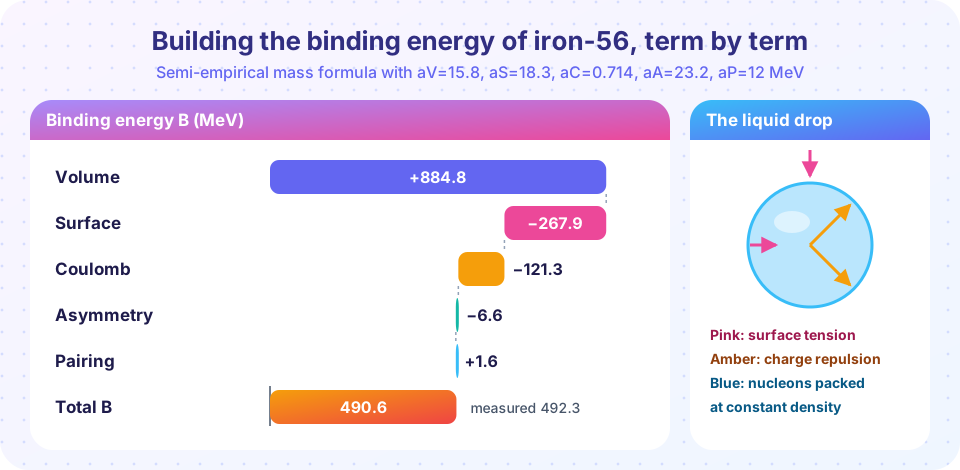
- Volume: 15.8 × 56 = 884.8 MeV.
- Surface: 18.3 × 56^(2/3) = 18.3 × 14.64 = 267.9 MeV.
- Coulomb: 0.714 × 26 × 25 / 56^(1/3) = 0.714 × 650 / 3.826 = 121.3 MeV.
- Asymmetry: 23.2 × (56 − 52)² / 56 = 23.2 × 16 / 56 = 6.6 MeV.
- Pairing (even-even): +12/√56 = +1.6 MeV.
B = 884.8 − 267.9 − 121.3 − 6.6 + 1.6 = 490.6 MeV. The measured value is 492.3 MeV, an error of 0.35%.
What the formula predicts
The valley of stability. For a fixed A, B is largest at a particular Z, found by setting dB/dZ = 0. The result is, in good approximation, Z₀ = A / (1.98 + 0.0155 A^(2/3)): Z₀ ≈ A/2 for light nuclei and noticeably below A/2 for heavy ones, exactly as the chart of nuclides shows (lesson 3 of chapter 1).
Beta decay energies. For a fixed odd A the masses form a parabola in Z, and the nucleus slides down the parabola by β decay. For an even A there are two parabolas (even-even lower, odd-odd higher) because of pairing, and some nuclei can decay in two steps (double beta decay).
Fission. Compare the surface term (which favors a single drop) with the Coulomb term (which favors splitting). The ratio is governed by the fissility Z²/A. A nucleus with Z²/A around 49 would split instantly. ²³⁵U has Z²/A = 36.0, which is near enough to the limit that it will split if you add just a little energy by capturing a neutron: the barrier is only a few MeV (chapter 5).
Where the model fails
It is a smooth function, so it misses the shell effects. At the magic numbers (2, 8, 20, 28, 50, 82, 126) real nuclei are bound a few MeV more than the formula predicts. It is also poor for the lightest nuclei (A below about 20), where there is no interior. It cannot tell you spins, excited states or magnetic moments. Those need the shell model (next lesson), and the best nuclear mass models today combine the liquid-drop idea with shell corrections.
Common misconceptions
"The nucleus really is a liquid." The analogy is about energies. Nucleons are quantum objects, and the nucleus is far from a classical drop.
"Semi-empirical means the numbers are guessed." The coefficients are fitted to data, but each term has a physical derivation and a predicted dependence on A and Z.
"The Coulomb term is why nuclei fall apart." It reduces binding; the nucleus is stable as long as the total B stays positive and above the thresholds for decay.
Try it
Compute the formula for several nuclides and compare with measured binding energies.
Press Run (or Ctrl + Enter) to see the result here.
Program input · what you'd type while the program runs
Type the answers before you press Run, one per line. Each time the program reads a line (with input()), it gets the next line from this box.
Now plot B/A from the formula along the valley of stability and compare it with real data.
Press Run (or Ctrl + Enter) to see the result here.
Program input · what you'd type while the program runs
Type the answers before you press Run, one per line. Each time the program reads a line (with input()), it gets the next line from this box.
Finally, an interactive version: choose Z and N and see each term as a bar.
Check your understanding
Quick check · 5 questions
of 5 answered You scored / 5 · perfect!
-
1. Which term of the formula is responsible for most of the binding?
The volume term (about 15.8 MeV per nucleon) is the largest, and the other terms are corrections. -
2. Why is the surface term proportional to A^(2/3)?
The number of surface nucleons scales with 4πR², and R ∝ A^(1/3), so the term goes as A^(2/3). -
3. Which type of nucleus gets a positive pairing bonus?
Even-even nuclei have all nucleons paired, and the pairing term is +aP/√A for them. -
4. What does the asymmetry term do?
The Pauli principle makes unbalanced nuclei fill higher levels, so −aA(A−2Z)²/A lowers B when N differs from Z. -
5. For which kind of nuclei does the liquid-drop formula work worst?
Light nuclei have no true interior, and magic nuclei have extra shell binding that the smooth formula omits.
Summary
- B = aV A − aS A^(2/3) − aC Z(Z−1)/A^(1/3) − aA (A−2Z)²/A + δ.
- Volume and surface come from saturating short-range forces; Coulomb from proton repulsion; asymmetry from the Pauli principle; pairing from spin coupling.
- The formula predicts the valley of stability and the fissility Z²/A.
- It ignores shell effects, which the next lesson adds.
Track your progress
Create a free account to tick off lessons and pick up where you left off on any device.
of Nuclear and Particle Physics lessons completed