


















Lesson 4 of 51 · Getting Started
The Four Forces and the Particle Zoo
Compare the strong, electromagnetic, weak and gravitational forces by strength, range and carrier, and meet quarks, leptons and bosons at a glance.
Everything that happens in the universe, from a falling apple to a supernova, comes from just four fundamental interactions. Only two of them matter much inside the nucleus, and a third explains why some nuclei decay. The fourth, gravity, is by far the weakest, yet it dominates the cosmos because it never cancels. In this lesson you rank the forces, learn why each has the range it has, and take a first look at the particles the next chapters will study in detail.
What you will learn
- Name the four forces and compare their strength, range and carrier particle.
- Explain why a massive carrier gives a short-range force (the ħc/mc² rule).
- Describe the three particle families: quarks, leptons and bosons.
- Say which force is responsible for nuclear binding, for beta decay and for the structure of the atom.
Key terms
Interaction (force): a way particles influence each other, described in modern physics as an exchange of carrier particles.
Boson: a particle that carries a force (photon, gluon, W, Z) or the Higgs field excitation.
Quark: a fundamental particle that feels the strong force; six flavors exist (up, down, charm, strange, top, bottom).
Lepton: a fundamental particle that does not feel the strong force (electron, muon, tau and three neutrinos).
Hadron: a particle made of quarks: a baryon (three quarks, like the proton) or a meson (a quark and an antiquark).
The four interactions
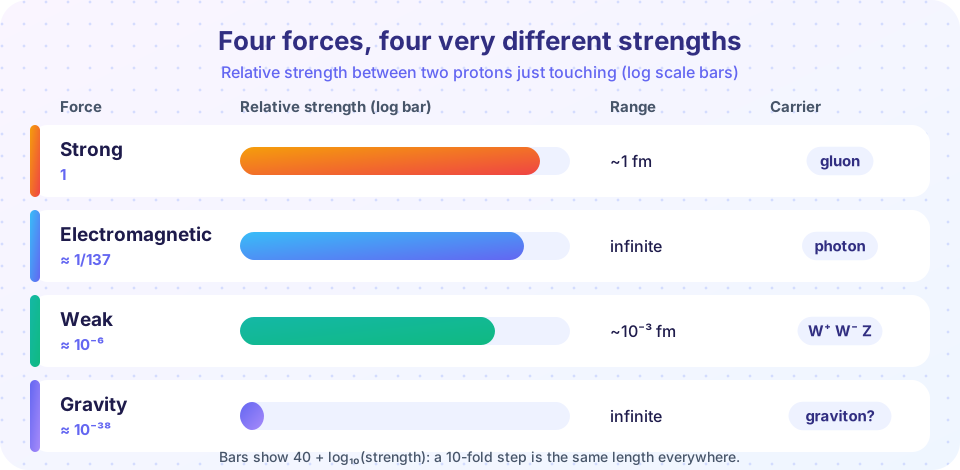
| Force | Acts on | Carrier | Relative strength | Range |
|---|---|---|---|---|
| Strong | quarks, gluons | gluons | 1 | about 1 fm (confined) |
| Electromagnetic | electric charge | photon | about 1/137 | infinite |
| Weak | all quarks and leptons | W⁺, W⁻, Z⁰ | about 10⁻⁶ | about 10⁻³ fm |
| Gravity | all energy and mass | graviton (hypothetical) | about 10⁻³⁸ | infinite |
The comparison of strengths depends on what you compare; the numbers above refer to two protons close together. The electromagnetic strength is the dimensionless fine-structure constant, α = e²/(4πε₀ħc) ≈ 1/137. Gravity between two protons is smaller than their electric repulsion by a factor of about 10³⁶. The weak force is "weak" mostly because its carriers are so heavy; at energies far above 100 GeV it is as strong as electromagnetism, which hints at a deeper unity of the two (the electroweak theory, chapter 6).
Why ranges differ
A force carried by a massless particle, such as the photon, has an infinite range and a potential that falls like 1/r. A force carried by a particle of mass m can only reach about
range ≈ ħc / (mc²)
because a virtual carrier can exist only for a time Δt ≈ ħ/(mc²) allowed by the energy-time uncertainty relation, and even at the speed of light it cannot travel farther than cΔt. Plug in the W boson (80.4 GeV/c²) and you get 0.0025 fm. Hideki Yukawa used the same argument in 1935 to predict a particle of about 100–200 MeV/c² to carry the nuclear force; the pion (139.6 MeV/c²) was found in 1947 and gives a range of 1.4 fm, just right.
The shape of such a force is the Yukawa potential, V(r) ∝ e^(−r/λ) / r, with λ = ħc/mc². Beyond a few λ it is exponentially small, which is why nuclear forces vanish a few fm outside a nucleus.
The strong force, closer up
At its most basic level the strong force acts between quarks and is carried by gluons. Quarks carry a "color charge" and are confined: no one has ever seen a free quark. Protons and neutrons are color-neutral bundles. The force that binds nucleons into nuclei is a leftover, the residual strong force, in the same way that the force between neutral molecules is a leftover of electromagnetism. It is attractive at 1–2 fm, strongly repulsive below about 0.5 fm and almost zero beyond 3 fm.
The electromagnetic force
It holds electrons around nuclei and creates all of chemistry. Inside the nucleus it is a troublemaker: the protons repel each other, and the repulsion adds up across the whole nucleus (Coulomb energy ∝ Z²). It limits the size of nuclei. Beyond Z = 82 no nucleus is stable, and above Z = 100 even the longest-lived nuclei last only hours to months, and beyond Z = 110 the known ones live for seconds or less.
The weak force
The weak force can change one type of quark into another, which is why it can turn a neutron into a proton in beta decay. It is also the only force to which neutrinos respond (apart from gravity). It violates parity, meaning nature can tell left from right in weak processes, a discovery of 1956–57 you will meet in chapter 3.
Gravity
Between two protons gravity is 10³⁶ times weaker than electric repulsion. It matters in the cosmos because matter overall is electrically neutral, so electric forces cancel, while mass only ever adds up. It plays no role in nuclear structure, though it holds the star together in which nuclear reactions occur.
A first look at the particle zoo
All ordinary matter is built from three particles: the up quark (charge +2/3), the down quark (−1/3) and the electron (−1). A proton is up-up-down (uud), a neutron up-down-down (udd). Nature repeats this pattern twice more with heavier copies, called generations:
| Generation | Quarks | Charged lepton | Neutrino |
|---|---|---|---|
| 1 | up, down | electron | νₑ |
| 2 | charm, strange | muon | ν_μ |
| 3 | top, bottom | tau | ν_τ |
The carriers are the photon, eight gluons, W⁺, W⁻, Z⁰, and then the Higgs boson (125 GeV/c²), discovered in 2012. Every particle has an antiparticle with opposite charge. Chapter 6 studies all of this properly.
Worked example: electric versus gravitational force
For two protons at any separation r, both forces fall off as 1/r², so their ratio is constant:
F_el / F_grav = e² / (4πε₀ G m_p²)
With e = 1.602 × 10⁻¹⁹ C, m_p = 1.673 × 10⁻²⁷ kg, G = 6.674 × 10⁻¹¹ N·m²/kg² and 1/(4πε₀) = 8.988 × 10⁹ N·m²/C², the ratio is about 1.2 × 10³⁶. That is why you can ignore gravity in every calculation in this course.
Common misconceptions
"Gravity holds the nucleus together." The binding force is the residual strong force; gravity is 10³⁸ times weaker.
"The weak force is weak at all energies." It is weak at low energy because of the heavy W and Z. At energies above 100 GeV it becomes comparable to electromagnetism.
"Force carriers are tiny balls thrown between particles." They are quanta of fields; the exchange picture is a calculation tool of quantum field theory, not a literal ball game.
Try it
Compute the comparison between gravity and electromagnetism, and the ranges of several carriers.
Press Run (or Ctrl + Enter) to see the result here.
Program input · what you'd type while the program runs
Type the answers before you press Run, one per line. Each time the program reads a line (with input()), it gets the next line from this box.
Now plot the Yukawa potential for the pion against the pure 1/r shape of a massless carrier. The factor e^(−r/λ) is what cuts the force off.
Press Run (or Ctrl + Enter) to see the result here.
Program input · what you'd type while the program runs
Type the answers before you press Run, one per line. Each time the program reads a line (with input()), it gets the next line from this box.
Check your understanding
Quick check · 5 questions
of 5 answered You scored / 5 · perfect!
-
1. Which force is responsible for beta decay?
Beta decay changes a quark flavor, which only the weak interaction (W boson exchange) can do. -
2. Why does the weak force have a very short range?
A carrier of mass m limits the range to about ħc/(mc²). For the W boson this is only 0.0025 fm. -
3. A proton consists of which quarks?
uud gives charge +2/3 + 2/3 − 1/3 = +1. -
4. Roughly how many times stronger is the electric repulsion between two protons than their gravitational attraction?
The ratio e²/(4πε₀Gm_p²) is about 1.2 × 10³⁶. -
5. Which particle did Yukawa predict in 1935 to carry the nuclear force?
From the range of about 1.4 fm he estimated a mass near 140 MeV/c²; the pion was found in 1947.
Summary
- Four interactions: strong, electromagnetic, weak and gravity, with strengths spanning about 38 orders of magnitude.
- A carrier of mass m gives a range of about ħc/(mc²); massless carriers give infinite range.
- The nuclear force is the residual strong force, with a range of 1–3 fm.
- Matter comes from quarks and leptons in three generations; forces come from bosons.
Track your progress
Create a free account to tick off lessons and pick up where you left off on any device.
of Nuclear and Particle Physics lessons completed