


















Lesson 27 of 51 · Fission and Fusion
Nuclear Reactors and Criticality
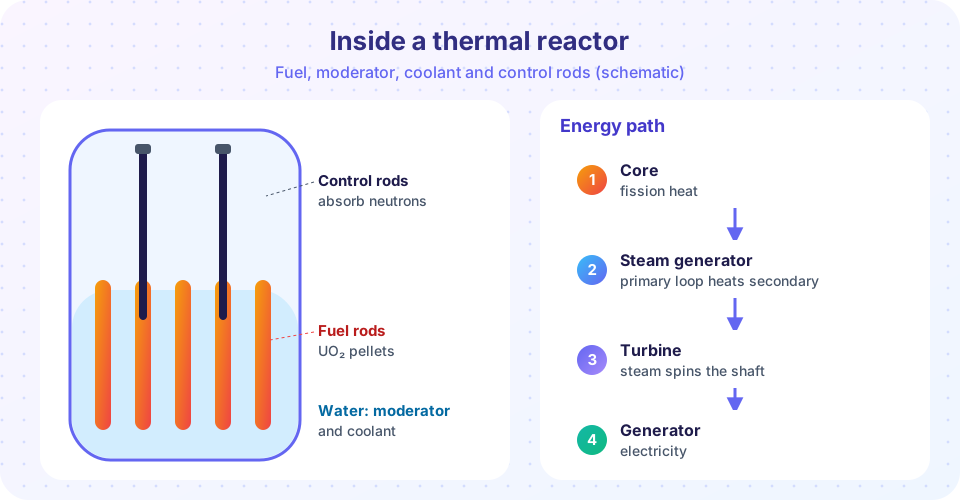
Fuel, moderator, coolant and control rods; the four-factor formula; reactivity and delayed neutrons; feedback and xenon, with a point-kinetics simulation.
A nuclear reactor is a machine that holds a fission chain reaction at exactly k = 1 and carries the heat away. That sounds simple, yet it has to be done for years, with power that can be turned up and down, and with safety even when something fails. This lesson explains how the parts do their jobs and why delayed neutrons and feedback make this possible.
What you will learn
- Why most reactors slow neutrons down, and what moderators do.
- What the four-factor formula says about
k. - How reactivity, delayed neutrons and control rods keep power steady.
- Why feedback effects make well-designed reactors self-stabilising.
- Why a shut-down reactor still makes heat.
Key terms
Moderator: a light material (water, heavy water, graphite) that slows fast neutrons by collisions without absorbing many.
Thermal neutron: a neutron in equilibrium with its surroundings, about 0.025 eV at room temperature.
Enrichment: the percentage of ²³⁵U in uranium. Natural uranium has 0.72%; typical power reactors use 3 to 5%.
Reactivity ρ: the fractional departure from criticality, ρ = (k − 1) / k.
Decay heat: heat from the beta and gamma decay of fission products after the chain has stopped.
Why slow neutrons down?
Neutrons from fission start with an average energy of about 2 MeV. The probability that ²³⁵U fissions follows roughly 1/v at low speed: slow neutrons are very much more effective. At thermal energies the fission cross-section of ²³⁵U is about 585 barns, against around 1 barn for MeV neutrons.
A moderator slows neutrons by elastic collisions. A neutron loses the most energy when it hits something of its own mass, so hydrogen in water is an excellent moderator, though ordinary hydrogen also absorbs neutrons. Heavy water (deuterium oxide) absorbs very few neutrons, so reactors that use it, such as the CANDU design, can run on natural uranium. Graphite is a third option. A fission neutron needs about 20 collisions in water, or about 115 in graphite, to reach thermal energies.
Reactors using the slowing-down approach are called thermal reactors. Fast reactors use no moderator, need more fissile material and typically use liquid metal coolant (sodium); in exchange they can convert ²³⁸U into plutonium and burn some long-lived waste.
The four-factor formula
To follow neutrons around one generation in an infinite reactor, use four factors:
k∞ = η · f · p · ε
η(eta): neutrons produced per neutron absorbed in fuel. For ²³⁵U at thermal energyη ≈ 2.07; for natural uranium about 1.34, which is why enrichment helps.f: thermal utilisation, the fraction of thermal neutrons absorbed in fuel and not in the moderator or structure.p: resonance escape probability, the fraction that survive slowing down without being captured by ²³⁸U resonances.ε: fast fission factor, a small boost (about 1.02 to 1.08) from fission of ²³⁸U by fast neutrons.
A real, finite core also leaks neutrons, so k = k∞ · P_NL where P_NL is the non-leakage probability. Designers play these terms against each other: fuel lumped into rods increases p (neutrons slow down in the water, away from the ²³⁸U resonances), while too much fuel lowers f.
Reactivity, control rods and delayed neutrons
Reactor engineers measure how far from critical the core is with the reactivity ρ = (k − 1)/k. It is often given in units of β, the delayed neutron fraction (about 0.0065 for ²³⁵U), called "dollars": ρ = 1 $ means ρ = β.
- If
0 < ρ < β, the reactor is supercritical but needs the delayed neutrons to keep growing. Power rises on a scale of seconds to minutes. This is the regime of normal power changes. - If
ρ ≥ βthe reactor is prompt critical: the chain sustains itself without delayed neutrons and power rises in milliseconds. Every design keeps reactivity far below 1 $.
Control rods contain strong neutron absorbers such as boron carbide, hafnium or silver-indium-cadmium. Inserting them lowers f, so k drops. Boron dissolved in the cooling water of a pressurized water reactor gives slow, fine control through the fuel cycle.
Feedback: reactors that stabilise themselves
When power rises, the fuel heats up. In a well-designed light water reactor:
- Doppler broadening makes ²³⁸U capture more neutrons in its resonances as it gets hotter, lowering
p. - Water expands or boils and moderates less, lowering
fand reactivity.
Both effects lower k as temperature rises: a negative temperature coefficient. A power surge limits itself. A design with a positive void coefficient (more steam leads to more reactivity) lacks this safety net; it was one of the contributing factors in the 1986 Chernobyl accident, together with design weaknesses in the control rods and serious operating errors.
Xenon-135 is a fission product with a huge neutron absorption cross-section (about 2.6 million barns). It builds up after a power reduction and can make restart temporarily difficult. Operators must account for it.
After the chain stops
Even with the control rods fully in, the fission products keep decaying and give off heat: about 6 to 7% of full power immediately after shutdown, falling to roughly 1% after a day. Cooling must continue, and that is why the safety systems of power plants are mainly about removing decay heat.
Common misconceptions
"Control rods slow neutrons." They absorb neutrons. The moderator slows them.
"The reactor core is at the same temperature as the Sun." The middle of a fuel pellet reaches roughly 1,000 to 1,500 °C, and the coolant is about 300 °C. Fusion needs about a hundred million degrees.
"Higher enrichment is always better." Power reactors need only a few percent. Fuel above 20% is used only in special reactors and needs strict safeguards.
Try it
Press Run (or Ctrl + Enter) to see the result here.
Program input · what you'd type while the program runs
Type the answers before you press Run, one per line. Each time the program reads a line (with input()), it gets the next line from this box.
Press Run (or Ctrl + Enter) to see the console output here.
No output.
Check your understanding
Quick check · 5 questions
of 5 answered You scored / 5 · perfect!
-
1. What is the job of the moderator?
Slow (thermal) neutrons have much larger fission cross-sections in ²³⁵U, so a moderator greatly improves the chain. -
2. Which reactor design can use natural uranium?
Heavy water absorbs very few neutrons, so the neutron economy is good enough for unenriched fuel. -
3. In k∞ = η f p ε, what does the symbol p stand for?
p is the chance that a neutron slows to thermal energy without being captured in a ²³⁸U resonance. -
4. A reactor's temperature rises and its reactivity falls. This is called...
Negative feedback makes the reactor self-limiting. Doppler broadening and moderator expansion both reduce k when temperature rises. -
5. Why must cooling continue after a reactor is shut down?
Decay heat is about 6 to 7% of full power right after shutdown and decreases slowly.
Summary
- Thermal reactors slow neutrons with a moderator because slow neutrons fission ²³⁵U far more readily.
k∞ = η f p ε; leakage reduces it to the actualk. Reactivity isρ = (k − 1)/k.- Delayed neutrons (about 0.65%) set the reactor's response time; designs never approach prompt criticality.
- Control rods absorb neutrons; a negative temperature coefficient makes the core self-regulating.
- Decay heat continues after shutdown, so cooling must be maintained.
Next: Fusion in Stars
Track your progress
Create a free account to tick off lessons and pick up where you left off on any device.
of Nuclear and Particle Physics lessons completed