


















Lesson 45 of 51 · Cosmic Frontiers
Chapter Review: Cosmic Frontiers
A one-page recap of the early universe, nucleosynthesis, neutrino oscillations, dark matter and dark energy, cosmic rays and antimatter, with a mixed ten-question quiz.
This chapter connected the particles of the Standard Model with the history and contents of the universe. The questions here are among the most active in physics, and many are still open. Use this review to fix the main facts and numbers before the practice and project chapter.
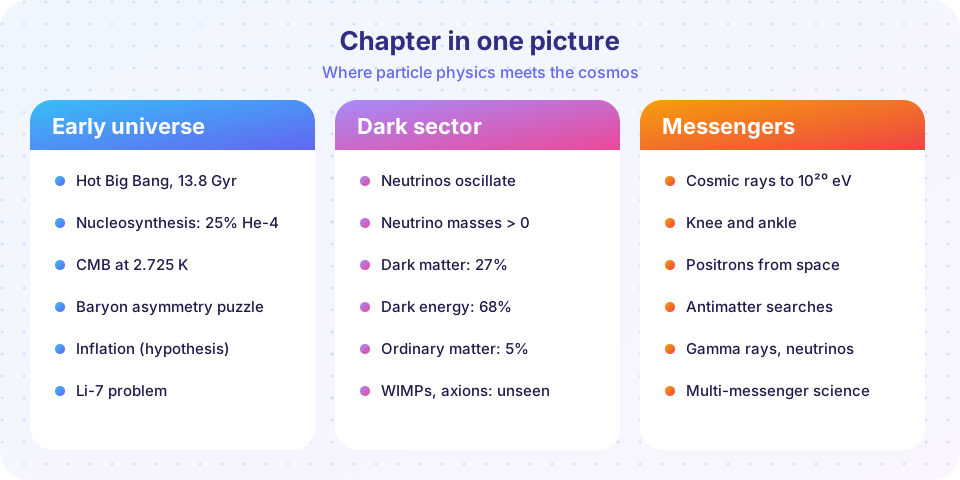
Recap
| Lesson | Main ideas | Numbers to remember |
|---|---|---|
| The big picture | Expansion, CMB, abundances, baryon asymmetry | T_CMB = 2.7255 K; η ≈ 6×10⁻¹⁰; kT ≈ 1 MeV at 1 s |
| Nucleosynthesis | Freeze-out, deuterium bottleneck, Y_p |
n/p: 1/6 to 1/7; Y_p ≈ 0.25; D/H ≈ 2.5×10⁻⁵ |
| Neutrinos | Mixing, oscillation, masses | Δm²₃₂ ≈ 2.5×10⁻³ eV²; P = sin²2θ sin²(1.267 Δm² L/E) |
| Dark matter and energy | Rotation curves, lensing, acceleration, Λ | 5% / 27% / 68% budget |
| Cosmic rays and antimatter | Spectrum, shocks, GZK, positrons | knee 3×10¹⁵ eV; ankle 5×10¹⁸ eV; GZK ≈ 5×10¹⁹ eV |
Ways to reason
- Follow the scaling. Matter dilutes as
a⁻³, radiation asa⁻⁴, temperature as1/a; many results in cosmology follow from these rules. - Find the competition. Nucleosynthesis: neutron decay versus nuclear burning. GZK: proton energy versus CMB photon energy. Galaxy halos: visible versus unseen mass.
- Separate evidence from interpretation. Gravitational evidence for dark matter is robust; the particle identity is unknown. Oscillations are certain; neutrino mass ordering is not.
Early universe
Dark sector
Neutrinos
Messengers
Try it
Press Run (or Ctrl + Enter) to see the result here.
Program input · what you'd type while the program runs
Type the answers before you press Run, one per line. Each time the program reads a line (with input()), it gets the next line from this box.
Press Run (or Ctrl + Enter) to see the console output here.
No output.
Check your understanding
Quick check · 10 questions
of 10 answered You scored / 10 · perfect!
-
1. Which of these is the temperature of the CMB today?
It started at about 3,000 K at recombination and has been redshifted by 1,100. -
2. At nucleosynthesis n/p ≈ 1/7. What is the helium-4 mass fraction?
Y = 2(n/p)/(1 + n/p) = 0.25. -
3. Which observation first showed that solar neutrinos change flavor?
SNO found that the total flux of all flavors matched the solar model. -
4. What do neutrino oscillations tell us about neutrino masses?
The oscillation phase depends on Δm², so neutrinos must have unequal non-zero masses. -
5. About how much of the universe's energy is ordinary matter?
Dark matter is about 27% and dark energy about 68%. -
6. How does the density of a cosmological constant evolve?
It does not dilute as space expands. -
7. What is the Bullet Cluster evidence for?
Lensing showed mass peaks passing through the collision, away from the gas. -
8. What effect cuts off the highest-energy cosmic-ray protons?
Above about 5×10¹⁹ eV, p + γ_CMB → p + π⁰ drains their energy. -
9. Which is NOT one of Sakharov's conditions?
Baryon number violation is required, which allows proton decay in principle. -
10. Deuterium abundance mainly tells us the...
More baryons destroy more deuterium, so D/H is a sensitive baryometer.
Summary
- The hot Big Bang is supported by expansion, the CMB and the light-element abundances; the matter excess needs new physics.
- Nucleosynthesis fixes
Y_p ≈ 0.25and gives the baryon density through deuterium; lithium-7 disagrees. - Neutrino oscillations prove that neutrinos have masses; ordering, CP violation and Majorana nature are open.
- Dark matter (27%) and dark energy (68%) dominate; ordinary matter is about 5%.
- Cosmic rays reach 10²⁰ eV; antimatter is rare; understanding why is a major goal.
Track your progress
Create a free account to tick off lessons and pick up where you left off on any device.
of Nuclear and Particle Physics lessons completed