


















Lesson 24 of 51 · Nuclear Reactions
Chapter 4 Review: Reactions in One Page
Review chapter 4: reaction notation, conservation laws, Q-values and thresholds, cross sections and rates, direct and compound mechanisms, and isotope production.
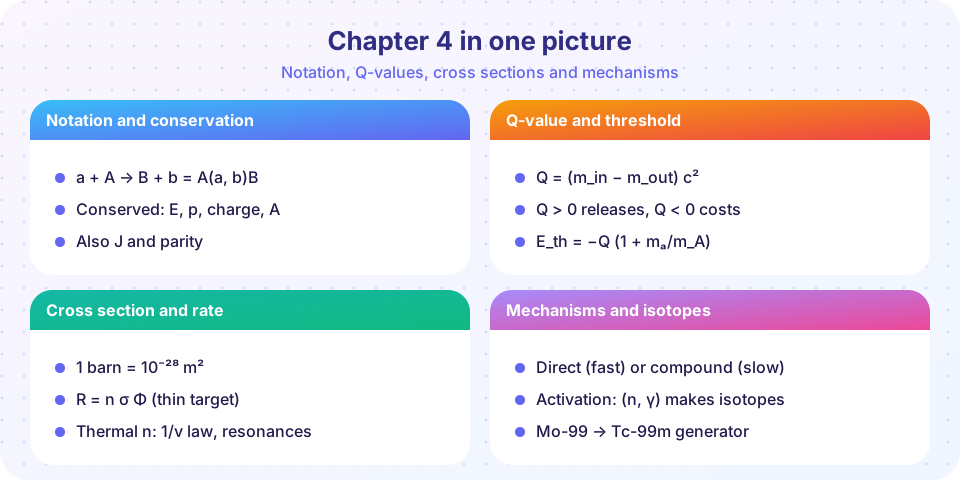
Chapter 4 turned nuclei from things you watch into things you hit. You can now write a reaction, check that it balances, calculate whether it gives or takes energy, find the threshold, estimate the Coulomb barrier, say how often it will happen, and describe how reactors and cyclotrons use it to make isotopes. This review puts it on one page, adds worked problems and ends with a ten-question quiz.
What you will learn
- Recall the key formulas of nuclear reactions.
- Solve mixed problems combining Q-value, threshold, barrier and rate.
- See how this chapter prepares for fission and fusion in chapter 5.
Key terms
A(a, b)B: compact reaction notation (target, projectile, ejectile, residual nucleus).
Q: (Σ m_in − Σ m_out)c²; positive means energy is released.
E_th: threshold energy ≈ −Q(1 + m_a/m_A) for endothermic reactions.
σ and R: cross section (barn = 10⁻²⁸ m²) and reaction rate R = ΦNσ.
E*: excitation energy of a compound nucleus, S + E_cm.
The chapter in a table
| Topic | Key facts and formulas |
|---|---|
| Notation | a + A → B + b = A(a, b)B; conserve Z, A, energy, momentum, spin |
| Types | scattering, capture (n, γ), transfer (d, p), knockout, fission, fusion |
| Q-value | Q = (Σ m_in − Σ m_out)c²; Q > 0 exothermic, Q < 0 endothermic |
| Threshold | E_th ≈ −Q(1 + m_a/m_A) in the lab |
| Coulomb barrier | V ≈ 1.44 Z₁Z₂/(1.2(A₁^(1/3) + A₂^(1/3))) MeV; tunnelling below it |
| Cross section | 1 b = 10⁻²⁸ m²; R = ΦNσ; I = I₀e^(−nσx) |
| Neutron σ(E) | 1/v at low energy, Breit-Wigner resonances, smooth in the fast region |
| Mechanisms | direct (10⁻²² s, forward peaked), compound (≥ 10⁻¹⁹ s, independence hypothesis) |
| Isotopes | (n, γ) in reactors, (p, n) in cyclotrons, generators like Mo-99/Tc-99m |
| Landmarks | Rutherford 1919, Chadwick 1932, Cockcroft-Walton 1932, Joliot-Curie 1934 |
Worked review problems
Problem 1 (Q-value). ²H + ³H → ⁴He + n. Masses: 2.014102, 3.016049, 4.002603, 1.008665 u. Initial 5.030151, final 5.011268, difference 0.018883 u, so Q = 17.59 MeV. This is the fusion reaction of chapter 5.
Problem 2 (threshold). ⁷Li(p, n)⁷Be has Q = −1.644 MeV. E_th = 1.644 × (1 + 1.008/7.016) = 1.88 MeV.
Problem 3 (barrier). An alpha particle on ²⁰⁸Pb: V = 1.44 × 2 × 82/(1.2 × (1.587 + 5.925)) = 236/9.01 = 26.2 MeV. A 5.5 MeV alpha particle cannot reach the surface of lead.
Problem 4 (attenuation). A thin foil has nσ = 0.50 cm⁻¹ for thermal neutrons. How thick must it be to stop 99% of them? e^(−0.5x) = 0.01, so x = ln 100/0.5 = 9.2 cm.
Problem 5 (growth). A product with half-life 6 hours is made at a constant rate R. After 12 hours of irradiation the activity is R(1 − 1/4) = 0.75 R.
Problem 6 (compound nucleus). α + ¹⁴N at E_cm = 6.0 MeV makes ¹⁸F with S = 4.4 MeV, so E* = 10.4 MeV.
Where this leads
Chapter 5 uses the same tools on two special classes of reaction. In fission a neutron makes a heavy nucleus split and releases about 200 MeV plus more neutrons, which can sustain a chain reaction. In fusion light nuclei overcome the Coulomb barrier to merge, with Q-values like the 17.59 MeV above. The binding energy curve of chapter 2 explains the energy; the cross sections of this chapter decide whether it can be harnessed.
Common misconceptions
"Threshold energy is the same as |Q|." It is larger, because the products must carry the projectile's momentum.
"A larger cross section always means a faster reaction." The rate also depends on the flux and the number of target nuclei.
"Medical isotopes are made in the hospital's X-ray machine." They are made in reactors or cyclotrons and delivered, or, for generators, produced from a longer-lived parent.
Try it
A reaction workbench: for any reaction it computes Q, the threshold, the Coulomb barrier and whether a given beam energy is above them.
Press Run (or Ctrl + Enter) to see the result here.
Program input · what you'd type while the program runs
Type the answers before you press Run, one per line. Each time the program reads a line (with input()), it gets the next line from this box.
A real activation estimate, step by step. The numbers are illustrative: 10 g of natural molybdenum in a reactor flux of 10¹⁴ n cm⁻² s⁻¹, making ⁹⁹Mo by capture on ⁹⁸Mo.
Press Run (or Ctrl + Enter) to see the result here.
Program input · what you'd type while the program runs
Type the answers before you press Run, one per line. Each time the program reads a line (with input()), it gets the next line from this box.
Check your understanding
Quick check · 10 questions
of 10 answered You scored / 10 · perfect!
-
1. What is the residual nucleus in ¹⁰B(n, α)?
Z: 5 + 0 − 2 = 3; A: 10 + 1 − 4 = 7, so ⁷Li. This is the reaction that makes boron a neutron absorber. -
2. A reaction has Q = −2.0 MeV and the projectile is 4 times lighter than the target. What is the approximate threshold?
E_th = 2.0 × (1 + 1/4) = 2.5 MeV. -
3. A foil has 10²⁰ target nuclei and σ = 2 b. The flux is 10¹² cm⁻² s⁻¹. What is the reaction rate?
R = ΦNσ = 10¹² × 10²⁰ × 2 × 10⁻²⁴ = 2 × 10⁸ per second. -
4. Which of these describes a direct reaction?
Direct reactions take about 10⁻²² s and are forward peaked. -
5. A product with a half-life of 2 days is made at rate R. How long must the irradiation last to reach 75% of R?
75% corresponds to two half-lives, 4 days. -
6. Which particle in the reaction ¹⁴N(n, p)¹⁴C is the ejectile?
The ejectile is the light outgoing particle, here the proton; ¹⁴C is the residual nucleus. -
7. Why do the neutron cross sections of many nuclei rise sharply at low energy?
The 1/v law: halving the speed doubles the probability of capture. -
8. Which is the correct statement about E = mc² in the Cockcroft-Walton experiment?
Q = 17.35 MeV comes from the mass difference of ⁷Li + p and two ⁴He. -
9. What is the main advantage of a radionuclide generator?
The parent decays slowly and keeps regenerating the daughter, which can be extracted on demand. -
10. The excitation energy of a compound nucleus is E* = ?
The projectile brings its binding S and its relative kinetic energy E_cm.
Summary
- Reactions are written a + A → B + b or A(a, b)B, conserving Z, A, energy, momentum and spin.
- Q = (Σ m_in − Σ m_out)c²; endothermic reactions need a threshold; charged particles need to pass the Coulomb barrier.
- Rates follow R = ΦNσ; cross sections vary strongly with energy.
- Direct and compound mechanisms differ in time, energy sharing and angular distribution.
- Reactors, cyclotrons and generators make the isotopes used in medicine and industry.
- You are ready for chapter 5, where the same ideas drive fission and fusion.
Track your progress
Create a free account to tick off lessons and pick up where you left off on any device.
of Nuclear and Particle Physics lessons completed