


















Lesson 5 of 51 · Getting Started
Chapter 1 Review: Scales, Notation and Forces
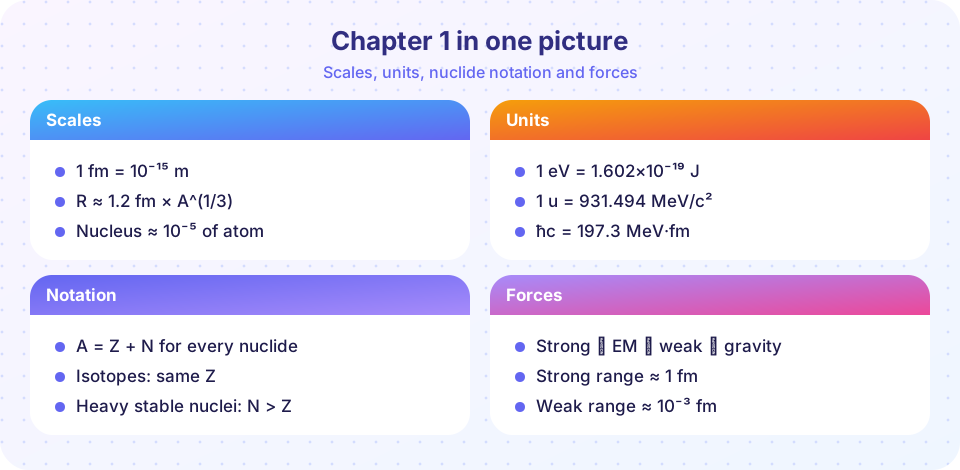
Review chapter 1 with a one-page picture, a recap table and a ten-question quiz covering scales, units, nuclide notation and the four forces.
You now have the vocabulary of nuclear and particle physics: femtometres and MeV, the symbol ᴬ_Z X, the valley of stability and the four forces. This review pulls the chapter into a single picture, lists the facts you should be able to recall without looking, and tests you with a longer quiz that mixes all three lessons.
What you will learn
- Check that you can use every key formula of chapter 1 from memory.
- Spot and fix the typical errors in unit conversions and nuclide counting.
- Connect the chapter to what comes next: structure, decay and reactions.
Key terms
Femtometre: 10⁻¹⁵ m.
MeV: 1.602 × 10⁻¹³ J, the typical energy of a nuclear process.
ħc: 197.327 MeV·fm, the bridge between energy and length.
Valley of stability: the curved band of stable nuclei on the N–Z chart.
Residual strong force: the short-range force between nucleons, a leftover of the color force between quarks.
The chapter in a table
| Topic | Key facts and formulas |
|---|---|
| Sizes | atom 10⁻¹⁰ m, nucleus 2–15 fm, proton 0.84 fm; R ≈ 1.2 fm × A^(1/3) |
| Energy units | 1 eV = 1.602 × 10⁻¹⁹ J; nuclear energies are in MeV |
| Mass and energy | E = mc²; 1 u = 931.494 MeV/c²; proton 938.272, neutron 939.565, electron 0.511 MeV/c² |
| Notation | ᴬ_Z X with A = Z + N; isotopes share Z, isotones N, isobars A |
| Stability | light nuclei N ≈ Z; heavy nuclei up to N/Z ≈ 1.5; no stable nuclide above Z = 82 (Bi-209 is practically stable) |
| Forces | strong, electromagnetic, weak, gravity: 1 : 10⁻² : 10⁻⁶ : 10⁻³⁸ |
| Ranges | strong 1–3 fm, weak about 10⁻³ fm, EM and gravity infinite; range ≈ ħc/mc² |
| Particles | quarks and leptons in three generations; carriers photon, gluon, W, Z; Higgs |
Worked review problems
Problem 1. How many neutrons does ²⁰⁸Pb have, and what is its radius? N = 208 − 82 = 126. R = 1.2 × 208^(1/3) = 1.2 × 5.925 = 7.11 fm.
Problem 2. A particle of mass 5 GeV/c² mediates a force. What is its approximate range? range = 197.3 MeV·fm / 5000 MeV = 0.039 fm.
Problem 3. A reaction removes 0.0020 u of mass. How much energy appears? E = 0.0020 × 931.494 = 1.86 MeV.
Problem 4. Name an isotope, an isobar and an isotone of carbon-14. Isotope: ¹²C (same Z = 6). Isobar: ¹⁴N (same A = 14). Isotone: ¹⁶O (same N = 8).
Where this leads
Chapter 2 asks why nuclei are as big and as tightly bound as they are, and builds two models (the liquid drop and the shell model). Chapter 3 follows nuclei that sit outside the valley as they decay. Chapter 4 describes what happens when nuclei collide.
Common misconceptions
"MeV is a unit of mass." MeV is a unit of energy. MeV/c² is a unit of mass.
"The strong force is the same as the nuclear force." The nuclear force between nucleons is the residual effect of the strong (color) force between quarks.
"If A is the same, the nuclides are isotopes." Same A with different Z gives isobars; isotopes share Z.
Try it
A mini-calculator that takes any Z and A and reports everything this chapter taught.
Press Run (or Ctrl + Enter) to see the result here.
Program input · what you'd type while the program runs
Type the answers before you press Run, one per line. Each time the program reads a line (with input()), it gets the next line from this box.
An interactive converter for the units of this chapter.
Check your understanding
Quick check · 9 questions
of 9 answered You scored / 9 · perfect!
-
1. What is the approximate radius of ⁶⁴Cu using R = 1.2 fm × A^(1/3)?
64^(1/3) = 4, so R = 1.2 × 4 = 4.8 fm. -
2. Which quantity does ħc = 197.327 MeV·fm let you convert?
Dividing ħc by an energy gives a length (the distance scale that energy probes). -
3. A nucleus has A = 90 and Z = 40. What are N and N/Z?
N = A − Z = 50 and N/Z = 50/40 = 1.25. -
4. Which force is carried by massless particles with infinite range?
The photon is massless and the graviton, if it exists, would also be massless; both give infinite range. -
5. Rank the forces by decreasing strength between two nearby protons.
Strong (1), electromagnetic (about 1/137), weak (about 10⁻⁶), gravity (about 10⁻³⁸). -
6. ¹⁴C and ¹⁶O have the same neutron number (8). What are they called?
Nuclides with the same N are isotones. -
7. A mass of 0.0050 u disappears in a reaction. How much energy is released?
0.0050 × 931.494 MeV = 4.66 MeV ≈ 4.7 MeV. -
8. Why does a heavy stable nucleus contain more neutrons than protons?
More neutrons spread out the charge and add binding without extra Coulomb repulsion, up to a limit set by the Pauli principle. -
9. What are the quark contents of the proton and neutron?
Proton: up, up, down (charge +1). Neutron: up, down, down (charge 0).
Summary
- Nuclear physics works in fm and MeV; E = mc² and ħc link mass, energy and length.
- A nuclide is described by Z, N and A, and stable ones lie in a curved valley.
- Four forces differ enormously in strength; carrier mass sets the range.
- You are ready for chapter 2: how nuclei are built.
Track your progress
Create a free account to tick off lessons and pick up where you left off on any device.
of Nuclear and Particle Physics lessons completed