


















Lesson 37 of 51 · Accelerators and Detectors
How Accelerators Work
Electric fields, radio-frequency cavities, bending magnets and focusing: how linacs, cyclotrons and synchrotrons work, why electrons radiate, and what luminosity means.
Every accelerator rests on two facts from classical electromagnetism. An electric field can change a charged particle's energy. A magnetic field can change its direction but never its energy. The art of accelerator design is to use the first to speed particles up and the second to keep them in a small, controlled path, again and again.
What you will learn
- How linear accelerators, cyclotrons and synchrotrons differ.
- Why the rule
p = 0.3 B rlimits the energy of a ring. - Why electron rings lose so much energy to synchrotron radiation.
- What bunches, RF cavities and focusing magnets do.
- What luminosity is and how to turn it into event counts.
Key terms
RF cavity: a metal cavity in which an oscillating electric field accelerates passing bunches.
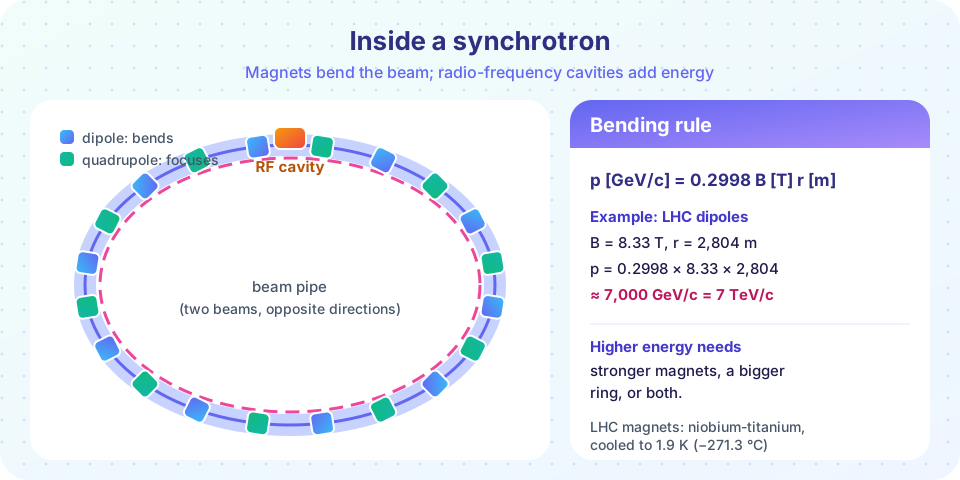
Dipole magnet: bends the beam. Quadrupole magnet: squeezes it toward the axis, like a lens.
Synchrotron radiation: electromagnetic radiation emitted by charged particles when they are forced to curve.
Bunch: a clump of particles in the beam, tens of centimetres long; an RF cavity accelerates bunches, not a continuous stream.
Cross-section σ: the effective target area for a given process (1 barn = 10⁻²⁸ m², 1 pb = 10⁻¹² b).
Electric fields: linear accelerators
A static high-voltage gap (as in a Cockcroft-Walton or Van de Graaff machine) can accelerate a particle through a few million volts before sparks occur. To go beyond, accelerators use a radio-frequency field. A linac (linear accelerator) is a line of cavities. The field oscillates so that each bunch arrives just as the field points forward. A particle of charge q crossing a gradient G over a length L gains ΔE = q G L. Superconducting cavities reach about 20 to 30 MV/m. The SLAC linac, 3.2 km long, accelerated electrons to 50 GeV; the shorter Linac4 at CERN brings hydrogen ions to 160 MeV.
Magnetic fields: bending in circles
A charged particle in a magnetic field B follows a circle of radius r with momentum
p = q B r → p [GeV/c] = 0.2998 × B [T] × r [m] (for unit charge)
Ernest Lawrence's cyclotron exploits this: a particle spirals between two D-shaped electrodes; each half-turn it crosses the gap and is accelerated. In the non-relativistic limit the orbital frequency f = qB / (2π m) does not depend on energy, so a fixed-frequency field works. For a proton in 1.5 T it is about 23 MHz. When energies climb, m → γm and the frequency falls, so the particles lag behind the field and the simple cyclotron stops working at a few tens of MeV, unless it is modified.
A synchrotron solves this by keeping the radius fixed: the magnetic field is raised as the momentum grows, and the RF frequency is adjusted to follow. The ring needs only a thin vacuum pipe with magnets around it. The momentum limit is then set by the product B r. The LHC, with r ≈ 2.8 km of bending radius and superconducting dipoles of 8.33 T, reaches p ≈ 7 TeV/c per beam. To double the energy, either the magnets must be twice as strong or the ring twice as large.
Keeping the beam together: focusing
A beam of billions of charged particles wants to spread out, both because of the particles' own mutual repulsion and because of imperfections. Quadrupole magnets act like lenses, but a quadrupole that focuses in one transverse direction defocuses in the other. Alternating focusing and defocusing quadrupoles gives net focusing in both, the principle of strong focusing (Courant, Livingston and Snyder, 1952), which made small apertures and large rings possible.
Why electrons are different
An accelerated charge radiates. A particle moving in a circle radiates energy per turn
ΔE ∝ γ⁴ / ρ with γ = E / (m c²)
where ρ is the bending radius. The factor γ⁴ makes light particles suffer dramatically: for electrons, ΔE [MeV] ≈ 0.0885 E⁴[GeV] / ρ[m]. LEP ran at 104.5 GeV per beam in a ring with ρ ≈ 3,026 m and lost about 3.5 GeV per turn to radiation, which had to be replaced by RF cavities. A proton of the same energy radiates (m_p/m_e)⁴ ≈ 10¹³ times less. That is why the highest-energy circular machines accelerate protons, whereas electron machines of higher energy will either be linear or very large, and why future electron-positron colliders need rings of 90 km or more.
Luminosity: how many collisions?
The probability for a given process is its cross-section σ; the rate is
rate = σ × L where L = f n_b N₁ N₂ / (4π σx σy) (head-on beams)
with f the revolution frequency, n_b the number of bunches per beam, N the protons per bunch and σx, σy the transverse beam sizes at the collision point. At the LHC f = 11,245 Hz, n_b ≈ 2,808, N ≈ 1.15×10¹¹ and σ ≈ 17 µm, giving about 10³⁴ cm⁻² s⁻¹ (up to twice that in later runs). The total proton-proton cross-section is about 80 mb (8×10⁻²⁶ cm²), which means roughly a billion collisions per second. In contrast the Higgs production cross-section is about 50 pb at 13 TeV, around one billionth of that: about one Higgs boson every two seconds. Over the 2015 to 2018 run, with an integrated luminosity near 140 fb⁻¹, about 7 million Higgs bosons were produced.
Common misconceptions
"Magnets accelerate the particles." A magnetic force is perpendicular to the velocity, so it does no work. Only electric fields add energy.
"Particles go round the LHC at almost zero speed at first." The beam is injected at 450 GeV, already 99.9998% of the speed of light. Going from 450 GeV to 6.8 TeV changes the speed by a negligible amount, but the energy by a factor of fifteen.
"A bigger ring is only for bigger energy." Bigger rings also reduce synchrotron losses for electrons and let magnets be weaker.
Try it
Press Run (or Ctrl + Enter) to see the result here.
Program input · what you'd type while the program runs
Type the answers before you press Run, one per line. Each time the program reads a line (with input()), it gets the next line from this box.
Press Run (or Ctrl + Enter) to see the result here.
Program input · what you'd type while the program runs
Type the answers before you press Run, one per line. Each time the program reads a line (with input()), it gets the next line from this box.
Press Run (or Ctrl + Enter) to see the console output here.
No output.
Check your understanding
Quick check · 5 questions
of 5 answered You scored / 5 · perfect!
-
1. What does a magnetic field do to a charged particle's energy?
The magnetic force is perpendicular to the velocity and does no work. -
2. A ring has dipoles of 4 T and bending radius 1,000 m. What is the maximum momentum for unit charge?
p = 0.2998 × 4 × 1000 ≈ 1,200 GeV/c = 1.2 TeV/c. -
3. Why do circular accelerators for electrons lose so much more energy than those for protons at equal energy?
At the same energy the electron's γ is about 1,800 times larger, so the loss is about 10¹³ times bigger. -
4. Why is a simple fixed-frequency cyclotron limited to modest energies?
f = qB/(2πγm), so f decreases as γ grows. -
5. A process has cross-section 50 pb and the luminosity is 10³⁴ cm⁻² s⁻¹. What is the rate?
50 pb = 5×10⁻³⁵ cm²; times 10³⁴ cm⁻² s⁻¹ gives 0.5 per second.
Summary
- Electric fields (RF cavities) add energy; magnetic fields bend and keep the beam in orbit.
p [GeV/c] = 0.2998 B [T] r [m]sets the energy reach of a ring; the LHC reaches 7 TeV with 8.33 T andr ≈ 2.8 km.- Cyclotrons break down at relativistic energies; synchrotrons ramp the field and RF frequency.
- Quadrupoles focus; strong focusing alternates focusing and defocusing.
- Synchrotron loss per turn scales as
γ⁴/ρ, severe for electrons. - Event rate is
σ × L; the LHC luminosity is around 10³⁴ cm⁻² s⁻¹.
Next: How Detectors Work
Track your progress
Create a free account to tick off lessons and pick up where you left off on any device.
of Nuclear and Particle Physics lessons completed