


















Lesson 23 of 51 · Nuclear Reactions
Making Isotopes: Activation, Cyclotrons and the Technetium Generator
How radioactive isotopes are made: neutron activation in reactors, proton reactions in cyclotrons and the molybdenum-technetium generator, with growth and decay calculations.
Every year tens of millions of patients receive a small injection of a radioactive substance that lights up their heart, bones or tumours on a scan. The isotope used in most of these procedures, technetium-99m, lives for only six hours. It cannot be stockpiled or shipped across an ocean. Instead, hospitals receive a different isotope with a longer life that produces technetium continuously, like a cow that is milked every morning. Making such isotopes is the most important everyday application of nuclear reactions, and it combines everything from this chapter: reactions, cross sections, decay and growth.
What you will learn
- Explain how reactors make neutron-rich isotopes and cyclotrons make proton-rich ones.
- Calculate the growth of activity during irradiation, A = R(1 − e^(−λt)).
- Describe a radionuclide generator and compute its daughter activity with the Bateman equation.
- Name key medical and industrial isotopes and their production routes.
Key terms
Activation: making a nucleus radioactive by a nuclear reaction, usually neutron capture.
Saturation activity: the maximum activity, equal to the production rate R, reached after many half-lives of irradiation.
Radionuclide generator: a device holding a long-lived parent that continuously produces a short-lived daughter, which is extracted (eluted) when needed.
Elution: washing the daughter nuclide out of the generator with saline.
Radiotracer: a radioactive isotope used to follow a substance through the body or a process.
Route 1: neutron capture in a reactor
A nuclear reactor provides a huge flux of neutrons (10¹³ to 10¹⁵ per cm² per second). A stable target absorbs a neutron in an (n, γ) reaction and becomes one neutron heavier: neutron-rich, so it decays by β⁻.
- ⁵⁹Co(n, γ)⁶⁰Co (σ = 37 b): cobalt-60 (5.27 years) for radiotherapy sources and sterilization.
- ¹⁹¹Ir(n, γ)¹⁹²Ir: iridium-192 (74 days) for industrial radiography and brachytherapy.
- ²³⁷Np(n, γ)²³⁸Np → ²³⁸Pu (via β⁻): plutonium-238 (87.7 years) for the heat sources of space probes.
Reactors also make isotopes as fission products. When uranium-235 fissions, about 6% of the fragments are molybdenum-99 (the "6.1% fission yield") and about 3% are iodine-131. These are chemically separated from irradiated uranium targets.
During irradiation the number of produced nuclei N grows at the rate R = ΦNσ while they decay with λ:
dN/dt = R − λN so A(t) = λN = R (1 − e^(−λt))
After one half-life the activity reaches 50% of the saturation value R, after two 75%, after four 94%. Irradiating much longer than 2–3 half-lives wastes reactor time, and this is why long-lived products like ⁶⁰Co are irradiated for months while short ones are irradiated for days.
Route 2: charged particles in a cyclotron
A cyclotron accelerates protons (or deuterons or alpha particles) to 10–30 MeV. The Coulomb barrier is overcome, and the products have fewer neutrons per proton than the target, so they decay by β⁺ or electron capture.
| Reaction | Product | Half-life | Use |
|---|---|---|---|
| ¹⁸O(p, n)¹⁸F | ¹⁸F | 109.8 min | PET imaging (fluorodeoxyglucose) |
| ¹⁴N(p, α)¹¹C | ¹¹C | 20.4 min | PET research tracers |
| ¹⁴N(d, n)¹⁵O or ¹⁵N(p, n)¹⁵O | ¹⁵O | 2.0 min | PET blood flow |
| ⁶⁸Zn(p, 2n)⁶⁷Ga | ⁶⁷Ga | 3.3 days | gamma imaging |
Since the half-lives are so short, a PET cyclotron is placed in or near the hospital. With ¹⁸F, a delivery that takes 3 hours loses a fraction 1 − 2^(−180/109.8) = 68% of the activity on the way.
Route 3: the radionuclide generator
The best way to deal with a short-lived isotope is to have its parent nearby. In a generator, a long-lived parent decays into the short-lived daughter, which is chemically different and can be washed out without the parent.
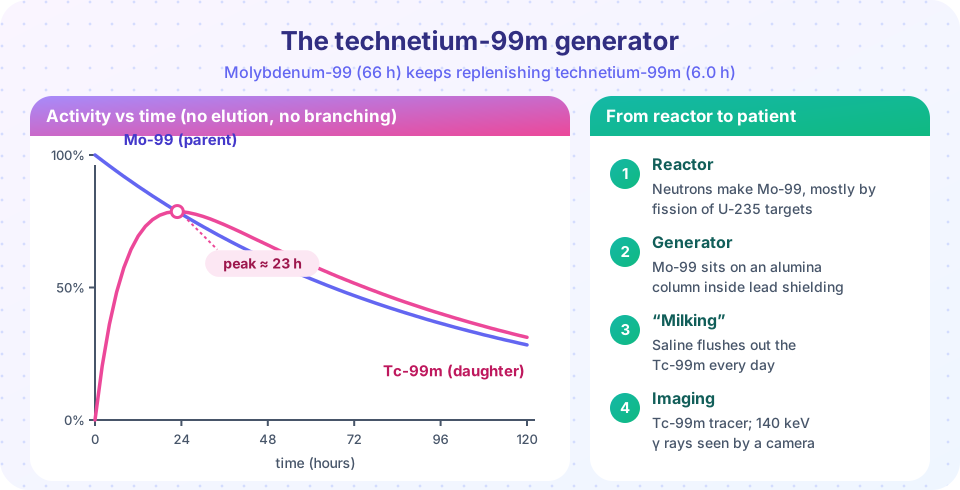
⁹⁹Mo → ⁹⁹ᵐTc. Molybdenum-99 (half-life 65.9 hours) decays by β⁻, in about 88% of cases into the isomer ⁹⁹ᵐTc (6.01 hours), which emits a 140.5 keV gamma ray and relaxes to ⁹⁹Tc (211,000 years, effectively stable). The molybdenum, as molybdate, sits on an alumina column inside lead shielding. A saline solution passed through washes out the pertechnetate containing the technetium, and leaves the molybdenum behind. After elution the column starts accumulating again.
Neglecting the branching ratio, the daughter activity obeys the Bateman equation (introduced with decay chains in chapter 3):
A₂(t) = A₁(0) × λ₂/(λ₂ − λ₁) × (e^(−λ₁t) − e^(−λ₂t))
The daughter activity peaks at t_max = ln(λ₂/λ₁)/(λ₂ − λ₁). With λ₁ = ln 2/65.9 h and λ₂ = ln 2/6.01 h this is about 23 hours, which is why hospitals elute their generators once a day. At the peak the daughter activity equals the parent's, then both decay together with the parent's half-life (transient equilibrium).
Other generator pairs include ⁶⁸Ge (271 days) → ⁶⁸Ga (68 minutes) for PET, and ⁸²Sr (25 days) → ⁸²Rb (75 seconds) for heart perfusion studies.
Safety and supply
The world depends on a handful of research reactors for molybdenum-99, and shutdowns have caused shortages in the past. This has driven efforts to make it with accelerators and to use low-enriched uranium targets. Medical isotopes are handled by trained staff under strict regulation, and the doses to patients are chosen to be as low as is consistent with a good image (ALARA, lesson 6 of chapter 3).
Common misconceptions
"Radioactive medical tracers stay in the body for years." Most are chosen for short half-lives (hours) and are excreted or decay away quickly.
"Irradiating longer always gives more." The activity saturates; beyond a few half-lives nothing more is gained.
"The generator creates technetium out of nothing." It holds a store of molybdenum-99; each elution removes the technetium that has grown from it.
Try it
First, simulate a generator with daily elutions. After each elution the technetium is removed and starts growing again from the molybdenum that remains.
Press Run (or Ctrl + Enter) to see the result here.
Program input · what you'd type while the program runs
Type the answers before you press Run, one per line. Each time the program reads a line (with input()), it gets the next line from this box.
Second, the cost of short half-lives: compare the common PET isotopes after a delivery delay, and compute the activity that must be made to leave 370 MBq after a 2-hour trip.
Press Run (or Ctrl + Enter) to see the result here.
Program input · what you'd type while the program runs
Type the answers before you press Run, one per line. Each time the program reads a line (with input()), it gets the next line from this box.
Last, irradiation time. Choose an isotope and an irradiation time, and see how much of the saturation activity you reach.
Check your understanding
Quick check · 5 questions
of 5 answered You scored / 5 · perfect!
-
1. Which type of accelerator or source makes neutron-rich isotopes by (n, γ) capture?
Reactors provide intense neutron fluxes; capture produces neutron-rich nuclei that decay by β⁻. -
2. A sample is irradiated for exactly 3 half-lives of the product. What fraction of the saturation activity is reached?
A/R = 1 − (1/2)³ = 0.875. -
3. Why is molybdenum-99 used in a generator rather than technetium-99m being shipped directly?
Tc-99m would mostly decay in transit. The longer-lived parent continuously regenerates it at the hospital. -
4. Which reaction makes fluorine-18 for PET in a cyclotron?
Protons on oxygen-18-enriched water give fluorine-18 by the (p, n) reaction. -
5. F-18 has a half-life of about 110 minutes. After a 220-minute journey, what fraction of the activity is left?
220 minutes is two half-lives, so (1/2)² = 1/4.
Summary
- Reactors make neutron-rich isotopes by (n, γ) and as fission products; cyclotrons make proton-rich β⁺/EC emitters.
- Activity during irradiation grows as A = R(1 − e^(−λt)) and saturates at R.
- A generator such as ⁹⁹Mo/⁹⁹ᵐTc supplies a short-lived daughter from a longer-lived parent; the daughter peaks near 23 h.
- Short half-lives set the logistics: PET isotopes are made close to where they are used.
Track your progress
Create a free account to tick off lessons and pick up where you left off on any device.
of Nuclear and Particle Physics lessons completed