


















Lesson 46 of 46 · Projects and Practice
Where to go next
Plan your next steps in architecture: neighboring subjects on this site, classic books, skills to practice, careers and a study-plan calculator.
You have reached the end of this introduction. You can read a plan, section and elevation, estimate a U-value, size an overhang, compare the carbon of two designs, and take a project from brief to board. That is a real foundation, but architecture is a wide field, and the best next step depends on what caught your interest.
This final lesson maps the neighboring subjects, suggests books and habits, outlines the typical paths into the profession and ends with a study-plan calculator.
What you will learn
- Which subjects on this site deepen which parts of architecture
- Which classic books to read next
- Which habits make the most difference to a beginner
- What paths lead into architecture and related careers
- How to plan your own study schedule
Key terms
Portfolio: a curated collection of your work, used to apply for study or jobs.
Technologist: a professional who specializes in the technical detail of how buildings are made.
Licensure: the legal permission to practice as an architect, which varies by country.
Interdisciplinary: involving more than one field, as architecture does with engineering, art and planning.
Connections to other subjects
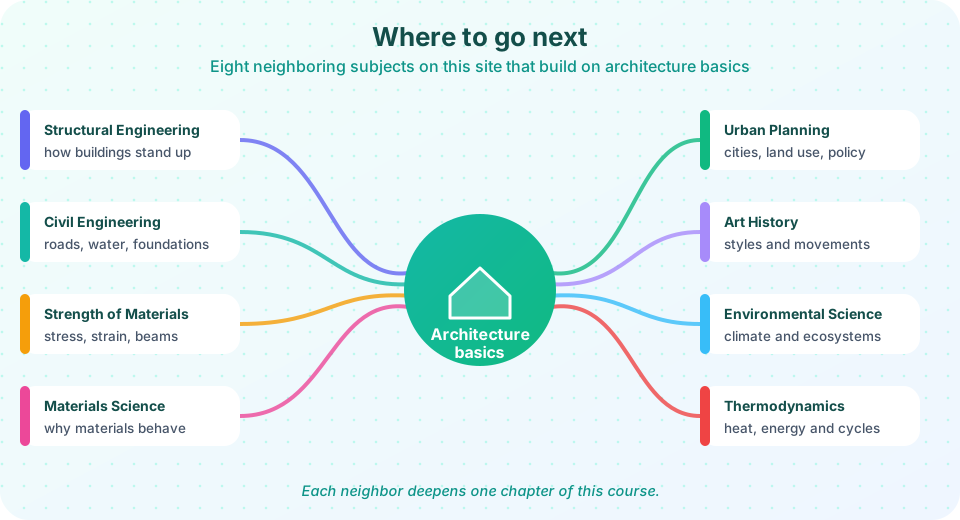
Architecture sits where several fields meet, so many other subjects can take you deeper.
- How buildings stand up: the Structural Engineering tutorial extends the structure ideas from the first half of this course, and Strength of Materials gives the mathematics of stress, strain and beams behind every column and floor.
- Ground, water and infrastructure: Civil Engineering Basics covers foundations, drainage, roads and the networks that serve buildings.
- Why materials behave as they do: Materials Science explains the structure of concrete, steel, timber and glass, which pays back in every detailing decision.
- Heat and energy: Engineering Thermodynamics provides the physics of heat transfer, heat pumps and cooling cycles that sit behind Chapter 5.
- Climate and ecosystems: Environmental Science puts carbon, energy and biodiversity into a bigger frame.
- Cities and policy: Urban Planning continues the Chapter 7 themes of density, streets and land use.
- History and culture: Art History offers the stories of styles, movements and meanings that shape what buildings look like.
- The course itself: the architecture basics course page lists every lesson, if you want to revisit a chapter.
Books worth finding
These are widely read and take different angles. You do not need to read them cover to cover; dip in and see what speaks to you.
- Vers une architecture (1923) by Le Corbusier, a manifesto of modern architecture that is polemical and still influential.
- Experiencing Architecture by Steen Eiler Rasmussen (English edition 1959), a graceful introduction to how people perceive space, light, rhythm and scale.
- A Pattern Language by Christopher Alexander and colleagues (1977), a catalog of design patterns for buildings and towns.
- The Image of the City by Kevin Lynch (1960), on how people mentally map urban places.
- Design with Climate by Victor Olgyay (1963), the classic on climate-responsive design.
- Architecture: Form, Space, and Order by Francis D. K. Ching (first published 1979), an illustrated guide to the elements of design.
- Architects' Data by Ernst Neufert (first published in German in 1936), a reference of dimensions and layouts for every common building type.
- Thinking Architecture by Peter Zumthor (1998), a short book on atmosphere and materials.
Habits that matter most
- Sketch every day, for ten minutes. Draw what is in front of you: a doorway, a street corner, a staircase. Drawing trains your eye faster than any lecture.
- Visit buildings, and measure them. Walk through a building and ask: where does the light come from, how does the floor feel, how are the parts joined? Measure a room, then draw it to scale.
- Make models. A cardboard model of a room teaches proportion more directly than any drawing.
- Keep a precedent library. Collect plans and sections of buildings you admire, redraw them at the same scale and compare.
- Learn the tools. Start with simple 3D modeling software, then try a drawing package, and later a BIM tool. Tools change, but the habit of drawing carefully does not.
- Talk about your work. Practice the five-beat talk with friends and invite critique.
Paths into the field
Education varies by country, but most routes combine a university degree (often five to seven years in total when practical experience and examinations are included), supervised work in an office, and a professional examination or license. Related careers share much of the training:
- Architect: designs and coordinates buildings; legally protected title in many countries.
- Architectural technologist: specializes in the technical detail and building regulations.
- Landscape architect: designs outdoor spaces, parks and ecologies.
- Urban designer or planner: shapes streets, neighborhoods and policy.
- Interior designer: designs rooms, furniture and lighting.
- Structural or services engineer: calculates and designs the load-bearing structure and the mechanical and electrical systems.
- Conservation specialist: repairs and protects historic buildings.
- Building-performance consultant: models energy, daylight and carbon.
Many people move among these roles. If you are unsure, build a portfolio of 8 to 12 pieces: sketches, a few measured drawings, a model photograph and a project like the pavilion from the previous lessons. It shows how you think, which matters more than polished images.
Common misconceptions
"You must be a great artist to become an architect." Drawing skill helps and can be learned; the key abilities are curiosity, problem solving, clear communication and persistence.
"Architecture is only about buildings." It deals with cities, landscapes, interiors, furniture, policy and the people who use them.
"Software does the design." Software draws and calculates, but the decisions about what is worth building are made by people.
"There is one correct path." People enter through architecture, engineering, art, craft, planning and construction.
Try it
First, a study-plan calculator. Enter how many hours a week you can spare, and it splits them across five habits and estimates how many weeks a ten-lesson topic would take.
Press Run (or Ctrl + Enter) to see the result here.
Program input · what you'd type while the program runs
Type the answers before you press Run, one per line. Each time the program reads a line (with input()), it gets the next line from this box.
Second, a pathway finder. Tick your interests and see which neighboring subjects to explore first. It is a prompt for your own thinking, not a prediction.
Check your understanding
Quick check · 4 questions
of 4 answered You scored / 4 · perfect!
-
1. Which subject would deepen your understanding of stress, strain and beams?
Strength of materials gives the mathematics behind structural members. -
2. Which habit does this lesson recommend for a beginner?
Regular drawing trains observation faster than almost anything else. -
3. What is a portfolio?
Portfolios show how you think and work. -
4. Which statement about careers is accurate?
Building projects involve many specialties and people often move among them.
Summary
- Each neighboring subject deepens a part of this course: structures, materials, energy, environment, cities, history.
- A few classic books and daily drawing habits give the best return.
- Paths into the field vary; related careers share skills, and a portfolio shows how you think.
- Plan your study time across drawing, reading, calculation, models and visits.
Next: back to the Introduction to Architecture course page to revisit any chapter.
Track your progress
Create a free account to tick off lessons and pick up where you left off on any device.
of Introduction to Architecture lessons completed