


















Lesson 13 of 46 · Design Principles and Space
Proportion, scale and rhythm
Learn how architects use ratios, the golden section, modular systems, human scale and rhythm to make a building feel ordered, comfortable and alive.
When you look at a well-designed facade, you rarely think about numbers. Yet behind the calm feeling there is usually a quiet system: the windows are related to each other and to the wall, the door has a pleasing shape, and the building looks the right size for the street. That system is made of three ideas that often work together: proportion (how dimensions relate), scale (how big something feels) and rhythm (how parts repeat and vary).
Designers have been studying these ideas for as long as there have been designers. Vitruvius wrote about them, Renaissance architects built their plans on them, and Le Corbusier invented a whole measuring system around them. This lesson shows how they work and how to use them without turning design into mere arithmetic.
What you will learn
- What proportion is and how simple ratios and the golden section are used
- What a modular system such as the Modulor or a tatami grid does for a designer
- The difference between size, scale and human scale
- Four kinds of rhythm and how an accent creates a focal point
Key terms
- Proportion: the ratio between two dimensions, or between a part and the whole.
- Golden ratio (phi): the number (1 + √5) / 2, about 1.618, in which the whole divided by the larger part equals the larger part divided by the smaller.
- Module: a basic unit of measure that other dimensions are multiples or fractions of.
- Scale: the apparent size of a building or element compared with something we know, usually the human body.
- Rhythm: a pattern created by the repetition of elements at intervals.
Proportion: ratios that relate parts
A proportion is just a ratio such as 1:2 or 3:4. What makes a proportion interesting is that it can be repeated at different levels: a room that is twice as long as it is wide, with a window that is twice as high as it is wide, feels related to itself. When all the dimensions of a design are linked by a few ratios, the result tends to feel unified.
Simple whole-number ratios (1:1, 1:2, 2:3, 3:4) were favored by Greek and Renaissance designers, who connected them with musical harmony. Another famous ratio is the square root of 2, about 1.414. A rectangle with that ratio can be cut in half to make two smaller rectangles of the same shape. That is why the international A-series of paper sizes (A4, A3, A2...) all share one proportion, and the same fact makes it easy to enlarge a drawing from one paper size to the next.
The golden section
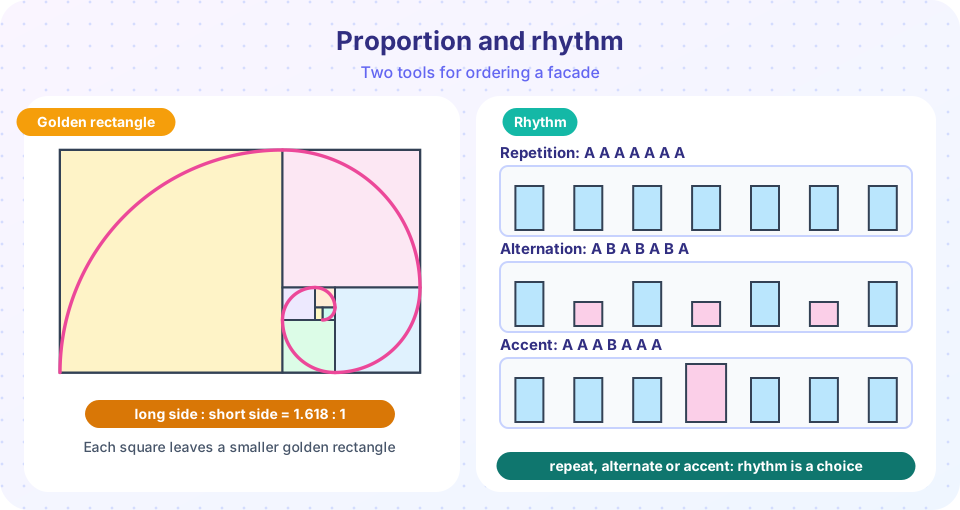
The golden ratio is denoted by the Greek letter phi and equals about 1.618. If you divide a line into two parts so that the whole is to the larger part as the larger part is to the smaller, the ratio is phi. A golden rectangle has sides in this ratio. Cut a square off one end and what remains is a smaller golden rectangle, and you can do it again and again, which is what the spiral in the illustration shows. The numbers in the Fibonacci sequence (1, 1, 2, 3, 5, 8, 13...) give ratios between neighbors that approach phi, as you saw in the plot in the overview.
The golden ratio has acquired a reputation as the secret of beauty, and it is often claimed to be present in the Parthenon, the pyramids and countless paintings. Many of those claims are weak. Measurements are flexible, and with enough lines drawn over a photograph you can find phi anywhere. The sober view is: the golden section is a handy, geometrically elegant way to relate parts, and some designers use it deliberately, but there is no proof that people always prefer it, and no great building depends on it.
Modular systems
A module is a basic unit that fixes many dimensions at once. In Greek temples, the diameter of a column was the module for everything else. In traditional Japanese houses, the tatami mat (about 910 by 1,820 mm, a 1:2 rectangle, though sizes vary by region) sets the size of rooms, which are described as "six-mat" or "eight-mat" rooms. A module makes design faster, builders' work simpler and the result consistent.
Le Corbusier's Modulor, published in 1948, was a modern attempt to base a system on the human body and on the golden ratio. He started with a person 1.83 m tall (earlier versions used 1.75 m) and used a man with a raised arm, 2.26 m. Two interlocking series of numbers, called red and blue, both based on phi, were intended to give architects a scale of related dimensions. Whether or not you like it, it shows an important point: proportion and human size should be linked.
Scale: how big does it feel?
Size is a measurable dimension. Scale is how big something seems, usually in relation to a person. A cathedral nave is large, and it also feels large because we have clear scale cues: a door we recognize, steps we can count, people in it. A building without scale cues, such as a smooth cube with no windows, can look small or big depending on what is next to it.
Architects distinguish:
- Human (or intimate) scale. Dimensions that match the body: a bench at 450 mm, a handrail at 900 mm, a ceiling at 2.4 to 2.7 m. These feel comfortable, welcoming and safe. A cottage or a café usually aims at it.
- Monumental scale. Dimensions deliberately larger than needed, to inspire awe or show power: the Pantheon's dome, a parliament's great steps. This works because the human figure acts as a measuring stick against it.
- Generic scale. The size of an element compared with others in the same building, for example, whether a window is large or small relative to the wall.
Designers play with scale. An oversized door and handles make a child feel small. A big window with a low sill makes a small room feel larger because the view expands the space. A very large element next to a very small one makes both look more dramatic.
Rhythm: pattern in space
If a series of elements repeat at regular intervals, the eye reads a beat. This is rhythm, and it is one of the strongest tools for organizing a facade or a plan. There are four basic kinds, shown in the right half of the illustration above.
- Repetition. The same element repeated, A A A A A A. It gives calm, order, and sometimes monotony. Arcades and colonnades work this way.
- Alternation. Two elements that take turns, A B A B A B. It adds variety within order, like a swinging beat. Classical architecture alternates triglyphs and metopes in the Doric frieze.
- Progression. A gradual change in size, spacing or color, for example windows that get smaller on the way up a tower. The eye is led along.
- Accent. A repeated pattern interrupted by one different element, A A A B A A A. The accent becomes a focal point, such as a big door at the center of a long facade.
Related ideas are balance and hierarchy. A symmetrical facade is balanced around an axis and has an obvious hierarchy: the main entrance sits at the center. An asymmetrical composition can still balance, as a small heavy object can balance a big light one, but it needs more skill. Hierarchy can be created by size, position, color, material or detail. Not everything can be most important.
Common misconceptions
"The golden ratio makes anything beautiful." It is a useful tool, not a guarantee. Many beautiful buildings do not use it, and many ugly ones could be drawn with it.
"Scale means size." Size is a number; scale is a relationship. The same 3 m opening feels small in a stadium and large in a bedroom.
"Rhythm means repeating everything." Repetition is one kind of rhythm. A facade made only of repetition can be dull. Variety, alternation and accents bring it to life.
Try it
The first demo calculates a Modulor-style series by dividing and multiplying by phi. The second prints the sizes of the international A-series paper to show the square root of 2 at work. The third is a facade generator in which you choose the kind of rhythm.
Press Run (or Ctrl + Enter) to see the result here.
Program input · what you'd type while the program runs
Type the answers before you press Run, one per line. Each time the program reads a line (with input()), it gets the next line from this box.
Press Run (or Ctrl + Enter) to see the console output here.
No output.
Check your understanding
Quick check · 5 questions
of 5 answered You scored / 5 · perfect!
-
1. What is the approximate value of the golden ratio?
Phi is (1 + sqrt(5)) / 2, about 1.618. The square root of 2 is about 1.414. -
2. What property makes the A-series paper sizes convenient?
The ratio is the square root of 2, which is preserved when a rectangle is halved. -
3. What is the main difference between size and scale?
A 3 m opening is the same size anywhere, but it feels small in a stadium and large in a bedroom. -
4. A facade of identical windows with one large window in the middle is an example of which rhythm?
A repeated pattern interrupted by one different element creates an accent, which becomes the focal point. -
5. What was the purpose of Le Corbusier's Modulor?
It was an attempt to link proportion and human size in one measuring system.
Summary
- Proportion is the ratio between dimensions; simple ratios, the square root of 2 and the golden ratio are common tools, but none guarantees beauty.
- A module, such as a column diameter, a tatami mat or the Modulor, fixes many dimensions from one unit.
- Scale is how big something seems; human scale feels comfortable, monumental scale impresses.
- Rhythm comes from repetition, alternation, progression and accent; an accent creates a focal point.
Track your progress
Create a free account to tick off lessons and pick up where you left off on any device.
of Introduction to Architecture lessons completed