


















Lesson 6 of 46 · History and Styles of Architecture
History of architecture: overview
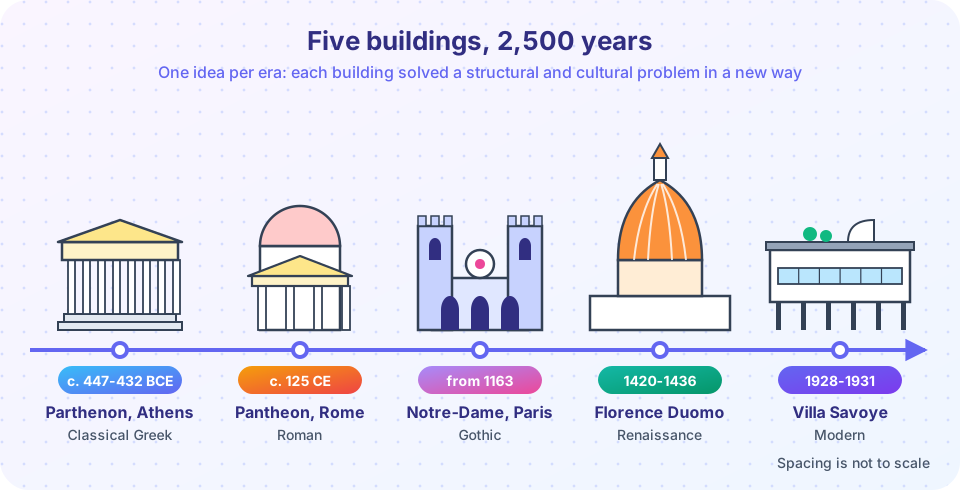
A map of chapter 2: how styles from classical Greece to the modern movement grew out of structural ideas, with a timeline of five landmark buildings.
Why study history in a course about designing buildings? Because every building you will ever design stands in a conversation that began thousands of years ago. When an architect uses columns, domes, pointed arches or glass walls, they are borrowing, rejecting or reinventing something earlier builders invented. Learning the main ideas lets you recognize them, and decide when they are worth using.
This chapter follows one famous thread of that conversation, from classical Greece through Rome, the Gothic cathedral, the Renaissance, to the modern movement. Each step grew out of a new way of carrying loads and a new idea of what buildings are for.
What you will learn
- How to think about a style as a family of ideas, not a list of decorations
- Five landmark buildings and the structural idea behind each
- How this chapter's lessons connect
- Why this story is only one of many
Key terms
- Style: a group of buildings that share forms, materials and ideas because their makers shared tools, beliefs and techniques.
- Order: the Greek system of column and entablature in three types (Doric, Ionic, Corinthian).
- Vault: an arched ceiling of stone or brick, a way of roofing space without timber.
- Buttress: a mass of masonry that braces a wall against sideways thrust.
- Modern movement: the early twentieth-century push for new architecture using steel, concrete and glass, and for plain, functional forms.
The big picture
A style is never just decoration. Greek temples look the way they do because stone beams cannot span far, so columns must stand close together. Roman builders learned to make concrete and could cast arches, vaults and domes: wide, open interiors. Gothic masons found how to push the weight of a stone vault down and out onto slender piers and flying buttresses, which freed the walls for glass. Renaissance architects turned back to Roman ideas, and added mathematics, symmetry and perspective. Modern architects used steel and reinforced concrete frames, so walls no longer held the building up, and they imagined buildings with free plans and long windows.
Ancient Greece
Proportion made visible.
Ancient Rome
Gothic
Renaissance
Modern
What each lesson covers
- Greek and Roman architecture looks at the temple, the three orders, then Roman arches, concrete and the Pantheon.
- Romanesque and Gothic architecture follows how heavy round-arched churches became tall, light cathedrals, and why a pointed arch pushes less sideways.
- Renaissance and Baroque architecture shows Brunelleschi's dome, Palladio's villas and the rule of proportion, and how the Baroque turned geometry into drama.
- The modern movement explains iron, steel, reinforced concrete, the five points of a new architecture, and the questions the movement raised.
- Chapter 2 review puts it all on one page.
A story with many threads
This is a standard route through history, and it is a partial one. Buildings of enormous importance are not on the five-building timeline. The domed Hagia Sophia in Istanbul was dedicated in 537 and shaped Byzantine and Ottoman architecture. The great mosques of the Islamic world developed arches, domes, courtyards and geometric decoration of extraordinary subtlety. In China, timber halls with deep bracketed roofs, such as the main hall of Foguang Temple (857), used a structural logic quite unlike European masonry. The shrine at Ise in Japan has been rebuilt on a regular cycle of about twenty years for over a thousand years, so the building is always new and the tradition is old. The Taj Mahal, built in the seventeenth century, shows Mughal craft at its height. Mesoamerican pyramids, the stone enclosures of Great Zimbabwe, and the temples of Angkor in Cambodia remind us that masonry and carpentry were invented independently around the world.
The reason for following the Mediterranean-European line first is practical: it is the route that leads to the steel-and-glass modern buildings most cities share today, and it is the standard background for studying architecture in many countries. Where useful, later chapters bring in other traditions, especially on climate (Chapter 5) and sustainability (Chapter 7).
Common misconceptions
"Styles are just fashion." Fashion plays a part, but each style solved real structural and cultural problems. The pointed arch is not a decoration: it changes how forces travel.
"Old buildings were built by people who did not understand structure." Medieval and ancient builders developed deep, experience-based knowledge. They worked by proportion, trial and inherited rules rather than by calculus, and some of their buildings still stand after a thousand years or more.
"History moves in a straight line from primitive to modern." Traditions overlap, borrow and revive. Neoclassical buildings of the 1800s copy Greek temples, and many twentieth-century architects looked back at Roman and vernacular buildings for inspiration.
Try it
First, explore the five landmarks and read a one-line summary of each. Then compute the time gaps between them: the number may surprise you.
Press Run (or Ctrl + Enter) to see the console output here.
No output.
Check your understanding
Quick check · 4 questions
of 4 answered You scored / 4 · perfect!
-
1. Which structural idea is most associated with Roman architecture?
Roman builders used arches and concrete to make wide, open interiors. Flying buttresses are Gothic and steel frames are modern. -
2. Why is a style more than decoration?
Each style solved structural and cultural problems with the tools of its time. -
3. Which building uses the Greek post-and-lintel system?
The Parthenon is a temple of stone columns carrying horizontal beams. -
4. Why does this chapter follow the Mediterranean-European thread first?
It is a practical route, not a claim that other traditions matter less. Other traditions appear in later chapters.
Summary
- A style is a family of buildings that share structural ideas, materials and beliefs.
- Five landmarks show the main steps: Greek post and lintel, Roman concrete dome, Gothic skeleton, Renaissance geometry and dome, and the modern frame.
- This chapter follows one thread of a much larger story that includes the Byzantine, Islamic, Chinese, Japanese, African, Mesoamerican and many other traditions.
Track your progress
Create a free account to tick off lessons and pick up where you left off on any device.
of Introduction to Architecture lessons completed