


















Lesson 35 of 46 · Sustainable and Urban Architecture
Reuse and heritage
Learn why reusing buildings saves carbon, how adaptive reuse and retrofit work, what conservation charters say, and how to decide between reusing and rebuilding.
A building is a store of energy and materials. A concrete frame, a brick wall and a timber roof each carry the carbon of their making, and demolishing a sound building throws that investment away and then spends more carbon to make a replacement. This simple observation has changed how architects think about new versus old: the lowest-carbon building is very often the one that already exists.
But reuse is more than a carbon calculation. Old buildings carry memory. They tie a neighborhood to its history, give cities their character, and sometimes contain craftsmanship that no one could afford today. Conservation, the practice of looking after the built heritage, protects those values. This lesson looks at both: the technical and economic case for reuse, and the ethical principles of caring for historic places.
What you will learn
- Why reuse can save carbon, materials and money
- The main types of intervention: preservation, restoration, adaptive reuse and reconstruction
- How retrofit improves energy performance without destroying character
- What conservation charters teach about authenticity and reversibility
- How to weigh reuse against rebuilding in a real project
Key terms
Adaptive reuse: adapting an old building for a new use while keeping much of its structure and character.
Retrofit: upgrading an existing building (insulation, windows, heating) to improve its performance.
Conservation: managing change in a historic place so that its significance is kept.
Authenticity: the degree to which a heritage building truly reflects its original materials, design and craftsmanship.
Reversibility: designing alterations so they can later be removed without damaging the original.
The carbon case for reuse
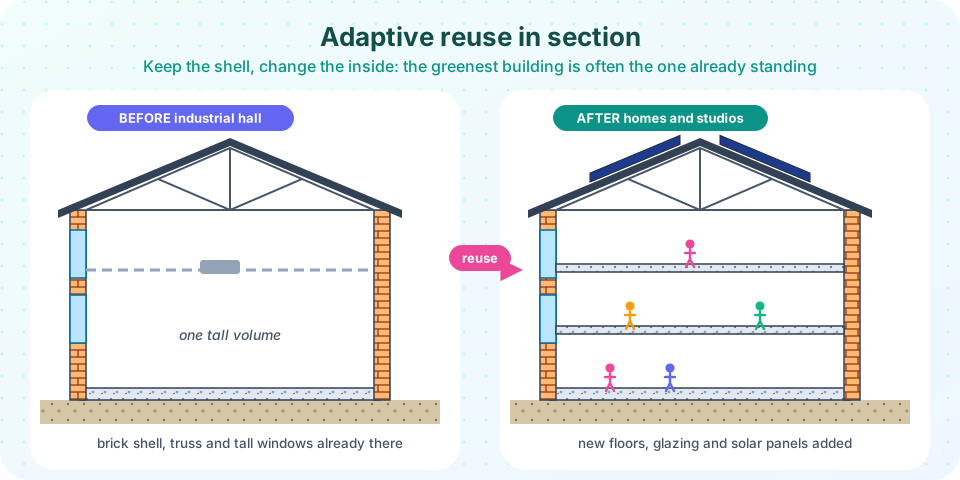
Suppose a 5,000 m2 office block has a sound concrete frame. A new building of similar size would need new foundations, a new frame, floors, walls and a roof. A good refurbishment keeps the frame and foundations, which often account for a large share of a building's embodied carbon, and replaces only the facade, services and interiors. Studies comparing typical cases often find that refurbishment saves a substantial share of the embodied carbon of a new build, although the exact figure depends on the building and how deep the work goes. The American architect Carl Elefante is widely credited with the saying that the greenest building is the one that is already built.
Other benefits are no less important:
- Waste. Construction and demolition create a large share of the waste in many countries.
- Time and cost. Keeping the frame can shorten programs, though old buildings have their own surprises (asbestos, damp, structural defects).
- Neighborhood continuity. Retaining people's familiar landmarks and community buildings keeps places recognizable.
- Embodied craftsmanship. Brickwork, stone and timber joinery of earlier eras often outlast modern equivalents.
But reuse is not always the best answer. Some buildings are structurally unsound, contaminated, impossible to make accessible, or inflexible in a way that would require so much alteration that rebuilding is more honest. A fair comparison counts the carbon of the new building and the energy of the old one over the same years.
Four treatments
Heritage practice distinguishes several ways of working on an existing building (the US Secretary of the Interior's Standards name four, and other countries use similar categories):
- Preservation keeps a building as it is, stopping decay and making only essential repairs.
- Restoration returns a building to its appearance at a chosen time in its history, removing later additions.
- Rehabilitation (adaptive reuse) makes a building usable for a new function, keeping the features that carry its character.
- Reconstruction rebuilds something that has been lost, from evidence.
Choosing among them is a design and an ethical decision. For example, restoring a facade to 1890 means removing the alterations of 1950 that are also part of the building's history.
Famous examples
- Tate Modern, London. The former Bankside Power Station, designed by Giles Gilbert Scott and built in stages between the late 1940s and early 1960s, was converted by the architects Herzog & de Meuron into a museum that opened in 2000. The enormous Turbine Hall became the entrance and exhibition space; the brick chimney and shell were kept.
- The High Line, New York. An elevated railway abandoned in the 1980s was turned into a linear park that opened in sections from 2009, designed by James Corner Field Operations with Diller Scofidio + Renfro. The old structure became a new public space.
- Tour Bois-le-Prêtre, Paris. In the early 2010s, Lacaton & Vassal with Frédéric Druot transformed a 1960s social housing tower by replacing its facade with larger apartments, winter gardens and balconies, rather than demolishing it. The firm received the Pritzker Prize in 2021, in part for its position that demolition should be the last resort.
Retrofit: improving the old
Old buildings often leak heat: single glazing, uninsulated walls, no airtightness. Retrofit improves them in stages, and the main design questions are these:
- Where to insulate? External insulation is the most effective, because it avoids thermal bridges and keeps the old masonry warm, but it changes the facade and is not acceptable on many listed buildings. Internal insulation preserves the outside but reduces room size and can cause damp problems in solid walls if done without care.
- How to treat the moisture? Old solid walls often manage moisture by being "breathable": they absorb and release water vapor. Sealing them with an impermeable material can trap moisture and cause damage, so breathable insulation and finishes are chosen.
- How to upgrade windows? Secondary glazing or restored sashes with draught proofing can improve performance without losing the original frames.
- How to heat? Heat pumps and low-temperature heating work best after fabric improvements.
Standards such as the Passivhaus-related EnerPHit certify deep retrofits, and many countries have heritage-sensitive guidance.
Conservation principles
International charters give shared principles. The Venice Charter (1964) argued that restoration must respect original material and authentic documents and that new additions should be distinguishable. The UNESCO World Heritage Convention (1972) established the list of places of outstanding universal value. The Burra Charter (Australia ICOMOS, 1979, revised since) introduced a process based on cultural significance: understand why a place matters before deciding what to do. Modern practice often follows a few rules:
- Understand significance first. Research the history and decide which parts matter most.
- Minimal intervention. Do as much as necessary and as little as possible.
- Honesty. New work should be recognizable as new, not a pretend antique, while respecting the old in scale, proportion and materials.
- Reversibility. Where possible, new elements should be removable without harming the original.
- Keep it in use. A building that people use is a building that someone maintains.
Deciding between reuse and rebuilding
A good project compares options on several axes at once: carbon (embodied and operational), cost and time, condition and risk, suitability for the new use (floor heights, structure grid, daylight depth, accessibility), heritage and community value, and future flexibility. A tall-ceilinged factory suits housing and studios. A deep-plan 1970s office with low ceilings may need so many changes that a rebuild, with the old frame partly recycled, is more sensible. The architect's job is to explain the trade-offs honestly, with numbers where possible.
Common misconceptions
"Old buildings are inefficient and should be replaced." Many can be upgraded to excellent performance, and replacing them can take decades to repay the carbon of new construction.
"Conservation means freezing buildings in time." Good conservation manages change; the best way to protect a building is to give it a viable use.
"New additions to old buildings should copy the old style." Charters generally recommend honest contemporary work that respects scale and materials.
"Reuse is always cheaper." Surprises in old structures can add cost; a thorough survey early is vital.
Try it
First, a carbon comparison. The values below are placeholders for a teaching calculation (kilograms of CO2e per square meter); real projects use measured data and a proper life cycle assessment.
Press Run (or Ctrl + Enter) to see the result here.
Program input · what you'd type while the program runs
Type the answers before you press Run, one per line. Each time the program reads a line (with input()), it gets the next line from this box.
Second, a decision aid. Tick the statements that are true for your building. It is a demonstration of how factors add up, not a professional assessment.
Check your understanding
Quick check · 5 questions
of 5 answered You scored / 5 · perfect!
-
1. Why can reusing a building's structure save carbon?
Structures carry a large share of embodied carbon; keeping them avoids producing it again. -
2. Which treatment returns a building to its appearance at a chosen date?
Restoration recovers a building's appearance from a particular period, removing later additions. -
3. What is a key principle of the Venice Charter regarding additions?
Honest, recognizable new work avoids misleading people about what is original. -
4. Which is a risk of insulating old solid brick walls internally with a vapor-tight material?
Old walls rely on breathing; a vapor-tight lining can trap moisture inside the masonry. -
5. The High Line in New York is an example of
An abandoned elevated rail line was reused as public open space.
Summary
- The greenest building is often the one that exists; reuse saves embodied carbon, waste and character.
- Treatments range from preservation and restoration to adaptive reuse and reconstruction.
- Retrofit raises performance, with care for moisture, thermal bridges and heritage fabric.
- Conservation charters stress significance, minimal intervention, honesty and reversibility.
- A good decision compares carbon, cost, condition, suitability and heritage honestly.
Next: Chapter 7 review
Track your progress
Create a free account to tick off lessons and pick up where you left off on any device.
of Introduction to Architecture lessons completed