


















Lesson 12 of 46 · Design Principles and Space
Design principles and space: overview
A map of chapter 3: the four lenses architects use to shape buildings, proportion and scale, rhythm and balance, space and circulation, and light and human factors.
Imagine two buildings of exactly the same size, cost and materials. One feels calm and generous; the other feels cramped and awkward. What is different? Not the structure, and not the budget. The difference lies in decisions about proportion, rhythm, the way you move through the rooms, and the light. These decisions make up design, and the aim of this chapter is to give you words and tools for them.
Architects do not follow these principles as laws. They use them as lenses: questions to ask of a design, and of any building you visit. When a design feels wrong, a lens often tells you why. When a building feels right, a lens helps you find out what the designer did.
What you will learn
- The four lenses of this chapter and the question each one asks
- How the lessons in the chapter connect
- How to use the lenses when looking at any building
Key terms
- Composition: the arrangement of parts into a whole.
- Hierarchy: the ordering of elements by importance, so the eye knows where to look first.
- Axis: an imaginary line that organizes a composition, often through the main entrance.
- Circulation: the paths people take through a building.
- Human scale: sizing elements so that they relate to the human body and feel comfortable.
The four lenses
Proportion and scale
Is it in tune?
Rhythm and balance
Space and circulation
Light and human factors
Proportion and scale ask: are the parts related in a way that feels right, and does the size feel right for a person? A tall door in a small room feels grand or silly. A window twice as wide as it is high may feel stable; one that is five times higher than it is wide feels like a slit. We will look at the golden section, modular systems and the idea of human scale.
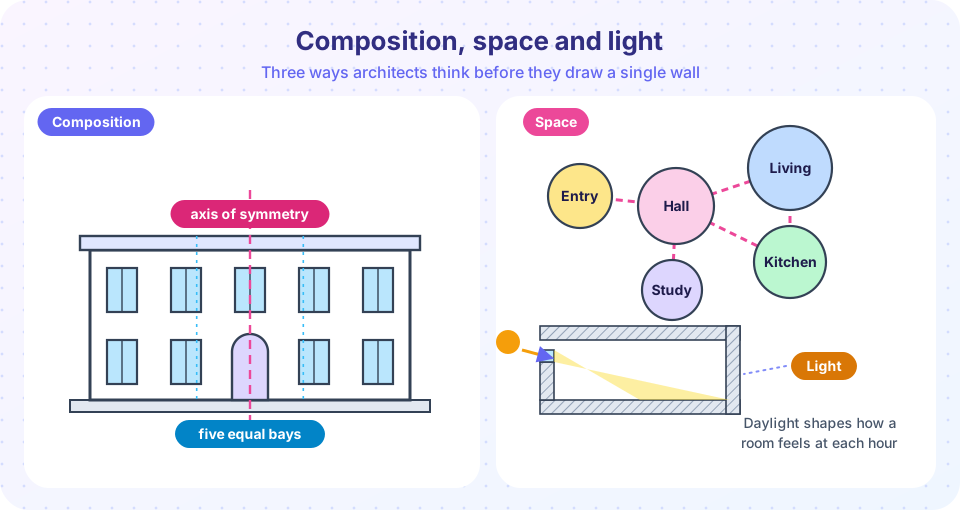
Rhythm and balance ask: how are the repeating parts organized, and does the whole feel stable? A row of identical windows has a steady beat; an alternating pattern has a swing; one big central door becomes a focal point. Symmetry gives instant balance, and asymmetry, if the weights are well matched, can give more excitement.
Space and circulation ask: how does a person move through the building, and what do they see on the way? A plan is not just a set of rooms; it is a sequence of experiences, from a narrow entrance to a large hall, from a dark passage to a bright courtyard. Circulation patterns decide whether a building is easy to understand or confusing.
Light and human factors ask: how does daylight enter, and do the dimensions suit people? Light changes everything about how a space feels, from a dark crypt to a glass pavilion. Human factors, also called ergonomics, include the heights of steps and counters, the widths of doors and corridors, and the needs of people of all ages and abilities.
What each lesson covers
- Proportion, scale and rhythm shows how ratios, the golden section and modular series work, and how repetition and accent organize a facade.
- Space, form and circulation introduces diagrams of movement, spatial sequence, and open and enclosed spaces.
- Light and human factors looks at daylight, standard dimensions, stairs and inclusive design.
- Chapter 3 review pulls the lenses together.
How to use the lenses
On your next walk, pick one building and run through the four questions. Is there an axis? Are the openings the same or different? Where do you enter, and where do you end up? Where does light come from? Make a quick sketch for each. After a few buildings, you will start to see how designers make the same kind of moves in a church, a train station and a house.
Common misconceptions
"Good design follows rules." The principles are not laws. Great buildings often break them on purpose. The skill is to know the principle well enough to know what breaking it will do.
"Proportion is a matter of taste." Taste plays a part, but patterns such as simple ratios, repetition and visible order repeatedly appear in buildings that people find harmonious across cultures and ages.
"These ideas apply only to beautiful or expensive buildings." They apply to every building. A cheap school with well-proportioned windows and good daylight can be a better place than an expensive one without.
Try it
The first demo overlays "design lenses" on a simple facade: switch on an axis, thirds or golden-section lines, and notice how some of them line up with real features. The second plot shows a famous pattern behind the golden section: ratios of neighboring Fibonacci numbers settle towards one value.
Press Run (or Ctrl + Enter) to see the result here.
Program input · what you'd type while the program runs
Type the answers before you press Run, one per line. Each time the program reads a line (with input()), it gets the next line from this box.
Check your understanding
Quick check · 3 questions
of 3 answered You scored / 3 · perfect!
-
1. What do the four lenses of this chapter help an architect do?
They are questions for judging and shaping a design, not formulas or laws. -
2. Which lens asks how a person moves through a building?
Space and circulation look at the paths and sequence of spaces. -
3. What is an axis in a composition?
Axes organize plans and facades, often passing through the main entrance.
Summary
- The four lenses are proportion and scale, rhythm and balance, space and circulation, and light and human factors.
- They are questions to ask, not rules to obey.
- You can apply them to any building: look for the axis, the pattern of openings, the path you take, and where the light comes from.
Track your progress
Create a free account to tick off lessons and pick up where you left off on any device.
of Introduction to Architecture lessons completed