


















Lesson 19 of 46 · Materials and Structure
Structural systems: beam, arch, truss, frame, cable and shell
Compare the six main structural systems, how each carries load through bending, compression or tension, and why triangles, curves and cables beat flat beams over long spans.
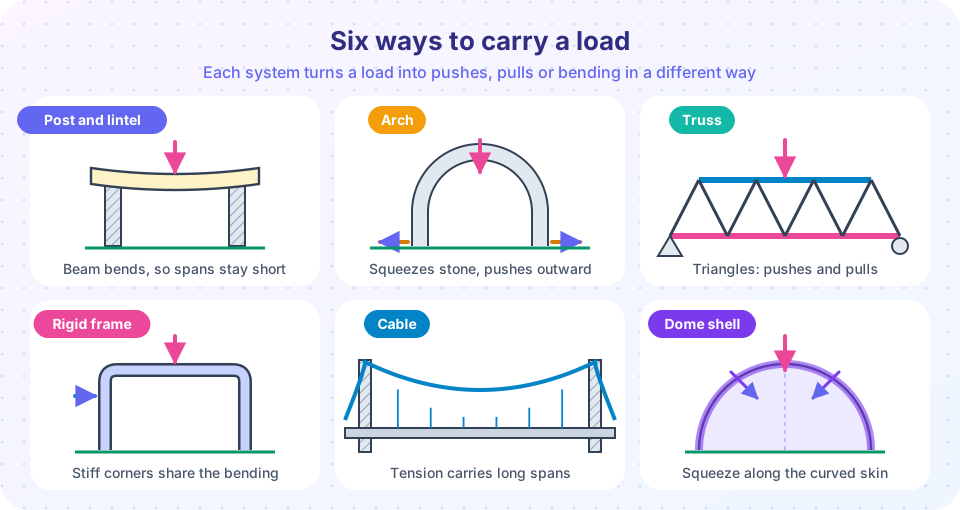
If you want to span a gap, you have choices. You can lay a beam across it. You can build an arch that curves over it. You can make a lattice of triangles. You can hang a cable from towers. You can make a thin curved skin. Each choice is a structural system, a way of organizing members so that loads travel safely to the ground. And each one gives a building a different character: the quiet strength of a colonnade, the leap of a bridge, the calm of a dome.
The best way to understand a system is to ask what kind of force does the main member carry? If it is mostly bending, the member is working inefficiently, since only the top and bottom edges are fully stressed. If it is mostly tension or compression, the whole cross-section works. The most efficient systems use the shape to turn bending into pure compression or tension.
What you will learn
- How post and lintel, arch, truss, frame, cable and shell carry load
- Why triangles are rigid and rectangles are not
- What thrust is and how arches resist it
- How buildings resist wind and earthquakes with bracing, walls and cores
Key terms
- Thrust: the sideways push of an arch or vault at its supports.
- Truss: a framework of straight members connected in triangles, so that each member carries only tension or compression.
- Rigid frame: a frame whose joints can transfer bending, so beams and columns work together.
- Shell: a thin curved surface that carries loads mainly through forces within its surface.
- Lateral load: a sideways load, such as wind or an earthquake.
Post and lintel
The oldest system: vertical posts carry a horizontal beam, which carries the load above. The beam works in bending, as in the last lesson, so it is limited by how stiff and strong it is. Stone beams cannot span far, which is why Greek temples have closely spaced columns. Timber and steel beams, being strong in tension, can span much farther, and today's concrete beams span farther still because they are reinforced.
Post and lintel is simple and clear. It works with any material and suits buildings of all sizes. Its limit is that, as you saw, deflection grows with the cube of the span, so long spans need very deep or very stiff beams.
Arch
An arch replaces bending with compression. If an arch has the right shape, every point in it is squeezed, and stone, which is good in compression, works well. The insight of Robert Hooke in the 1670s was that the ideal shape of an arch under its own weight is the shape a hanging chain takes, turned upside down. A chain in tension turned upside down becomes an arch in compression.
An arch has a price: thrust. The arch pushes outward at its base, and something must resist it. In a bridge, massive abutments do it. In a cathedral, buttresses do it. In a long arcade, each arch pushes on its neighbor so the thrusts cancel, but the ends need extra support. A tie, a rod or beam joining the feet, can also resist the thrust, which is how some roof structures work.
A vault is an arch extended in depth; a dome is an arch rotated about its center. They share the same thrust problem, and a ring around the base (the chain at Florence) resists it.
Truss
A truss is a framework of straight members joined at their ends in triangles. A triangle has a special property: it cannot change shape unless a member changes length. A four-sided frame with pinned corners can fold flat like a parallelogram, but add one diagonal and it is rigid. Because of this, a pin-jointed triangle framework carries load only by pushing and pulling along each member, with no bending.
In a typical roof truss, the top chord (the upper edge) is in compression, the bottom chord is in tension, and the diagonals carry shear as tension or compression, depending on their direction. Trusses use material very efficiently, since each member can be thin and lightweight, so they can span large distances, from house roofs to railway bridges, stadium roofs and cranes. They are made from timber, steel or aluminum. Common patterns have names, such as Warren, Pratt and Howe, that describe the arrangement of diagonals.
Because members are slim and numerous, trusses often look like the "bones" of a structure, and designers sometimes expose them as part of the architecture.
Rigid frame
A frame uses rigid joints between columns and beams, so bending moments pass around the corners. The members work together: a heavy load on a beam bends the columns slightly, and a sideways load on the frame bends the beams. A single-storey portal frame, a beam rigidly connected to two columns, is common in sheds and factories. Multi-storey frames in steel or reinforced concrete are the basis of most office buildings and apartment towers.
The frame frees the walls from carrying loads, as you saw with Villa Savoye. Its weakness is stiffness against sideways forces: a tall frame can sway. Designers add bracing (diagonal members, creating triangles), shear walls (stiff concrete walls), or cores (a stiff tube around lifts and stairs) to resist wind and earthquakes. Some tall buildings use their outer wall as a stiff tube, which is why skyscrapers often have closely spaced columns or crossing diagonals visible on their faces.
Cable
A cable works only in tension. It carries loads by hanging in a curve, and the force in it is directed along the cable. Because every fiber is working at full stress, cables are extremely efficient. Suspension bridges such as the Golden Gate Bridge (1937, main span about 1,280 meters) hang the deck from vertical hangers attached to huge main cables, which are anchored at the ends and passed over tall towers. Tents, cable nets and many stadium roofs use the same principle.
Cables are the mirror image of arches. For a cable of span L and sag f under a uniform load w, the horizontal force is H = w L² / (8 f), exactly the same as the thrust of an arch of rise f. The shallower the sag, the larger the force. This is why cable roofs need strong anchors or edge rings.
A cable is flexible, so it needs care: wind can make it flutter, and a change in load can change its shape. Designers stiffen cable structures with extra cables or by adding weight.
Shell
A shell is a thin curved surface, like an eggshell, that carries load through forces acting in its surface rather than bending across it. A shell can be astonishingly thin compared with its span. The engineer-architects Félix Candela in Mexico and Heinz Isler in Switzerland built concrete shells only a few centimeters thick over spans of tens of meters. Domes, barrel vaults and saddle-shaped surfaces are shells. They work best when their curvature is just right and their edges are supported properly; a local dent or poor edge can cause failure.
Resisting sideways loads
Every system must also handle lateral loads. The three main strategies are:
- Bracing: adding diagonals to make triangles.
- Shear walls: solid walls, often concrete, that resist sliding in their own plane.
- Moment frames: rigid joints that make the frame stiff.
In a building, the lateral system and the gravity system are planned together. A stiff core near the middle often does the lateral job while columns around the edge carry gravity.
Common misconceptions
"Arches are strong because of their shape alone." They also need the abutments or buttresses to resist the thrust. Remove a support and the arch spreads and collapses.
"A truss is strong because it has many members." It is efficient because the members form triangles and carry only axial forces. A badly arranged truss with the same number of members can be a mechanism.
"Cables cannot hold weight because they are thin." Steel cable is extremely strong in tension per unit of weight. The difficulty is anchoring and controlling shape, not strength.
Try it
The first demo shows the forces in a simple triangular truss. The second lets you vary the sag of a cable and the rise of an arch under the same load and compare the pull and the thrust. The third checks whether a pin-jointed frame is rigid.
Press Run (or Ctrl + Enter) to see the result here.
Program input · what you'd type while the program runs
Type the answers before you press Run, one per line. Each time the program reads a line (with input()), it gets the next line from this box.
Press Run (or Ctrl + Enter) to see the console output here.
No output.
Check your understanding
Quick check · 6 questions
of 6 answered You scored / 6 · perfect!
-
1. Which system carries load mainly through tension?
A cable only works in tension. An arch works in compression and a lintel in bending. -
2. Why is a triangle a rigid shape?
A pinned four-sided frame can fold, but adding a diagonal makes triangles, which cannot. -
3. What is thrust?
An arch pushes outward at the base, so it needs abutments, buttresses or a tie. -
4. In a simple roof truss, which chord is usually in tension?
The top chord is squeezed and the bottom chord stretched, like the fibers of a beam. -
5. Which of these resists wind sideways loads in a tall frame building?
Lateral systems stiffen the frame so it does not sway too much. -
6. For the same load, a cable with a smaller sag has what?
H = wL^2 / (8f), so smaller sag f gives larger H.
Summary
- Post and lintel works by bending; arches work in compression and push outward; trusses use triangles to carry only axial forces; frames use rigid joints; cables work in tension; shells carry loads through their surface.
- The same relation H = wL²/(8f) applies to the thrust of an arch and the pull in a cable: smaller rise or sag means bigger force.
- Triangles are rigid; four-sided pinned frames can fold unless braced.
- Buildings resist sideways loads with bracing, shear walls, cores or stiff frames, planned together with the gravity system.
Next: Building materials
Track your progress
Create a free account to tick off lessons and pick up where you left off on any device.
of Introduction to Architecture lessons completed