


















Lesson 2 of 46 · Getting Started
What is architecture?
Learn what architecture is, how it differs from simple building, and why the Roman writer Vitruvius asked for durability, utility and delight in every design.
Ask ten people what architecture is and you will hear ten answers: "tall glass towers," "old churches," "the plan of a house," "what architects draw." All of them are partly right. Architecture is both a thing (a building you can walk into) and an activity (the thinking, drawing and deciding that comes before it). It is also one of the oldest human skills. People were deliberately arranging stone, wood and earth to shape space long before anyone wrote about it.
This lesson gives you a working definition and the most durable tool for judging a building: the triangle of qualities described two thousand years ago by a Roman writer.
What you will learn
- A practical definition of architecture, and how it differs from construction alone
- The three Vitruvian qualities and how to apply them to any building
- Why the qualities pull against each other, and how designers balance them
- Three common arguments about what counts as architecture
Key terms
- Firmitas: Latin for firmness: the building is strong, stable and lasts.
- Utilitas: Latin for utility: the building works for the people and activities it serves.
- Venustas: Latin for delight or beauty: the building gives pleasure and meaning.
- Vernacular architecture: buildings shaped by local people, climate and materials without a professional designer.
- Program: the list of activities and rooms a building must hold.
Shelter, building, architecture
Start with the simplest idea. A shelter keeps off rain, sun and cold. A cave does that. A building is a shelter someone made. A tent, a mud hut and a garage are all buildings. Architecture begins when the maker starts asking more questions than "will it keep the rain out?" Where should the door face? How will people move from the kitchen to the garden? What will the room feel like at four in the afternoon? What will it say to people who pass by?
A useful working definition is this: architecture is the art and science of designing buildings and spaces so that they are sound, useful and meaningful. The word "science" covers the physics of structure, heat, light and sound. The word "art" covers composition, proportion, atmosphere and symbolism. There is also craft: the knowledge of how materials are cut, joined and finished. A great building needs all three.
The word itself comes from Greek: arkhi- (chief) and tekton (builder). The architect was originally the chief builder: the person who understood the whole job well enough to guide everyone else. Over centuries the role split off from construction and became a profession of its own, with drawing as its main tool, which is why Chapter 6 of this course is devoted to representation.
The Vitruvian triad
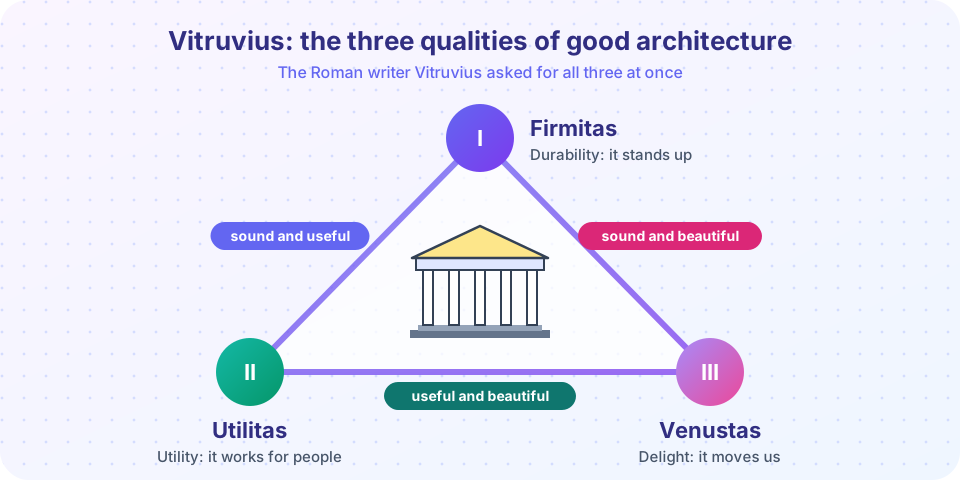
Around 30 to 15 BCE, a Roman engineer and writer named Marcus Vitruvius Pollio wrote ten books on architecture, called De architectura. They are the only complete architectural treatise to survive from antiquity. In them he says that a building should have three qualities, which later readers summarized as:
- Firmitas (firmness). The building must stand up and keep standing. It needs sound foundations, appropriate materials and a structure that can resist loads, weather and time.
- Utilitas (utility). The building must work. Rooms should be arranged so that the activities inside can happen without obstruction, and without waste of space or effort.
- Venustas (delight). The building should be beautiful to look at and to be inside. Vitruvius connects this to proportion: parts that are rightly related to each other and to the whole.
An English translation by the diplomat Henry Wotton in 1624 gave the famous phrasing "firmness, commodity and delight." You will still hear architects quote it.
Notice what the triad does for you. It gives you three questions you can ask about any building, from a village school to an airport:
- Does it stand, and will it last? (structure, materials, maintenance)
- Does it work? (plan, circulation, comfort, accessibility)
- Does it make us feel something, and does it fit its place? (form, light, proportion, meaning)
A building that fails the first is dangerous. A building that fails the second is frustrating. A building that fails the third may be perfectly adequate but it will not be loved. The point of Vitruvius is that all three must be achieved together, not one at the expense of the others.
When the qualities pull apart
In real projects the three qualities often compete. Thin glass walls delight the eye but make a building hard to keep warm. A deep, cool courtyard house is climate-wise but may be awkward for a client who wants a large open living room. A strict budget favors firmness and utility over delight, and designers must decide what to protect.
The Sydney Opera House shows this tension well. Its sail-like roof, designed by the Danish architect Jørn Utzon after winning a competition in 1957, is one of the best-known silhouettes of the twentieth century. But the shells were extremely hard to build with the technology of the time. The project ran years late and cost many times more than first estimated, and Utzon left before it was finished. The building opened in 1973 and is now loved worldwide. Was it a success? On delight, yes. On the cost of firmness, it was painful. Many people today would say the result justified the pain; others would say a better process was possible. That conversation is the heart of the profession.
A well-designed building is rarely one where the three qualities are each perfect. It is one where the architect found a balance that suits the client, the place and the era.
Is it architecture? Three arguments
People argue about where architecture begins. Here are three positions, and it is worth being able to state each fairly.
- Architecture is only the special buildings. The art historian Nikolaus Pevsner famously distinguished a cathedral (architecture) from a bicycle shed (mere building) on the grounds that architecture aims at aesthetic appeal. This view focuses on delight.
- Architecture is every designed building. On this view a thoughtful bicycle shed, with good ventilation, a well-placed roof and a pleasant proportion, is architecture. This view focuses on intention and care.
- Architecture includes buildings without architects. In 1964 the Austrian-American writer Bernard Rudofsky curated an exhibition at the Museum of Modern Art in New York called Architecture Without Architects, showing vernacular buildings such as cave dwellings, adobe villages and stilt houses. These were shaped by generations of local experience and are often superbly adapted to climate and materials, so many people count them as great architecture even though no professional designed them.
There is no single right answer. For this course we will use the broad view: architecture is the thoughtful shaping of buildings and spaces, whether or not a famous name signed the drawings.
Common misconceptions
"Architecture is just about how buildings look." Appearance is only one-third of Vitruvius's triad. A beautiful building that leaks, overheats or cannot be used by someone in a wheelchair has failed on the other two.
"Architects only draw." Drawing is the tool, but the work is decision-making: coordinating structure, services, budgets, regulations, and people's needs. Many architects spend as much time in meetings and on sites as at the drawing board.
"Only famous or old buildings count as architecture." The triad applies equally to a local clinic or a farm shed. Judging ordinary buildings well is the first skill an architect learns.
Try it
The first demo lets you rate an imaginary building on the three qualities and shows where its weakest side is. The second computes a simple balance score for a few imaginary designs. These are discussion tools, not measurements: real judgments are more complicated.
Press Run (or Ctrl + Enter) to see the result here.
Program input · what you'd type while the program runs
Type the answers before you press Run, one per line. Each time the program reads a line (with input()), it gets the next line from this box.
Check your understanding
Quick check · 5 questions
of 5 answered You scored / 5 · perfect!
-
1. Which Latin word means that a building is strong and lasts?
Firmitas is firmness: sound foundations, materials and structure. Utilitas is utility and Venustas is delight. -
2. Who wrote the ten books De architectura that describe the three qualities?
Marcus Vitruvius Pollio, a Roman engineer and writer, wrote it around the end of the first century BCE. Palladio and Le Corbusier came much later. -
3. A beautiful house that leaks badly has mainly failed which quality?
Keeping water out is part of making a building sound and durable. Beauty alone does not make up for it. -
4. What did the 1964 exhibition Architecture Without Architects argue by example?
It showed buildings shaped by local knowledge over generations. Many people count them as great architecture even without a professional designer. -
5. Why is the Vitruvian triad useful for judging a building?
It is a set of questions, not a score. The qualities often compete and the designer must balance them.
Summary
- Architecture is the art and science of designing buildings and spaces so that they are sound, useful and meaningful.
- Vitruvius named three qualities: firmitas (firmness), utilitas (utility) and venustas (delight).
- The qualities must be achieved together, but they often compete, and the designer must find a balance.
- People disagree about where architecture begins; this course uses the broad view that includes ordinary and vernacular buildings.
Next: Who designs and builds?
Track your progress
Create a free account to tick off lessons and pick up where you left off on any device.
of Introduction to Architecture lessons completed