


















Lesson 20 of 46 · Materials and Structure
Building materials: stone, brick, timber, steel and concrete
Compare the five main structural materials, how each behaves under squeezing and stretching, why steel inside concrete works, and what fire, weight and durability mean for design.
A structure is more than shape. The same arch, drawn in stone, timber or steel, is a different building. Each material has its own strengths and weaknesses, its own weight, its own way of being shaped and joined, its own weather and fire behavior, and its own effect on the environment. A good architect thinks about material from the first sketch, because it affects proportions, spans, details and cost.
This lesson reviews the five materials that make up most of the world's structures: stone, brick, timber, steel and concrete. For each we ask the same questions: how does it carry load, what is it good and bad at, and how is it used.
What you will learn
- How strength in compression and in tension differs among materials, and why that matters
- Why steel bars inside concrete make reinforced concrete work
- The typical uses, advantages and limits of stone, brick, timber, steel and concrete
- How to compare materials by weight, strength, fire behavior and durability
Key terms
- Masonry: construction from separate units (stone, brick or block) bonded with mortar.
- Reinforced concrete: concrete with embedded steel bars (rebar) to resist tension.
- Density: mass per volume, in kilograms per cubic meter (kg/m³).
- Yield strength: the stress at which steel starts to deform permanently.
- Mass timber: large engineered wood products such as glued laminated timber (glulam) and cross-laminated timber (CLT).
The key difference: squeezing and stretching
You met compression and tension in the last lessons. Materials rarely treat them equally.
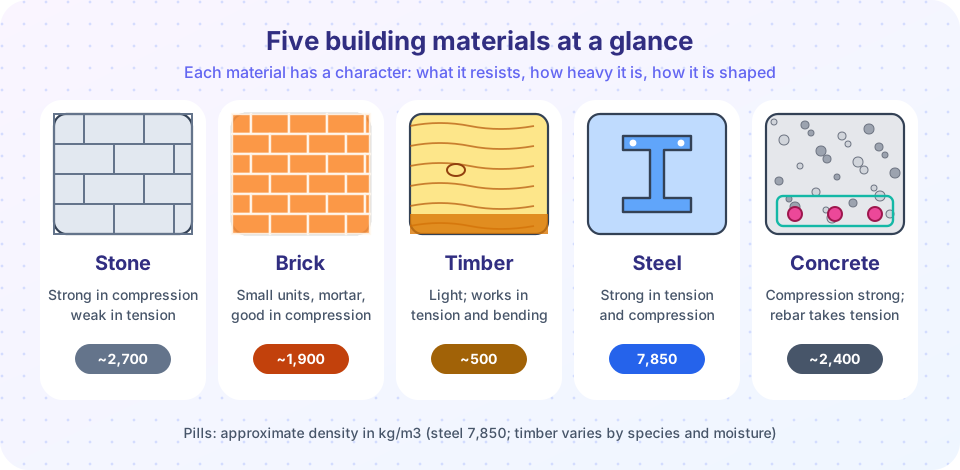
- Stone, brick and plain concrete are strong when squeezed and weak when stretched. Their tensile strength is only a small fraction (often about a tenth, sometimes much less) of their compressive strength. They crack when pulled.
- Timber has good strength along the grain in both directions and is weaker across it. Its strength-to-weight ratio is very high.
- Steel is strong in both tension and compression, and is stronger than the others by a wide margin per unit of area.
A designer's first rule follows: put compression-loving materials where there will be compression, and use tension-loving materials where there will be tension. That is the secret of arches in stone and of cables in steel, and the reason reinforced concrete exists.
Stone and brick
Stone is the oldest structural material. Granite, limestone, sandstone and marble have been quarried and carved for thousands of years. It is very durable, fireproof and good in compression, and it gives a feeling of permanence. It is also heavy, laborious to cut and place, and weak in tension, which is why stone buildings use thick walls, arches and vaults rather than long beams.
Brick is fired clay in small regular units, usually small enough to lay with one hand. A common size in the United Kingdom is 215 x 102.5 x 65 mm. Bricks are cheap, durable, fire-resistant and store heat, and can be laid in many bonds (patterns of overlapping courses) that spread loads and add texture. Brick is only about as strong as a weak stone and only in compression, so walls are thick and openings are spanned with arches or lintels. Both stone and brick are held together by mortar, a mix of sand, lime or cement and water, which bonds the units and spreads the loads evenly.
Masonry's thermal mass is useful: thick walls absorb heat during the day and release it at night, which can keep a building comfortable in a climate with big day-night swings. The disadvantages are weight, slow construction and poor performance in earthquakes unless it is reinforced.
Timber
Timber is wood used as a building material. It is light (about 500 kg/m³ for common softwoods), easy to cut and join with simple tools, renewable if forests are managed well, and good in both tension and compression along the grain. This explains why it has been the basis of houses, roofs and floors in forested regions for thousands of years, from the Chinese bracketed timber hall to Scandinavian stave churches to modern frame houses.
Its drawbacks are that it burns, rots if kept damp, can be attacked by insects, and shrinks and swells with moisture. Strength varies by species, moisture and defects such as knots. Good design keeps timber dry and protects it with overhangs, good details and treatments.
In recent decades mass timber has changed what timber can do. Glued laminated timber (glulam) makes long, curved beams from small boards, and cross-laminated timber (CLT) glues layers of boards crosswise into large panels. Tall timber buildings have been built, such as the 18-storey Mjøstårnet in Norway (about 85 m, completed in 2019). Heavy timber chars slowly in a fire, which can protect the core of the section, and this is part of how such buildings are designed to be safe.
Steel
Steel is iron with a little carbon. Cheap mass production became possible after Henry Bessemer's process of 1856, and steel then transformed building: frames for skyscrapers, long-span roofs, bridges. It is extremely strong, for example a structural steel might have a yield strength of 355 MPa, ten times that of strong concrete in compression. It is also uniform, predictable and easy to prefabricate. It can be rolled into efficient shapes such as the I-section, hollow tubes and angles, and it is bolted or welded on site.
Its weaknesses are fire and corrosion. Steel loses much of its strength at temperatures around 500 to 600 degrees Celsius, which a building fire can reach, so structural steel is usually covered with fireproof boards, sprays or paint. It rusts if kept wet and must be painted, galvanized or kept dry. Also, steel is slender, so compression members can buckle, bending sideways under load at stresses far below their strength, and must be braced.
Concrete and reinforced concrete
Concrete is a mix of cement, sand, gravel and water. The cement reacts chemically with water and hardens (cures) into a stone-like mass. Modern Portland cement was patented by Joseph Aspdin in 1824. Concrete is cheap, can be cast into any shape, is fire-resistant and durable, and has high compressive strength, typically 20 to 50 MPa for structural use. But, like stone, it is weak in tension.
The solution is reinforced concrete: put steel bars, called rebar, in the places where tension will occur, and cast the concrete around them. Look at the illustration: when a beam bends under load, the top is squeezed and the bottom is stretched. Concrete handles the squeezing; the steel at the bottom handles the stretching. Where the concrete cracks in the stretched zone, which is normal and expected, the steel carries the pull. Steel stirrups (loops around the bars) resist shear and hold the bars in place.
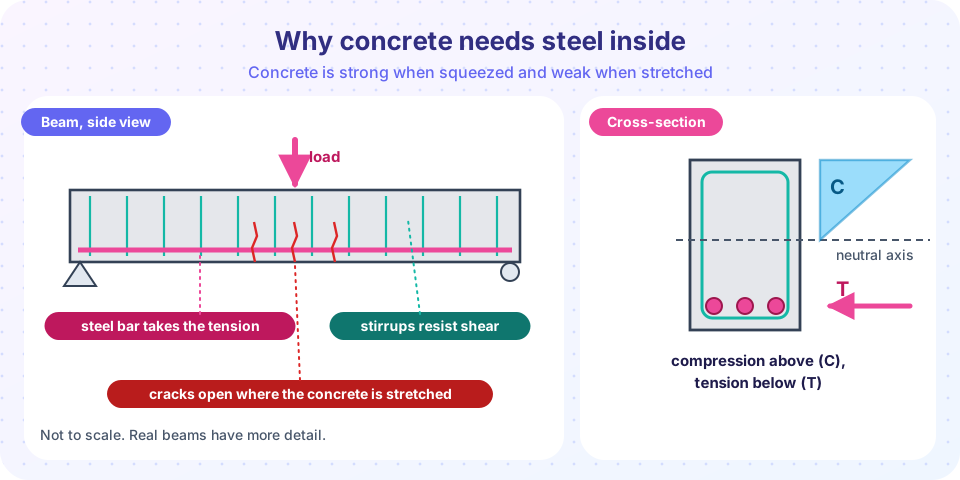
Two lucky facts make the combination work. First, steel and concrete expand and contract with temperature by almost the same amount (about 12 millionths per degree), so they do not tear apart when it gets hot or cold. Second, concrete is alkaline and protects steel from rust, provided there is enough cover (concrete thickness) over the bar. If cracks let water and salt reach the steel and it rusts, the rust swells and pops the cover off, which is a common reason concrete structures decay.
Reinforced concrete can be cast in place with formwork, or precast in a factory and lifted into position. Prestressed concrete uses steel tendons that are stretched before or after casting, squeezing the concrete so it never goes into tension under service loads; it allows longer, thinner beams and bridges.
Choosing a material
A designer weighs many things: strength and stiffness, weight, cost, availability, speed of construction, fire behavior, durability, appearance, local skills and environmental impact. Concrete and steel produce large amounts of carbon dioxide when made (we study this in Chapter 7), which is one reason architects are revisiting timber, earth, recycled materials and mixed designs. Many successful buildings use several materials, each in the role it does best: a concrete foundation, a steel frame, timber floors, brick walls and glass windows.
Common misconceptions
"Concrete and cement are the same thing." Cement is the powder that acts as the glue. Concrete is the mix of cement, sand, gravel and water.
"Steel is always safer than timber in a fire." Unprotected steel loses strength in a fire and can fail suddenly, while thick timber chars on the outside and keeps its core strength for a time. Both can be designed to be safe; the details matter.
"Reinforced concrete does not crack." It is designed to crack in small, controlled ways in the tension zone, where the steel takes over. Wide cracks are a warning sign.
Try it
The first demo compares how heavy a cube of each material is, and how tall a column of it could stand before crushing under its own weight. The second calculates the steel bars needed for the beam in the lesson. The third rates the five materials on six properties with rough teaching scores.
Press Run (or Ctrl + Enter) to see the result here.
Program input · what you'd type while the program runs
Type the answers before you press Run, one per line. Each time the program reads a line (with input()), it gets the next line from this box.
Press Run (or Ctrl + Enter) to see the console output here.
No output.
Check your understanding
Quick check · 6 questions
of 6 answered You scored / 6 · perfect!
-
1. Why is steel placed in the bottom of a concrete beam?
Concrete is weak in tension. Steel in the stretched zone carries the pull. -
2. Why do steel and concrete work well together?
Similar expansion keeps them bonded as temperatures change, and the alkaline concrete protects the bars from corrosion. -
3. Which material is known for chars that protect its core in a fire?
Thick timber chars on the outside, and the char insulates the core, so it keeps some strength for a time. -
4. What is the difference between cement and concrete?
Cement is one ingredient. Concrete is the finished material. -
5. Which is a common weakness of structural steel?
Steel needs fireproofing and protection from corrosion. -
6. Which materials are strong in compression but weak in tension?
Masonry and plain concrete crack when pulled, so they are used in arches, walls and columns, or reinforced.
Summary
- Stone, brick and plain concrete resist compression but crack in tension; timber and steel work in both, with different strengths.
- Reinforced concrete puts steel where tension occurs; the two share similar thermal expansion and concrete protects the steel.
- Steel needs fire protection and corrosion protection; timber needs to be kept dry and can be engineered into mass timber; masonry brings thermal mass but weight.
- Material choice balances strength, weight, fire, durability, appearance, cost and environmental impact.
Next: Chapter 4 review
Track your progress
Create a free account to tick off lessons and pick up where you left off on any device.
of Introduction to Architecture lessons completed