


















Lesson 47 of 47 · Projects and Practice
Further study: where to go after this course
What to learn after this structural engineering course: related tracks on this site, advanced topics like prestressed concrete and finite elements, codes and practice.
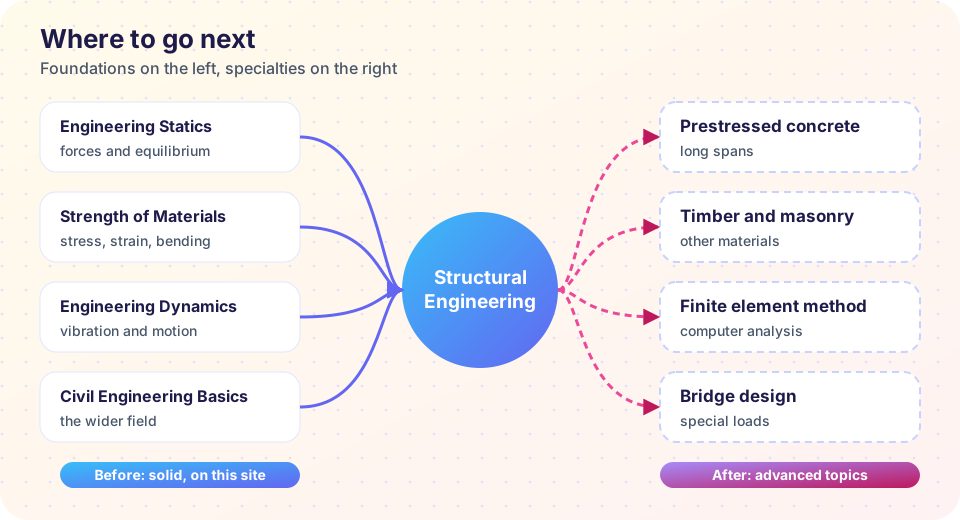
You have gone from loads and load paths to steel, concrete, soils and lateral systems. That is the backbone of an introductory structural engineering course. The field is much wider than one course can show, and the next step depends on whether you want more depth, more breadth or practice. This lesson is a map.
What you will learn
- Which tracks on this site deepen the foundations of this course.
- Which advanced topics come next.
- How design codes and professional practice fit in.
- A simple study plan.
Key terms
Prerequisite: knowledge you need before a topic makes sense.
Design code: a legal standard giving the loads, formulas and factors for design.
Licensure: the professional license required to sign structural drawings in most countries.
Peer review: independent checking of a design by another engineer.
Strengthen the foundations
Three subjects underlie everything in this course. If a part of it felt shaky, one of these is the place to go.
- Engineering Statics teaches equilibrium, free-body diagrams, trusses and frames. Reactions, member forces and load paths all start here.
- Strength of Materials covers stress, strain, bending, shear, torsion, buckling and deflection of beams. The formulas
σ = My/I,δ = 5wL⁴/384EIand the Euler load come from there. - Engineering Dynamics gives you vibration and motion: natural period, damping and response, which are the heart of earthquake and wind dynamics.
For a wider view of the profession, Civil Engineering Basics puts structures next to transport, water and geotechnical work.
Go deeper in structures
Once the basics are solid, there are many directions.
- Structural analysis of indeterminate structures: moment distribution, the slope-deflection method and the stiffness method are the basis of all analysis software.
- The finite element method (FEM): a computer-based method that divides a structure into small elements. Understanding it helps you trust, and question, the output of programs.
- Prestressed concrete: concrete members compressed in advance with tensioned steel, allowing longer spans and thinner slabs.
- Steel connections and stability: moment connections, base plates, second-order analysis and plastic design.
- Timber and masonry: the materials of houses and many historic buildings, with their own mechanics and codes.
- Bridges: moving loads, fatigue, bearings, and bridge-specific codes.
- Earthquake and wind engineering: nonlinear analysis, base isolation and dampers, wind tunnel testing.
- Geotechnical engineering: deep foundations, slope stability, ground improvement and soil-structure interaction.
- Structural health monitoring and assessment of existing buildings.
Codes and practice
Textbooks teach principles; practice is governed by codes. In this course we used the vocabulary of widely used steel and concrete standards, with SI units. Your own country will have a different set: for example the Eurocodes in Europe, national standards in Canada, Australia, India, China and Japan, and ACI, AISC and ASCE standards in the United States. They differ in factors and layouts but share the same structure: loads, load combinations, member checks and detailing rules.
Real practice adds topics that no course can fully cover: coordination with architects and contractors, drawing conventions, construction sequencing, inspection, cost, sustainability (embodied carbon is an increasing part of material choice), and professional ethics. The public relies on structural engineers for safety, which is why most countries require a license and peer review.
A study plan
- Redo the problem set of chapter 9 without looking at the answers.
- Pick a small real structure around you, such as a bus shelter, a pedestrian bridge or a garage, and sketch the load path.
- Write a one-page calculation of one member, with loads, checks and a conclusion.
- Read the table of contents of the design code used where you live and find where the topics of this course appear.
- Learn one analysis program, after understanding the hand method it automates.
Common misconceptions
"Software does the design." Software performs the arithmetic. Deciding on the model, the loads and the checks of the result is engineering judgement.
"Once I pass the course I can design a building." The course teaches principles. Real buildings need a licensed engineer, a checked code, a site investigation and review.
"Codes are the same everywhere." The structure is similar, but the factors and rules differ and must be followed locally.
Try it
Press Run (or Ctrl + Enter) to see the result here.
Program input · what you'd type while the program runs
Type the answers before you press Run, one per line. Each time the program reads a line (with input()), it gets the next line from this box.
Check your understanding
Quick check · 4 questions
of 4 answered You scored / 4 · perfect!
-
1. Which subject gives you free-body diagrams and equilibrium of trusses and frames?
Statics is the foundation of all structural analysis. -
2. What is a design code?
Codes set the rules that engineers must follow. -
3. Why should you learn the hand method before relying on software?
Software does arithmetic; the engineer checks the logic. -
4. Prestressed concrete is concrete that
Pre-compression allows longer spans and thinner members.
Summary
- Strengthen statics, strength of materials and dynamics, then branch into analysis, FEM, prestressed concrete, timber, masonry, bridges and geotechnical engineering.
- Codes differ by country but share a structure; learn the one that applies where you work.
- Practice means sketching real load paths and writing checked calculations.
Track your progress
Create a free account to tick off lessons and pick up where you left off on any device.
of Structural Engineering lessons completed