


















Lesson 3 of 47 · Getting Started
Forces, moments and equilibrium
Learn forces, components, moments, uniform load resultants and the three equilibrium equations, with worked beam examples and a runnable reaction solver.
Every structural calculation starts with a body that is standing still. A building does not drift, a bridge does not spin. That simple fact, called equilibrium, gives you three equations in two dimensions, and with them you can find unknown forces without knowing anything about steel or concrete. This lesson builds the toolkit: forces and their components, moments, the equivalent of a distributed load, and the free-body diagram.
What you will learn
- How to resolve a force into horizontal and vertical components.
- What a moment is and how to compute it about any point.
- How to replace a distributed load with an equivalent point load.
- How to write and solve the three 2D equilibrium equations from a free-body diagram.
Key terms
Force: a push or pull, measured in newtons (N) or kilonewtons (kN), with magnitude, direction and a line of action. Moment: the turning effect of a force about a point, in N·m or kN·m. Resultant: a single force equivalent to several. Free-body diagram (FBD): a sketch of the body alone with every force on it. Couple: two equal, opposite parallel forces that give a pure moment.
Forces and their components
A force is a vector. In a plane, any force F at an angle θ above the horizontal has components
Fx = F cos θ Fy = F sin θ
You resolve forces so each equation has one direction only. A 50 kN force at 30 degrees above the horizontal has Fx = 50 cos 30° = 43.3 kN and Fy = 50 sin 30° = 25.0 kN. Check: √(43.3² + 25²) = 50 kN. Choosing a sign convention (right and up are positive) and sticking to it is half the skill.
Press Run (or Ctrl + Enter) to see the result here.
Program input · what you'd type while the program runs
Type the answers before you press Run, one per line. Each time the program reads a line (with input()), it gets the next line from this box.
Moments
A moment measures how strongly a force tries to rotate something. For a force F whose line of action is a perpendicular distance d from a point O, the moment about O is
M = F × d
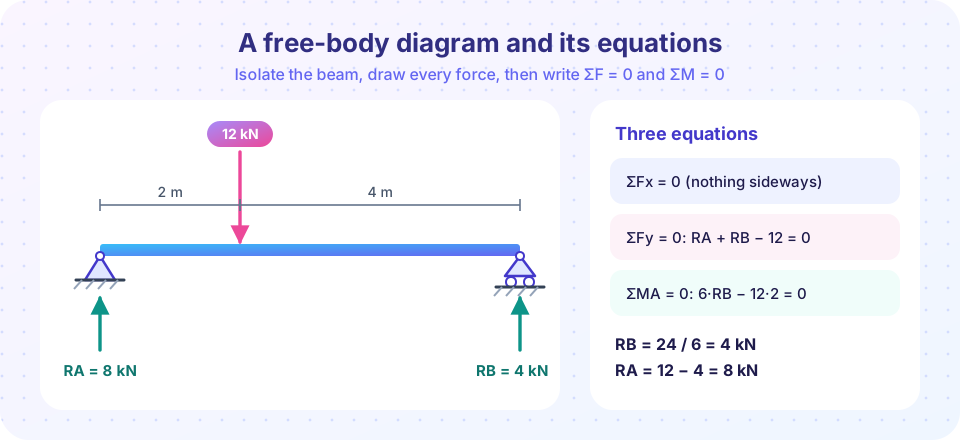
and it is positive if it turns counter-clockwise (the usual convention). A 12 kN force acting 2 m from a point gives 24 kN·m about that point. Moving the point changes the moment, but not whether the body balances.
A useful trick: when you take moments about a point where an unknown force passes through, that force drops out. That is why you take moments about a support.
Balance appears when 10 × dl = 15 × dr, for example dl = 3 m and dr = 2 m (the starting positions). This is the principle of moments: at equilibrium the clockwise and counter-clockwise moments about any point are equal.
Distributed loads
Real loads are often spread: floor loads, snow, water pressure. A distributed load w (in kN/m) over a length L acts as an equivalent point load, the resultant, with
R = area under the load diagram
acting at the centroid of that area
A uniform load w over length L gives R = w·L at the midpoint. A triangular load rising from zero to w gives R = ½·w·L acting one third of the length from the large end. For example, 10 kN/m over 6 m gives R = 60 kN at 3 m from either end. Use the resultant for reactions; use the original distribution when you later compute internal forces.
The three equations of equilibrium
For a body in a plane that is not accelerating:
ΣFx = 0 ΣFy = 0 ΣM (about any point) = 0
That gives three equations, so you can find at most three unknowns. Method:
- Draw the free-body diagram. Cut the body free of its supports and show every external force, including the unknown reactions. Mark dimensions and angles.
- Choose axes and a sign convention.
- Write the equations, starting with a moment equation about a point that eliminates most unknowns.
- Solve, then check with another equation (for example moments about the other support).
Worked example: inclined load
A 5 m beam AB has a pin at A and a roller at B. A 40 kN force acts at C, 2 m from A, pointing down and to the right at 30 degrees below the horizontal. Components: Fx = 40 cos 30° = 34.64 kN to the right, Fy = 40 sin 30° = 20 kN downward.
- ΣFx = 0: Ax + 34.64 = 0, so Ax = −34.64 kN (the pin pushes left).
- ΣM about A = 0 (counter-clockwise positive): By·5 − 20·2 = 0, so By = 8 kN upward.
- ΣFy = 0: Ay + 8 − 20 = 0, so Ay = 12 kN upward.
Check with moments about B: −Ay·5 + 20·3 = −60 + 60 = 0 ✓. The roller cannot resist horizontal force, so the pin has to take all of it. That is the reason for the arrangement of supports in the next lesson.
Press Run (or Ctrl + Enter) to see the result here.
Program input · what you'd type while the program runs
Type the answers before you press Run, one per line. Each time the program reads a line (with input()), it gets the next line from this box.
The code reproduces the hand answer: Ax = −34.64, Ay = 12, By = 8, and a zero moment check. In the second beam Ay + By equals the 50 kN total, as it must.
Common misconceptions
"A larger force always gives a larger moment." Moment also depends on the perpendicular distance. A force whose line of action passes through the point has zero moment about it.
"The reactions at the supports are always equal." They are equal only when the load is symmetric. The reaction nearest to a load is the larger one.
"A uniform load can only be replaced at its midpoint." That is true for uniform loads. Triangular and trapezoidal loads have resultants at their own centroids.
Check your understanding
Quick check · 5 questions
of 5 answered You scored / 5 · perfect!
-
1. A 20 kN force acts at 60° above the horizontal. What is its vertical component?
Fy = 20 sin 60° = 20 × 0.866 = 17.3 kN. -
2. How many independent equilibrium equations exist for a body in a plane?
ΣFx = 0, ΣFy = 0 and ΣM = 0 give three equations in two dimensions. -
3. A uniform load of 8 kN/m acts over 5 m. What is the resultant and where does it act?
R = 8 × 5 = 40 kN at the midpoint, 2.5 m from the start. -
4. Why take moments about a support?
A force through the point has no moment about it, so one equation can have fewer unknowns. -
5. A triangular load rises from 0 to 12 kN/m over 6 m. What is the resultant?
R = ½ × 12 × 6 = 36 kN, acting 2 m from the large end.
Summary
- Resolve forces into components; moment is force times perpendicular distance.
- A distributed load can be replaced by its resultant for finding reactions.
- Two dimensions give three equilibrium equations: ΣFx, ΣFy and ΣM.
- Draw the free-body diagram first, solve with a moment equation about a support, then check a second way.
Track your progress
Create a free account to tick off lessons and pick up where you left off on any device.
of Structural Engineering lessons completed