


















Lesson 24 of 47 · Steel Design
Columns and buckling: Euler and the column curve
Learn why slender columns buckle, how effective length and slenderness control strength, and how to compute design column capacity with the AISC-style curve.
Press down on a plastic ruler held on end. It does not crush; it bows sideways and snaps back when you let go. That sideways bow is buckling, and it is the reason steel columns are designed very differently from tension members. A tension member of a given area carries the same load whether it is 1 m or 10 m long. A column does not.
What you will learn
- Euler's formula for the elastic buckling load.
- How effective length factor K and slenderness
KL/rcontrol strength. - How to compute
FcrandφPnwith the standard column curve. - Why the weak axis, bracing and end conditions decide everything.
Key terms
Buckling: sudden sideways deflection of a compressed member under a load below its crushing load.
Radius of gyration r: r = √(I/A), a measure of how far the area sits from the axis.
Effective length KL: the length of an equivalent pinned-end column.
Slenderness: the ratio KL/r.
Critical stress Fcr: the stress at which the column fails.
Euler's elastic buckling load
In 1744 the Swiss mathematician Leonhard Euler solved the problem for a perfectly straight, pinned-end, elastic column. The load at which a slightly bent shape can exist in equilibrium is
Pcr = π² E I / L²
Divide by the area A and use I = A r² to get the critical stress:
Fe = Pcr / A = π² E / (L/r)²
Read the formula carefully. Strength is proportional to E (stiffness) and to 1/(L/r)². Yield stress does not appear: a slender column fails by instability, so a stronger steel does not help. Doubling the length quarters the buckling load.
End conditions and effective length
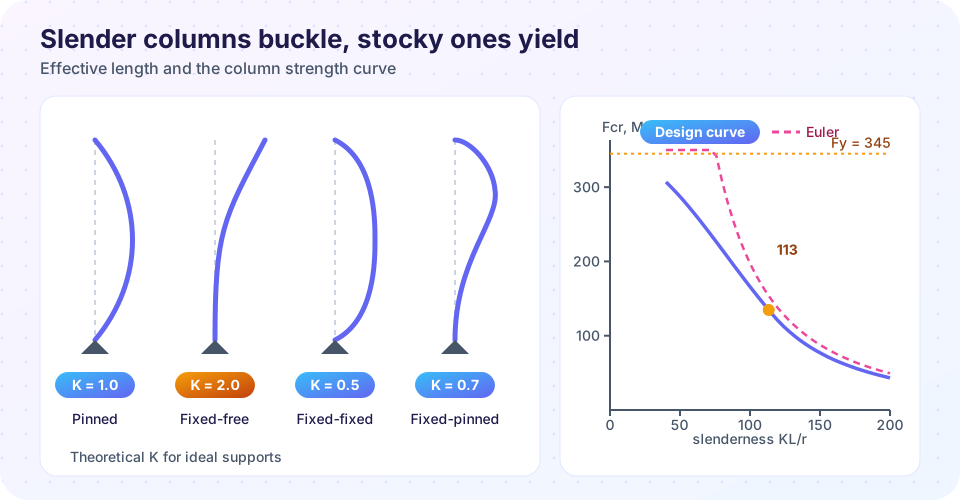
If the ends are not pinned, the buckled shape is different, and the column behaves like a pinned column of effective length KL. Ideal values are K = 1.0 for pinned-pinned, 2.0 for fixed-free (a flagpole), 0.5 for fixed-fixed and about 0.7 for fixed-pinned. Real supports are never perfectly fixed, so codes recommend values that are more conservative than the ideal ones for design, and frame columns use charts (alignment charts) that depend on how stiff the connecting beams are compared with the column.
Weak axis governs
A wide-flange section has a strong axis and a weak axis. The radius of gyration r is much smaller about the weak axis, so the column buckles about it unless it is braced. If you add bracing at mid-height in the weak direction, the weak-axis unbraced length is halved and its buckling stress rises fourfold. This is why bracing a column is often the cheapest way to strengthen it.
From theory to design: the column curve
Euler's formula assumes elastic behavior. Real columns have residual stresses from rolling and welding, initial out-of-straightness and imperfect loads. When the Euler stress would be more than about 44 percent of Fy, parts of the column are already yielding and Euler is unconservative. The practical design curve in the AISC style therefore has two parts:
Fe = π² E / (KL/r)²

If KL/r ≤ 4.71 √(E/Fy):   Fcr = 0.658^(Fy/Fe) × Fy      (inelastic)
Otherwise:                Fcr = 0.877 × Fe              (elastic)

φPn = 0.90 × Fcr × Ag
For Fy = 345 MPa and E = 200,000 MPa the limit is 4.71 × √(200,000/345) = 113. Below 113 the column is stocky and the curve is a smooth transition from Fy at zero length; above 113 it follows 0.877 of the Euler curve (the 0.877 lowers it to allow for out-of-straightness). Codes also limit KL/r to about 200 as a guide to keep columns manageable.
Worked example
A pinned-end column of length 4 m is built from a section with A = 10,000 mm² and r = 60 mm about the weak axis, Fy = 345 MPa. These numbers are illustrative.
KL/r = 1.0 × 4,000 / 60 = 66.7.Fe = π² × 200,000 / 66.7² = 444 MPa.66.7 < 113, so the inelastic formula applies:Fy/Fe = 0.777,Fcr = 0.658^0.777 × 345 = 249 MPa.φPn = 0.90 × 249 × 10,000 = 2,243,000 N ≈ 2,240 kN.
Without buckling, the squash load would be 0.90 × 345 × 10,000 = 3,105 kN. Buckling takes a 28 percent reduction at this slenderness.
Common misconceptions
"A stronger steel gives a stronger column." Only for stocky columns. For slender ones (above about 113 for 345 MPa steel) strength depends on E, which is the same for all steels.
"Check only the strong axis." Always check both axes (or find the governing one). The weak axis usually controls.
"Pinned ends mean no moment." True for the idealization, but real columns carry some bending, and design uses combined axial and bending interaction equations when moments exist.
Try it
Press Run (or Ctrl + Enter) to see the result here.
Program input · what you'd type while the program runs
Type the answers before you press Run, one per line. Each time the program reads a line (with input()), it gets the next line from this box.
Check your understanding
Quick check · 5 questions
of 5 answered You scored / 5 · perfect!
-
1. In Euler's formula, what happens to Pcr if the length doubles?
Pcr is proportional to 1/L², so doubling L gives one quarter. -
2. Which effective length factor is the ideal value for a flagpole (fixed base, free top)?
Fixed-free is K = 2.0: the column acts like a pinned column of twice its length. -
3. For a very slender column, what controls strength?
Elastic buckling depends on E and KL/r, not on Fy. -
4. A column has strong-axis KL/r = 40 and weak-axis KL/r = 90. Which axis governs?
The larger slenderness gives the lower Fcr. -
5. Adding mid-height bracing in the weak direction roughly does what to the weak-axis Euler load?
Unbraced length is halved, so Pcr is multiplied by four.
Summary
- Euler:
Pcr = π²EI/L², soFe = π²E/(KL/r)². Strength falls with the square of slenderness. - Real design uses a curve: inelastic below
KL/r ≈ 4.71√(E/Fy)and0.877Feabove,φ = 0.90. - End conditions set
K; the weak axis and the unbraced length usually govern. - Bracing is the most economical way to strengthen a column.
Next: Beams and flexure
Track your progress
Create a free account to tick off lessons and pick up where you left off on any device.
of Structural Engineering lessons completed