


















Lesson 17 of 47 · Indeterminate Structures
Chapter 4 overview: indeterminate structures
Why most real structures are statically indeterminate, how to compute the degree of indeterminacy, what redundancy gives you, and a map of the methods in this chapter.
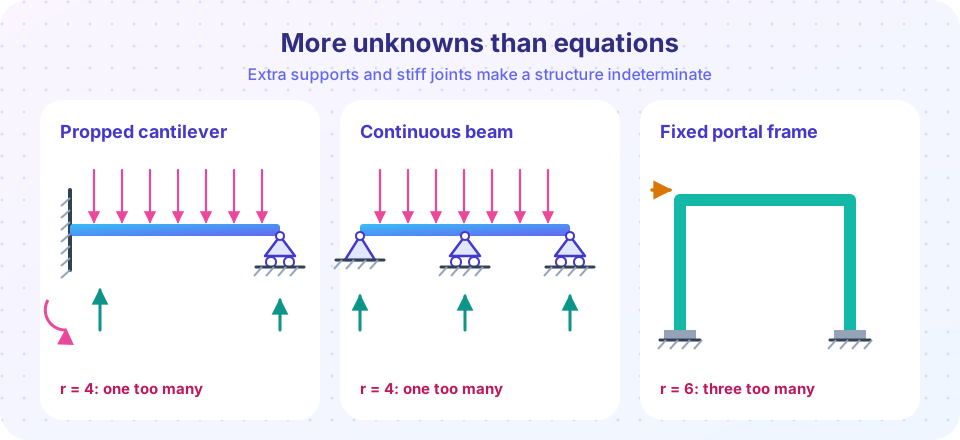
Most real buildings and bridges are statically indeterminate. A continuous floor beam over three columns, a frame with stiff joints, a roof truss with extra bracing: each has more unknown forces than equilibrium can solve. That sounds like a problem, but it is a feature. Extra supports and stiff joints give a structure spare load paths, smaller moments and less deflection. This chapter shows how to analyze such structures by adding the missing equations, which always come from how the structure deforms.
What you will learn
- What statically indeterminate means and why it is useful.
- How to count the degree of indeterminacy for beams, frames and trusses.
- Why indeterminate analysis needs stiffness information.
- A map of the three methods you will learn.
Key terms
Degree of indeterminacy: the number of unknowns beyond what equilibrium can solve. Redundant: an extra reaction or member force that could be removed without making the structure unstable. Compatibility: the requirement that displacements fit together (a support does not move, joined members keep the joint's rotation). Stiffness: force needed for a unit displacement. Flexibility: displacement caused by a unit force.
Why equilibrium is not enough
A simple beam on two supports has three reactions, and three equilibrium equations are enough. Put a third support under the middle and a fourth reaction appears. There are now infinitely many sets of reactions that satisfy equilibrium: you could shift load between the supports and the beam would still balance. Which one occurs? The answer depends on how the beam bends, because the middle support only pushes with the force needed to keep the beam from sinking below it.
So indeterminate analysis adds compatibility: "the deflection at the middle support is zero", or "these two members have the same rotation at the joint". Those equations bring in the stiffness EI of the members, which also means that in an indeterminate structure the forces depend on member sizes. Changing a beam's depth changes how the load is shared. That was not true for determinate structures.
Counting the degree of indeterminacy
Beams and rigid frames in a plane:
degree = 3m + r − 3j − c
where m is the number of members, j the number of joints (including supports and free ends), r the number of reactions and c the number of internal releases (hinges). Examples:
| Structure | m | j | r | c | Degree |
|---|---|---|---|---|---|
| Simple beam (pin + roller) | 1 | 2 | 3 | 0 | 0 |
| Propped cantilever | 1 | 2 | 4 | 0 | 1 |
| Two-span continuous beam | 2 | 3 | 4 | 0 | 1 |
| Portal frame, pinned bases | 3 | 4 | 4 | 0 | 1 |
| Portal frame, fixed bases | 3 | 4 | 6 | 0 | 3 |
| Three-hinged portal | 3 | 4 | 4 | 1 | 0 |
Pin-jointed trusses: degree = m + r − 2j, as in Chapter 3.
Press Run (or Ctrl + Enter) to see the result here.
Program input · what you'd type while the program runs
Type the answers before you press Run, one per line. Each time the program reads a line (with input()), it gets the next line from this box.
Closed loops add three degrees of indeterminacy each: a box girder or a closed ring is internally indeterminate even before it is supported.
Pros and cons of redundancy
Advantages
- Smaller moments and deflections. A fixed-end beam has about one third of the midspan moment of a simple beam under the same uniform load (wL²/24 vs wL²/8).
- Redundancy. If one element fails, the load may find another path, so collapse is less likely.
- Usually more economical in materials for the same span.
Disadvantages
- Settlement, temperature and lack of fit create forces. If a support in a continuous beam sinks, the moments change even with no load on the beam. A determinate beam would just rotate.
- Analysis is harder, because it needs stiffness values, which in reinforced concrete change as cracking develops.
- Joint design matters: rigid connections carry moment and need detailing.
How stiffness shares the load
At the far right the prop is nearly rigid and RB approaches 3wL/8 = 0.375wL, the propped cantilever result you will derive in the next lesson. At the far left the prop is soft, RB is almost zero and the beam behaves like a plain cantilever with a fixed-end moment of wL²/2. The reactions are not fixed numbers; they depend on stiffness. That is the signature of indeterminate structures.
The methods of this chapter
- Force method and superposition: remove redundants, find the incompatibility, restore it with the redundant force. Good for hand work on one or two redundants.
- Moment distribution: balance the joints one at a time and carry moments across, repeating until the numbers stop changing. The classic hand method for continuous beams and frames.
- The matrix stiffness method: assemble element stiffness matrices and solve K u = F. This is what structural software does.
- Chapter 4 review: recap and quiz.
Common misconceptions
"Indeterminate structures cannot be analyzed by hand." They can: the force method and moment distribution were the standard tools for generations of engineers. Software has replaced the drudgery but not the need to understand the result.
"The load always goes to the stiffest support." It is shared according to relative stiffness and deflected shape. A very stiff support attracts more, but the geometry decides how much.
"More redundancy is always better." Extra restraint also attracts thermal and settlement forces, and a design must account for them.
Check your understanding
Quick check · 5 questions
of 5 answered You scored / 5 · perfect!
-
1. A two-span continuous beam on three supports (pin + two rollers) has how many redundants?
r = 4 and there are three equilibrium equations, so the degree is 1. -
2. A fixed-base portal frame has m = 3, j = 4, r = 6, c = 0. What is the degree?
3m + r − 3j − c = 9 + 6 − 12 = 3. -
3. Why do member stiffnesses enter indeterminate analysis?
Compatibility uses deflections, and deflections depend on EI. -
4. What happens to bending moments in a continuous beam if one support settles?
Settlement forces the beam to bend, causing moments in an indeterminate structure. -
5. A three-hinged portal frame is
With a hinge at the crown, 9 + 4 − 12 − 1 = 0.
Summary
- Indeterminate structures have more unknowns than equilibrium equations; the extra equations come from compatibility of deformation.
- Degree = 3m + r − 3j − c for frames and beams; m + r − 2j for trusses.
- Forces depend on member stiffness; settlement and temperature produce forces.
- Redundancy brings smaller moments, stiffer behavior and spare load paths.
- Three methods follow: force method, moment distribution and matrix stiffness.
Track your progress
Create a free account to tick off lessons and pick up where you left off on any device.
of Structural Engineering lessons completed