


















Lesson 9 of 47 · Loads and Structural Systems
Load combinations: LRFD, ASD and Eurocode
Understand why loads are combined with factors, the main ASCE 7 LRFD and ASD combinations, the Eurocode approach, and compute governing combinations with code.
A building will almost never see its maximum dead load, maximum live load, maximum snow and maximum wind at the same time. It would be wasteful to design for that. But it would be dangerous to design for only one load at a time. Load combinations are the compromise: a short list of recipes, each mixing loads with factors, that a structure must survive. The member is designed for the worst result.
What you will learn
- Why combinations exist and why different loads get different factors.
- The main ASCE 7 load combinations for LRFD and ASD.
- How the Eurocode builds a combination with a leading action and companion actions.
- How to evaluate combinations in code and find the governing one.
Key terms
LRFD (load and resistance factor design): multiply the loads by factors, then compare with a resistance reduced by a factor φ. ASD (allowable strength design): use service loads and divide the nominal strength by a safety factor Ω. Limit state design (Eurocode): the European counterpart of LRFD, with partial factors on actions (γ) and materials. Leading action: the variable load assumed at full value in a combination. Companion action: other variable loads reduced because they are unlikely to peak together.
Why factor the loads at all?
Factors give each load its own margin, based on how uncertain it is. Dead load can be weighed, so its factor is small (1.2 in the US, 1.35 in Europe). Live load depends on use, so it gets more (1.6 or 1.5). Wind is variable but each recipe uses it with its own factor because it is statistically rare. And when a load helps resist a failure, such as dead load holding a roof down against wind uplift, the factor is lowered to 0.9 so that you do not rely on a weight that might be missing.
ASCE 7 LRFD combinations (the basic ones)
In the US, the strength-design combinations of ASCE 7 include (D dead, L live, Lr roof live, S snow, R rain, W wind, E earthquake):
- 1.4D
- 1.2D + 1.6L + 0.5 (Lr or S or R)
- 1.2D + 1.6 (Lr or S or R) + (L or 0.5W)
- 1.2D + 1.0W + L + 0.5 (Lr or S or R)
- 1.2D + 1.0E + L + 0.2S
- 0.9D + 1.0W
- 0.9D + 1.0E
Combination 1 usually governs only when the dead load is heavy and the live load small. Combination 2 governs most floors. Combinations 6 and 7 handle uplift and overturning, where dead load is a friend and is reduced. Read the current edition; the details of each combination vary between editions and between wind and seismic procedures.
ASCE 7 ASD combinations
Allowable strength design uses unfactored loads, with a reduction for combining several variable ones:
- D + L
- D + (Lr or S or R)
- D + 0.75L + 0.75 (Lr or S or R)
- D + (0.6W or 0.7E)
- 0.6D + 0.6W
- 0.6D + 0.7E
The factors 0.6 and 0.7 convert strength-level wind and seismic loads to a service level. The result is checked against strength divided by Ω.
The Eurocode approach
EN 1990 combines permanent actions G and variable actions Q. In its basic form for ultimate limit states:
Ed = Σ γG,j Gk,j + γQ,1 Qk,1 + Σ γQ,i ψ0,i Qk,i
with γG = 1.35 for unfavourable permanent actions (1.0 if favourable), γQ = 1.5 for unfavourable variable actions, one leading variable action Qk,1 at full value, and the others taken as companions multiplied by combination factors ψ0 (for example about 0.7 for office live load, 0.6 for wind, 0.5 for snow at lower altitudes; national annexes set the values). Every variable action takes a turn as the leading one and the largest result governs.
Serviceability checks use unfactored or lightly factored combinations (characteristic, frequent, quasi-permanent), since the question is "how much does it move in ordinary use?"
Press Run (or Ctrl + Enter) to see the result here.
Program input · what you'd type while the program runs
Type the answers before you press Run, one per line. Each time the program reads a line (with input()), it gets the next line from this box.
In the last case the net result of 0.9D + W is negative: the roof wants to lift off, and its connections must be designed to hold it down. That is why dead load is reduced to 0.9 in uplift combinations.
Press Run (or Ctrl + Enter) to see the result here.
Program input · what you'd type while the program runs
Type the answers before you press Run, one per line. Each time the program reads a line (with input()), it gets the next line from this box.
The largest result is the design value. Real designs add more combinations (accidental, seismic, serviceability), but the logic is the same.
Choosing between LRFD, ASD and limit state design
All three methods aim for a similar reliability. LRFD and limit state design treat each load according to its own uncertainty, which gives a more consistent margin across different load mixes. ASD is simple and familiar. The method is a code choice, not a personal one: use the one your jurisdiction and material standard require, and never mix a factored load with an allowable strength.
Common misconceptions
"A factored load is the real load." It is a design value, intentionally larger than anything you expect to see. Use factored loads for strength checks only; deflection checks normally use service loads.
"Adding a factor to every load is safe." Not for uplift and overturning: factoring dead load up there is unsafe, which is why 0.9D (ASCE) or 1.0 (Eurocode, favourable) is used.
"ASD is the old, wrong method." Both are valid and calibrated for similar safety; they differ in how the margin is applied.
Check your understanding
Quick check · 5 questions
of 5 answered You scored / 5 · perfect!
-
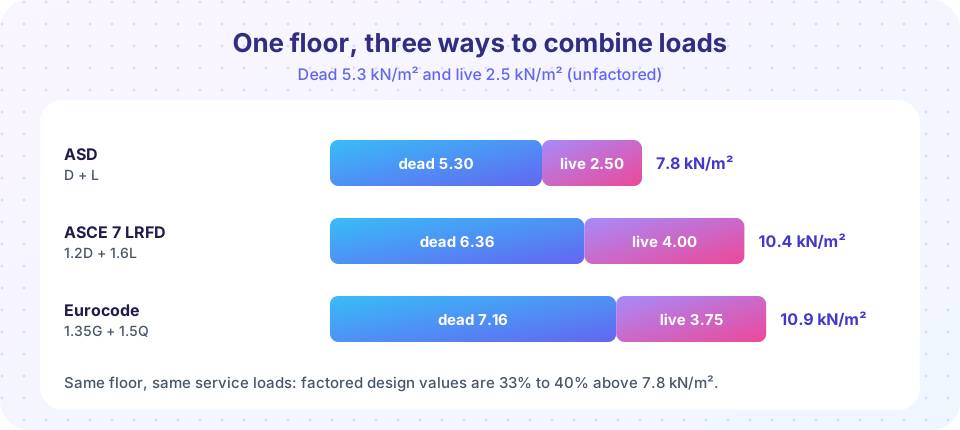
1. Which is the usual governing LRFD combination for a floor with dead load 5.3 kN/m² and live load 2.5 kN/m² (ASCE 7)?
1.2 × 5.3 + 1.6 × 2.5 = 10.36 kN/m², larger than 1.4 × 5.3 = 7.42 kN/m². -
2. Why is dead load factored by only 0.9 in uplift combinations?
When a load helps stability, you must not rely on its full value. -
3. In the Eurocode formula, what does ψ0 do?
ψ0 multiplies the companion actions in a combination. -
4. Compute 1.35G + 1.5Q for G = 4 kN/m² and Q = 2 kN/m².
1.35 × 4 + 1.5 × 2 = 5.4 + 3.0 = 8.4 kN/m². -
5. Which check normally uses service (unfactored) loads?
Serviceability checks ask how a structure behaves under ordinary loads, not at the design strength level.
Summary
- Combinations mix loads with factors because loads rarely peak together and have different uncertainty.
- ASCE 7 LRFD uses recipes such as 1.2D + 1.6L; ASD uses D + L with reduced companions.
- The Eurocode takes each variable action as leading with companions reduced by ψ0.
- Dead load is reduced to 0.9 (or 1.0 in Europe) when it helps resist uplift or overturning.
- Evaluate every combination and design for the governing one; use service loads for deflection.
Next: Structural systems
Track your progress
Create a free account to tick off lessons and pick up where you left off on any device.
of Structural Engineering lessons completed