


















Lesson 12 of 47 · Analysis of Statically Determinate Structures
Chapter 3 overview: analysis of statically determinate structures
A map of determinate structural analysis: when equilibrium alone is enough, how to count members and reactions, and what trusses, beams and deflections have in common.
Some structures can be solved with nothing but equilibrium: three equations for a body, two for each joint of a truss. They are called statically determinate, and they are the foundation of structural analysis. Almost every complex method, from indeterminate frames to computer finite-element software, is a way of adding information to these three equations. Master them here and the rest follows.
What you will learn
- What statically determinate means and how to test for it.
- The three questions every analysis answers.
- How the lessons of this chapter connect.
Key terms
Statically determinate: all reactions and internal forces can be found from equilibrium alone. Internal forces: the axial force N, shear force V and bending moment M inside a member. Truss: a structure of straight members joined at pins and loaded at the joints. Method of joints: solve a truss by balancing forces at each joint. Deflection: how far a point moves under load.
Three questions, in order
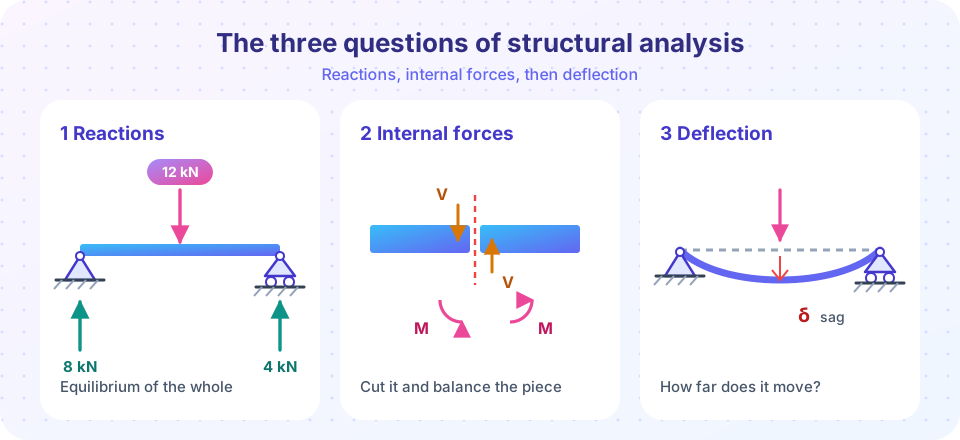
- What are the reactions? Treat the whole structure as one rigid body and apply equilibrium (Chapter 1).
- What are the internal forces? Cut the structure with an imaginary plane and balance the piece that remains. In a truss the answer is a single axial force per member. In a beam it is a shear force V and a bending moment M at every section.
- How far does it move? Integrating the curvature, which is proportional to M divided by the member's stiffness EI, gives slope and deflection.
Three questions
Tools in this chapter
Why it matters
How to tell if a structure is determinate
For a beam or single rigid body in a plane, count the reactions r. If r = 3 and they are arranged sensibly, it is determinate. For a pin-jointed truss, count members m, joints j and reactions r:
m + r = 2j   determinate (if the geometry is sound)
m + r < 2j   unstable: a mechanism
m + r > 2j   indeterminate to degree m + r − 2j
The reason is simple: each joint supplies two equilibrium equations (ΣFx and ΣFy), giving 2j equations, and the unknowns are the m member forces plus r reactions. When the numbers match, the system has exactly one solution.
Press Run (or Ctrl + Enter) to see the result here.
Program input · what you'd type while the program runs
Type the answers before you press Run, one per line. Each time the program reads a line (with input()), it gets the next line from this box.
The square with no diagonal is the classic mechanism: it can fold into a parallelogram. One diagonal makes it rigid. Two diagonals are redundant and need the methods of Chapter 4.
The cut: the key idea of the chapter
To find an internal force, cut the structure where you want it and draw the free-body diagram of one side. The cut exposes the internal forces as external forces on that piece, and equilibrium finds them. Slide the cut along this beam and watch the shear force and moment change.
What each lesson covers
- Trusses and the method of joints: axial forces, tension and compression, zero-force members, the method of sections.
- Shear force and bending moment diagrams: the relations between load, shear and moment, and how to sketch diagrams quickly.
- Beam deflection by integration: slope and deflection formulas and the serviceability check.
- Chapter 3 review: recap and quiz.
Common misconceptions
"Determinate means simple." It means solvable by equilibrium. A long truss with 100 members is determinate and still tedious to solve by hand.
"Determinate structures are safer." The opposite is often true: with no redundancy, one failed member can collapse the structure. Indeterminate structures usually have spare load paths.
Check your understanding
Quick check · 4 questions
of 4 answered You scored / 4 · perfect!
-
1. A truss has 11 members, 7 joints and 3 reactions. Is it determinate?
m + r = 14 and 2j = 14, so the count matches. -
2. What are the three internal forces in a beam section?
N, V and M are the internal force resultants at a section. -
3. A square frame of four pin-jointed bars with no diagonal is
It can fold into a parallelogram. A diagonal is needed to make it rigid. -
4. What does integrating twice from the bending moment give?
EI v″ = M, so integrating twice yields the deflection v.
Summary
- Determinate structures are solved by equilibrium alone: reactions first, then internal forces, then deflection.
- For trusses, m + r = 2j is the test; fewer is unstable and more is indeterminate.
- The imaginary cut turns internal forces into external forces you can balance.
- The methods of this chapter underpin every more advanced analysis.
Track your progress
Create a free account to tick off lessons and pick up where you left off on any device.
of Structural Engineering lessons completed