


















Lesson 11 of 47 · Loads and Structural Systems
Chapter 2 review: loads and structural systems
Review dead and live loads, tributary areas, load combinations and structural systems with a recap table, a load takedown calculator and a ten-question quiz.
Chapter 2 gave you the input side of structural design: what loads exist, how to add them up, how to share them out among members and how to combine them safely. It also introduced the systems that carry them. This review pulls it into one picture, then lets you run a full load takedown in code.
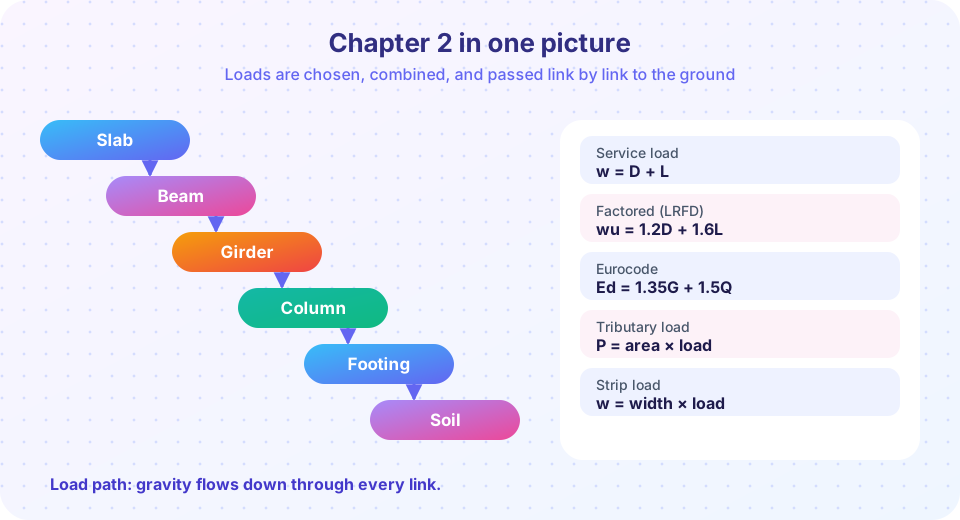
What you will learn
- How the four lessons chain into one workflow: loads, tributary area, combination, system.
- Which formulas to know by heart.
- Whether you are ready for statically determinate analysis.
Chapter in one table
| Lesson | Big idea | Key formula |
|---|---|---|
| Dead and live loads | Dead load from unit weights; live load from occupancy codes | load = thickness × γ; mass × 9.81 |
| Tributary areas and load paths | Cut halfway between supports to share the floor | w = width × floor load; P = area × floor load |
| Load combinations | Factor each load by its uncertainty; take the governing combination | 1.2D + 1.6L; 1.35G + 1.5Q; 0.9D + W |
| Structural systems | Axial action is more efficient than bending | M = wL²/8; H = wL²/(8f) |
Chapter workflow
- Collect loads for the occupancy and site: dead from layers and weights, live from the code, snow and wind from maps.
- Share them out with tributary areas into line loads and point loads.
- Combine with factors and pick the governing combination for each check.
- Choose the system that carries those loads efficiently and provides a lateral path.
- Check redundancy: where could one failure lead to collapse?
Try it
Press Run (or Ctrl + Enter) to see the result here.
Program input · what you'd type while the program runs
Type the answers before you press Run, one per line. Each time the program reads a line (with input()), it gets the next line from this box.
The beam moment of about 497 kN·m is what Chapter 5 will use to choose a steel section. The factored column loads go into the column check.
Press Run (or Ctrl + Enter) to see the result here.
Program input · what you'd type while the program runs
Type the answers before you press Run, one per line. Each time the program reads a line (with input()), it gets the next line from this box.
Work each question on paper first, then compare with the answer.
Common misconceptions
"Factor the live load, not the dead load." Both are factored, by different amounts, and sometimes the dead factor drops to 0.9.
"Tributary area and influence area are the same." They are different ideas: tributary area is for uniform loads on a floor; influence areas are used for live load reduction and moving loads.
Check your understanding
Quick check · 10 questions
of 10 answered You scored / 10 · perfect!
-
1. A slab is 160 mm thick reinforced concrete (25 kN/m³). Its self-weight is
0.16 × 25 = 4.0 kN/m². -
2. Beams span 7 m and are 4 m apart. Floor load 8 kN/m². What reaction does an interior beam deliver at each end?
w = 4 × 8 = 32 kN/m. Total 32 × 7 = 224 kN; each end carries 112 kN. -
3. A uniform load w acts on a span L. The maximum bending moment is
For a simply supported beam under uniform load, M = wL²/8 at midspan. -
4. Which combination is intended to check uplift?
Dead load resists uplift, so it is reduced to 0.9 in the combination with wind. -
5. The long and short spans of a slab are 4 m and 9 m. It acts as
The ratio is 2.25, above 2, so load travels mostly across the short span. -
6. What is true of a parabolic arch under a uniform load?
The parabola matches the funicular shape of a uniform load, so only axial compression arises. -
7. A designer applies Eurocode 1.35G + 1.5Q with G = 5 kN/m² and Q = 3 kN/m². Ed is
1.35 × 5 = 6.75 and 1.5 × 3 = 4.5, giving 11.25 kN/m². -
8. Live load reduction is not applied to a lightly loaded member because
Reduction only starts once the area is large enough (about 37 m² of K_LL × A_T in ASCE 7). -
9. A shear wall belongs to which part of a building structure?
Shear walls resist wind and seismic loads. -
10. Why does a flatter cable carry larger forces?
A small sag means the cable is nearly straight and must pull much harder to carry the load.
Summary
- Loads are collected, shared by tributary areas, combined with factors and passed down to the ground.
- Dead and live loads, 1.2D + 1.6L, and 0.9D + W cover most gravity and uplift checks.
- Axial systems (trusses, arches, cables) are efficient; every building also needs a lateral system.
- The numbers from this chapter (line loads, point loads, factored loads) are the inputs for the analysis in Chapter 3.
Next: Chapter 3 overview: analysis of statically determinate structures
Track your progress
Create a free account to tick off lessons and pick up where you left off on any device.
of Structural Engineering lessons completed