


















Lesson 4 of 47 · Getting Started
Supports, reactions and idealization
Learn pin, roller and fixed supports, how engineers idealize real structures, how to count reactions to test stability, and solve an overhanging beam with code.
A real bridge bearing is a lump of steel and rubber. A real column base is a plate bolted to a footing. To calculate, an engineer replaces each of these with a simple symbol that says exactly which movements and forces are allowed. That simplification, called idealization, is one of the most powerful and most dangerous steps in the profession: powerful because it makes the problem solvable, dangerous because the symbol has to behave like the real thing.
What you will learn
- The three standard support types and the reactions each supplies.
- How real structures are idealized into lines, joints and supports.
- How to count reactions to decide whether a structure is stable and determinate.
- How to solve an overhanging beam.
Key terms
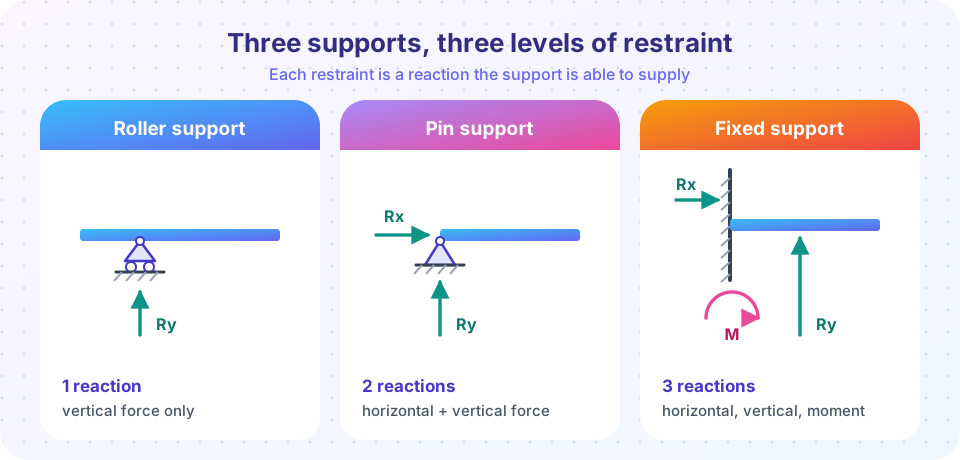
Pin (hinge) support: prevents translation in two directions but allows rotation. Roller support: prevents translation in one direction (usually vertical) and allows sliding and rotation. Fixed support: prevents translation and rotation. Statically determinate: reactions can be found from equilibrium alone. Stable: the structure cannot move as a rigid body.
The rule behind every support
A support provides a reaction force for every motion it prevents, and none for the motions it allows. That one sentence explains the whole table.
| Support | Prevents | Reactions | Real-life example |
|---|---|---|---|
| Roller | Movement perpendicular to the surface | 1 force | Bridge bearing on a rocker or sliding pad |
| Pin | Movement in x and y | 2 forces | Hinged connection, bolted gusset at a truss end |
| Fixed | Movement in x and y, and rotation | 2 forces and 1 moment | Cantilever balcony cast into a wall, column welded to a stiff base |
A roller cannot resist a horizontal load because it lets the structure slide. That is a feature, not a flaw. Long bridges expand and contract with temperature (steel grows about 12 millionths of its length per degree Celsius), so one end is given a roller to move freely while the other is pinned. A bridge pinned at both ends would build up large internal forces every hot day.
When drawing a free-body diagram, the unknown reactions go in as arrows. Guess a direction; if the answer comes out negative, the reaction acts opposite to your guess. A negative result is not wrong, it is information.
Idealizing a structure
Engineers apply the same simplifications again and again:
- Members as lines. A beam becomes a line along its centroid, with section properties attached later.
- Joints as pins or rigid. A bolted truss joint is idealized as a frictionless pin, so every member carries only axial force. A welded or monolithic concrete joint is rigid, so it transmits moment as well.
- Loads as arrows. Floor pressure becomes a uniform line load on a beam; a column on a beam becomes a point load.
- Supports as symbols. A footing on firm ground might be idealized as a pin or a fixed support, depending on how much rotation the soil allows.
The honest question is always: what would the real joint do? A bolted beam end plate resists a little moment, so treating it as a pin is conservative for the beam's midspan but under-predicts the moment at the connection. Good engineers bound the answer by checking both extremes when in doubt.
Counting reactions and testing stability
For a single rigid body in a plane, the number of reactions r compared with the three equilibrium equations tells you a lot.
- r < 3: unstable. The structure can move, so equilibrium may not be possible.
- r = 3: usually statically determinate. Equilibrium alone gives all reactions.
- r > 3: statically indeterminate to degree r − 3. Extra equations from deformation are needed (Chapter 4).
The count is necessary, but not sufficient. A beam with three reactions can still be unstable if the geometry is wrong:
- All reactions parallel: a beam on three rollers can slide sideways under any horizontal load.
- All reactions concurrent (their lines meet at one point): the structure can rotate about that point.
Press Run (or Ctrl + Enter) to see the result here.
Program input · what you'd type while the program runs
Type the answers before you press Run, one per line. Each time the program reads a line (with input()), it gets the next line from this box.
Two rollers give r = 2 and are unstable: the beam can slide horizontally. A propped cantilever has r = 4, so it needs the methods of Chapter 4.
Worked example: an overhanging beam
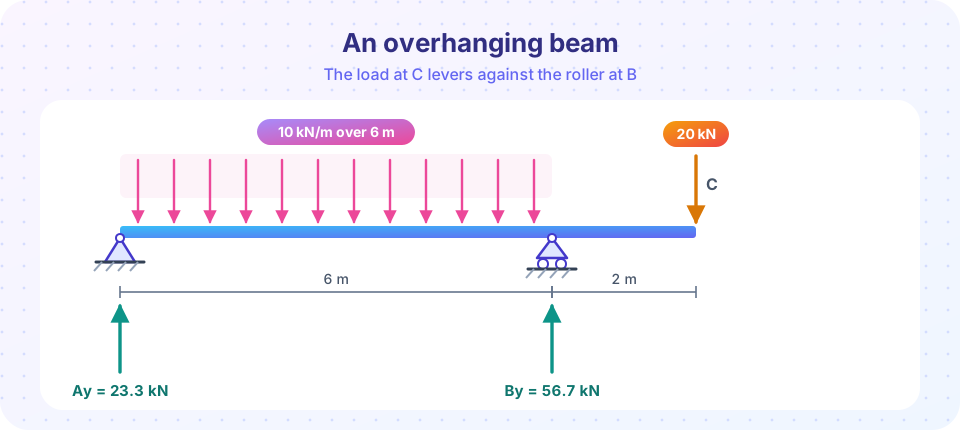
A beam runs from A to C. It has a pin at A (x = 0) and a roller at B (x = 6 m), then overhangs to C at x = 8 m. A uniform load of 10 kN/m covers AB, and a 20 kN point load acts downward at C.
- Resultant of the uniform load: 10 × 6 = 60 kN at x = 3 m.
- Moments about A (counter-clockwise +): By·6 − 60·3 − 20·8 = 0, so By = 340/6 = 56.67 kN up.
- ΣFy = 0: Ay + 56.67 − 60 − 20 = 0, so Ay = 23.33 kN up.
- Check with moments about B: −Ay·6 + 60·3 − 20·2 = −140 + 180 − 40 = 0 ✓.
Notice that the roller reaction is larger than the total load on AB. The overhang's 20 kN load levers against the support at B, so the support at A carries much less than a simple span would. In fact if the overhang load were large enough, Ay could turn negative, which means the beam would try to lift off at A and that support would need to hold it down.
Press Run (or Ctrl + Enter) to see the result here.
Program input · what you'd type while the program runs
Type the answers before you press Run, one per line. Each time the program reads a line (with input()), it gets the next line from this box.
The lines are called influence lines for the reactions. They show that Ay is positive when the load is between the supports and turns negative on the overhang. Bridge designers use influence lines to find the worst position of a truck.
Common misconceptions
"A pin and a roller are the same." A roller cannot resist horizontal force; a pin can. If a structure has only rollers, a sideways push makes it slide.
"Three reactions always means stable." Parallel or concurrent reactions leave the structure free to move, even with r = 3.
"The idealized model is the structure." It is a model. Check what the real joint does and whether the model errs on the safe side.
Check your understanding
Quick check · 5 questions
of 5 answered You scored / 5 · perfect!
-
1. How many reaction components does a fixed support provide in 2D?
A fixed support supplies horizontal and vertical forces and a moment. -
2. Why is one end of a long bridge usually placed on rollers?
The roller lets the deck slide as temperature changes its length. -
3. A beam is supported by three vertical rollers. Is it stable?
All the reactions point the same way, so nothing resists a horizontal load. r = 3 is not sufficient for stability. -
4. A propped cantilever has a fixed support and a roller. What is its degree of indeterminacy?
r = 3 + 1 = 4, which exceeds three equations by one. -
5. In the overhanging beam example, what is By?
Moments about A give By × 6 = 60 × 3 + 20 × 8 = 340, so By = 56.67 kN.
Summary
- A support supplies a reaction for each motion it prevents: roller 1, pin 2, fixed 3.
- Idealization turns real members, joints, loads and supports into a solvable model; always ask what the real joint does.
- Compare the number of reactions with 3: fewer is unstable, equal is determinate (if the geometry is sound), more is indeterminate.
- Overhangs lever against the near support and can even reverse a reaction.
Next: Chapter 1 review
Track your progress
Create a free account to tick off lessons and pick up where you left off on any device.
of Structural Engineering lessons completed