


















Lesson 27 of 47 · Steel Design
Chapter 5 review: steel design
Review steel design: tension, columns, beams and connections in one table and one picture, then test yourself with a ten-question mixed quiz.
You have now met the four members of a steel frame and the limit states that govern each. Before moving on to concrete, put them side by side. The pattern you should see is that every check is the same inequality, demand ≤ φ × capacity, with a different equation for the capacity.
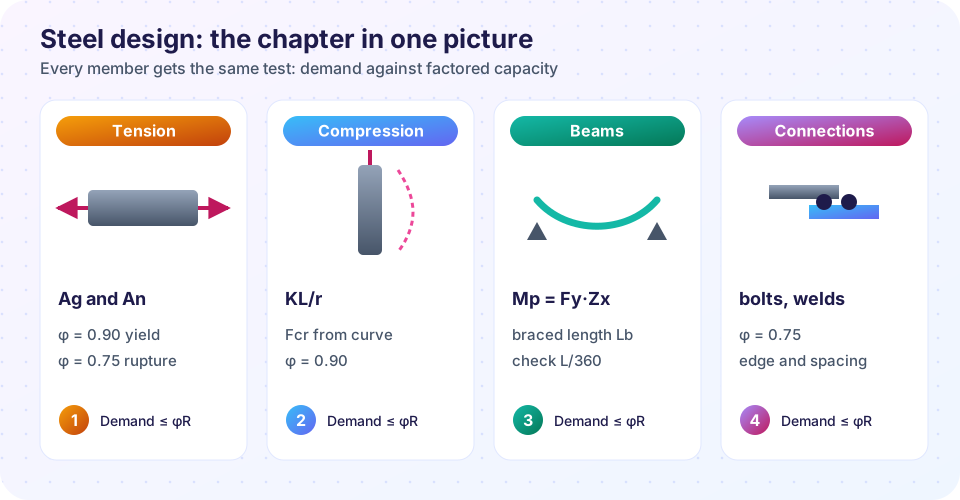
What you will learn
- The key formulas and resistance factors of the chapter in one place.
- How to decide which limit state is likely to govern a member.
- A repeatable order for checking a steel design.
Recap table
| Member | Limit state | Capacity | φ |
|---|---|---|---|
| Tension | Gross yield | Fy × Ag |
0.90 |
| Tension | Net rupture | Fu × U × An |
0.75 |
| Column | Flexural buckling | Fcr × Ag, Fcr from KL/r |
0.90 |
| Beam | Plastic moment | Fy × Zx (braced, compact) |
0.90 |
| Beam | LTB | reduced for Lb > Lp |
0.90 |
| Beam | Shear | 0.6 Fy d tw |
1.00 |
| Bolt | Shear | Fnv × Ab per plane |
0.75 |
| Weld | Fillet | 0.6 FEXX × 0.707 a × L |
0.75 |
How experts decide what governs
- Tension: with bolt holes, rupture usually governs; for welded or rod members yield does.
- Compression: the weak axis and the longest unbraced length. A column with no weak-axis bracing is the typical culprit.
- Beams: short span, heavy load: strength. Long span, light load: deflection. Unbraced: LTB.
- Connections: the weakest link of bolts, bearing, block shear and the base metal. Check all of them.
A good habit is to compute all candidate limit states and print the largest demand-capacity ratio. That ratio is the number that tells the engineer how much steel has been left unused.
Try it
Press Run (or Ctrl + Enter) to see the result here.
Program input · what you'd type while the program runs
Type the answers before you press Run, one per line. Each time the program reads a line (with input()), it gets the next line from this box.
Check your understanding
Quick check · 10 questions
of 10 answered You scored / 10 · perfect!
-
1. A 150 mm × 10 mm plate has two 24 mm holes in a line across its width. The net area is
(150 − 48) × 10 = 1,020 mm². -
2. Which resistance factor is used for net-section rupture?
Fracture is brittle, so φ = 0.75. -
3. Doubling a pinned column's length changes its Euler load by what factor?
Pcr is proportional to 1/L². -
4. A stronger steel (higher Fy) will most improve which member?
Yield-governed strength scales with Fy; buckling and deflection depend on E. -
5. In the equation Mp = Fy·Z, Z is
Z is the plastic section modulus. -
6. The shear plane of a bolt is
A bolt in single shear has one such plane. -
7. What is the throat of a 8 mm equal-leg fillet weld, to the nearest 0.1 mm?
0.707 × 8 = 5.66 mm. -
8. Lateral-torsional buckling is reduced by
Bracing shortens Lb. -
9. If both yield and rupture are checked for a tension member, the design strength is
Every limit state must be satisfied, so the smallest capacity governs. -
10. Why is the weak axis usually checked for columns?
r is smaller about the weak axis, so KL/r is larger and Fcr smaller.
Summary
- Every steel check is
demand ≤ φ × capacity; list the limit states and find the biggest ratio. - Tension: yield and rupture. Columns: slenderness. Beams:
Mp, LTB, shear and deflection. Connections: bolts, bearing, welds. - Bracing and detailing often matter more than the grade of steel.
Track your progress
Create a free account to tick off lessons and pick up where you left off on any device.
of Structural Engineering lessons completed